
The Myth and the Mane: A Guide to Authentic Viking Braids
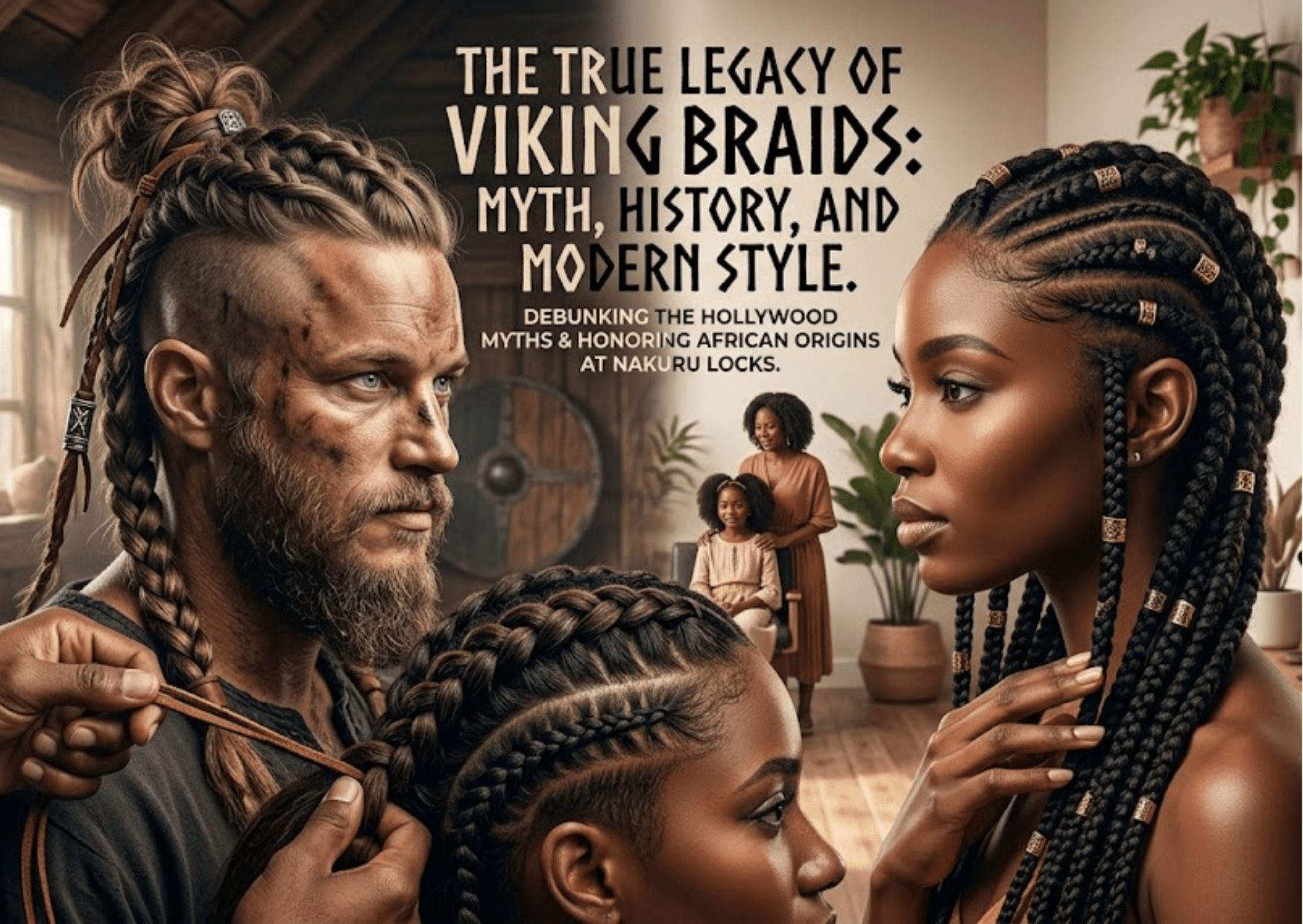
The bell chimes at Nakuru Locks and Braiding, and in walks a client clutching a phone screen displaying a rugged, battle-worn Ragnar Lothbrok. “I want these,” he says, pointing to the intricate, scalp-hugging plaits. It’s a scene we see weekly. Whether it’s the influence of Vikings, The Last Kingdom, or God of War, the “Viking Braid” has transitioned from 9th-century fjords to 21st-century urban style.
But as stylists, we often get asked the deeper questions: Is this historically accurate? Did Vikings actually invent these? How do they differ from the braids we do every day for our African clientele?
In this deep dive, we’re peeling back the layers of myth, history, and hairspray to explore the true legacy of Viking hairstyles.
The Origins: Did Vikings Invent Braids?
To understand viking braids history, we have to debunk a popular myth: No, the Norse people did not invent braiding. In fact, braiding is one of the oldest human art forms, predating the Viking Age (793–1066 AD) by tens of thousands of years.
Where Did Braids Originate?
The earliest evidence of braiding dates back roughly 30,000 years to the Venus of Willendorf, a female figurine discovered in Austria wearing a braided hair pattern. Braiding was well-established in:
-
Ancient Egypt: Elaborate wigs and plaits were status symbols.
-
Sub-Saharan Africa: Intricate cornrows and tribal braids designated age, wealth, and religion.
-
Ancient Greece and Rome: Women used braids to create complex updos.
The Vikings didn’t invent the concept; they adapted it to their unique lifestyle of seafaring, combat, and harsh Scandinavian winters. For a Viking, hair wasn’t just aesthetic—it was functional.
Historically Accurate Viking Braids vs. Hollywood
If you look at the “Viking hairstyles” on TV, you’ll see elaborate five-strand braids, shaved undercuts, and perfectly manicured beards. While some elements are grounded in truth, Hollywood takes significant creative liberties.
What the History Books Say
Archaeological evidence—such as the Valkyrie figurines found in Denmark and descriptions in the Poetic Edda—suggests that Norse hair was often a point of pride.
-
The “Viking Shag”: Historical accounts from observers like John of Wallingford suggest Norse men were “cleanliness obsessed.” They combed their hair daily and often wore it long in the front with the back of the head shaved or trimmed very short to prevent hair from getting caught in the scales of their armor.
-
Women’s Styles: Married women often wore their hair in a “knot” or a “bun” at the back of the head, secured with braids or colorful ribbons. Unmarried women wore their hair loose or with simple side plaits.
-
Utility over Vanity: Braids were used to keep hair out of the eyes during sailing or shield-wall combat.
Expert Insight: Unlike the perfectly clean lines we create at Nakuru Locks today, traditional Viking braids were likely grittier, secured with leather thongs or bone pins rather than clear elastic bands.
Did Vikings Wear Box Braids?
This is a frequent point of confusion in the salon. You might see a “Vikings box braids” tutorial online, but we need to set the record straight: Historically, Vikings did not wear box braids.
Viking Braids vs. African Braids & Cornrows
-
Box Braids: This specific technique uses square-shaped “box” parts and often incorporates synthetic extensions to add length and protection to textured hair. This is a staple of African and African-Diaspora culture.
-
Cornrows: These are braided flat against the scalp using an underhand technique. While Vikings did wear scalp-braids (similar to French or Dutch braids), they did not have the specific cultural patterns or protective intent of African cornrows.
-
Texture Differences: The Norse people had straight or wavy European hair textures. Their “scalp braids” were usually looser and intended to stay in for a day or two, whereas African braiding styles are designed to protect the hair for weeks.
At Nakuru Locks and Braiding, we appreciate the fusion of styles, but we always honor the distinct cultural origins of each technique.
Popular Viking Hairstyles for Modern Times
Whether you have long flowing locks or a short fade, there is a Viking-inspired look for you.
1. The Shieldmaiden (Half-Up, Half-Down)
This style features two or three small Dutch braids on the sides of the head, pulling the hair back from the face while leaving the rest of the hair loose and wavy. It’s the ultimate “warrior queen” look.
2. The Ragnar (Undercut with Single Braid)
Perfect for men or women with shaved sides. A single, thick 3-strand or 4-strand braid runs down the center of the head.
3. Viking Braids for Short Hair
Don’t think you need waist-length hair to pull this off. For shorter lengths, we recommend:
-
Side Rows: Two small braids on one side of the head, tucked behind the ear.
-
The Top Knot Braid: Braiding a small section at the crown and securing it into a messy bun or “man-bun.”
4. The Crow’s Nest (Multi-Braid)
A complex weave of several small braids that eventually merge into one large plait at the nape of the neck.
How to Do Viking Braids: A Professional Guide
If you can’t make it into the salon today, here is a simplified way to achieve the look at home.
Preparation
-
Texture is Key: Viking hair shouldn’t be “slippery.” Use a sea salt spray or dry shampoo to give the hair some “grit.”
-
Sectioning: Use a rat-tail comb to create clean, straight parts. For a classic look, create a central section from the forehead to the nape.
The Technique (Dutch Braid)
Most Viking-style braids are “Dutch” braids (the braid sits on top of the hair).
-
Take a small section of hair and divide it into three strands.
-
Cross the right strand under the middle strand.
-
Cross the left strand under the new middle strand.
-
Add a small amount of loose hair to the right strand before crossing it under again.
-
Repeat until you reach the end of the scalp, then continue with a regular 3-strand plait.
The Finishing Touches
To make it look “Viking,” avoid modern accessories. Use:
-
Leather cord or twine to wrap the ends.
-
Metal hair rings or beads with Norse runes.
-
A bit of teasing at the ends for a rugged, lived-in feel.
Realistic Timeline: What to Expect at the Salon
Braiding isn’t a “quick fix”—it’s an art form. At Nakuru Locks and Braiding, we prioritize the health of your scalp. Here is a rough timeline for Viking-inspired styles:
| Style Complexity | Estimated Time | Maintenance Level |
| Single Accent Braid | 15–20 Minutes | Low (Lasts 1-2 days) |
| Half-Head Shieldmaiden | 45–60 Minutes | Medium (Lasts 2-3 days) |
| Full Head / Intricate Weaves | 2–3 Hours | High (Lasts 4-7 days) |
| Viking Style with Extensions | 3+ Hours | High (Lasts 2-3 weeks) |
Maintenance and Care
Viking braids are meant to look a little “messy,” but you still need to care for your hair.
-
Sleep: Wear a silk or satin scarf at night to prevent the braids from frizzing prematurely.
-
Scalp Care: If you have tight braids, use a light oil (like jojoba or rosemary oil) to keep the scalp hydrated.
-
Washing: We recommend not washing your hair while the braids are in. Instead, use a damp cloth with a bit of witch hazel to cleanse your parts.
Why Choose Nakuru Locks and Braiding?
At Nakuru Locks, we bridge the gap between ancient tradition and modern flair. Our stylists are experts in all hair textures, ensuring that whether you’re looking for traditional Viking braids or authentic African cornrows, your hair is handled with precision and care. We understand the tension requirements for different hair types—avoiding “traction alopecia” while still giving you that tight, warrior-ready aesthetic.
FAQ: Everything You Need to Know
1. Can I get Viking braids if I have very fine hair?
Yes! In fact, Dutch braids can make fine hair look much thicker. We often use a “pancaking” technique, where we gently pull at the edges of the braid to widen it.
2. Are Viking braids considered cultural appropriation?
Braiding is a universal human practice. While certain patterns (like specific African tribal cornrows) have deep cultural and sacred meanings, the general act of braiding hair for utility and style is a shared global heritage. Wearing “Viking-style” braids is generally seen as a celebration of Norse history.
3. Did Vikings really use beads in their hair?
Archaeological finds in graves at Birka (Sweden) and Hedeby (Denmark) have uncovered various beads made of glass, amber, and silver. While many were for necklaces, it is highly likely they were also woven into hair and beards.
4. How long can I leave Viking braids in?
Unlike box braids, which can last 6–8 weeks, Viking braids on European hair textures typically look best for 3–5 days. After that, the “frizz” becomes overwhelming and the braid loses its shape.
5. Is there a difference between a Viking braid and a French braid?
Yes. A French braid crosses strands over the middle, creating a flat look. A Viking braid usually utilizes the Dutch method (crossing under), which makes the braid pop out and look more like a rope or a ridge.
6. Do Viking braids work for men with short hair?
Absolutely. As long as you have 3–4 inches of hair on top, we can create “top-row” braids that add a rugged edge to a fade or undercut.
Sources:
-
Price, N. (2020). The Children of Ash and Elm: A History of the Vikings.
-
Sarabia, D. (2018). “The Archaeology of Hair: Braids and Grooming in the North.” Journal of Nordic Studies.
-
Wallingford, J. (c. 1214). Chronicles of the English People (Historical accounts of Norse hygiene).
-
The Huldremose Woman (National Museum of Denmark) – Analysis of Iron Age hairstyles.
-
Gylfaginning (The Beguiling of Gylfi) – Prose Edda descriptions of deities’ appearances.
Ready to unleash your inner warrior? Whether you’re heading to a festival, a wedding, or just want to change up your daily look, visit us at Nakuru Locks and Braiding. We’ll help you find the perfect balance between historical grit and modern elegance.
Leave a Reply