
Crochet Dreadlocks Styles for Ladies: Timeless Beauty Meets Modern Versatility
For decades, the journey to cultivating traditional locs required years of patience, meticulous twisting, and an unwavering commitment to a permanent style.
Today, the global landscape of protective styling has shifted fundamentally. Modern hair technology allows women from Nairobi to London, and Lagos to New York, to enjoy the rich, textured aesthetic of mature locs in a matter of hours.
At the center of this revolution is the crochet installation method—a technique that pairs cornrow or individual braid bases with pre-formed, lightweight faux loc extensions using a latch-hook needle.
Whether you seek a low-maintenance corporate look or a voluminous bohemian statement, understanding the architecture of crochet dreadlocks styles for ladies ensures you achieve an elegant look without compromising the health of your scalp.
The Evolution of Crochet Dreadlocks Styles for Ladies
The term “crochet” in Afro-textured haircare does not refer to the hair fiber itself, but rather to the specialized installation mechanics.
Traditionally, faux locs were created by wrapping synthetic yarn or kanekalon hair around an individual braid from root to tip—a process that often took upwards of eight hours and created significant weight and tension on the hair follicle.
The modern crochet method utilizes pre-looped, industrially manufactured dreadlock extensions. By threading these pre-made locs through a secure cornrow framework or individual parting system, stylists can reduce total installation time by over 60%.
This approach drastically limits the window of scalp manipulation, effectively lowering the risk of traction alopecia (hair loss caused by sustained pulling on the roots).
Furthermore, the structural weight of the style is distributed evenly across a braided foundation rather than hanging solely from a single follicle base.
Simple Crochet Dreadlocks Styles for Ladies
For women prioritizing ease of maintenance, minimal weight, and clean lines, simple crochet dreadlocks styles for ladies offer the perfect intersection of functionality and style.
A “simple” installation typically features classic, uniform locs with straight textures, medium diameters (about the width of a standard pencil), and clean geometric parting.
Characteristics of Simple Crochet Locs
-
Base Pattern: A standard 10-to-12 straight-back cornrow pattern.
-
Texture Profile: Smooth, non-distressed synthetic fibers that resist frizzing over time.
-
Styling Versatility: Best suited for straightforward middle parts, classic side sweeps, or low buns.
Simple styles are highly recommended for individuals entering the world of protective styling for the first time, or those with sensitive scalps.
Because these styles do not feature heavy texturizing or complex embellishments, they require minimal daily intervention.
A nightly routine consisting of a satin bonnet and a lightweight, water-based scalp mist is sufficient to maintain their clean look for 6 to 8 weeks.
Short Crochet Dreadlocks Styles for Ladies
Framing the jawline and highlighting facial features, short crochet dreadlocks styles for ladies typically range from 8 to 12 inches in length. This length category has seen an explosion in popularity due to its lightweight nature and professional adaptability.
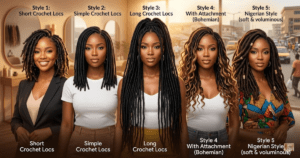
As illustrated in the image above, short loc styles can be highly texturized. The popular “butterfly loc” variant utilizes a distressed technique where loops of hair are pulled slightly outward along the shaft, giving the short bob a vibrant, organic silhouette that mimics naturally matured dreadlocks.
Top Short Styles for Modern Wardrobes
-
The Classic Asymmetrical Bob: Shorter in the back, tapering to longer strands around the chin to frame the face beautifully.
-
Micro-Loc Pixie: Extremely thin, 6-inch crochet locs installed on a dense braid base, creating a highly textured cropped look.
-
The Tapered Shag: Utilizing varying lengths of short locs (8 and 10 inches) to create a layered look with natural movement.
Short styles offer a major structural advantage: they minimize the leverage effect on hair roots. Long extensions can pull downward when wet or styled tightly, whereas short locs maintain a neutral weight footprint, making them excellent for active lifestyles or hot climates.
Long Crochet Dreadlocks Styles for Ladies
When a dramatic profile and maximum versatility are desired, long crochet dreadlocks styles for ladies deliver unmatched elegance. Ranging from 18 inches to well past 30 inches, long locs act as a canvas for intricate updos, sweeping high ponytails, and cascading half-up designs.
As shown in the reference image, long installations often utilize sleek, uniform fibers that maintain their structural integrity from root to tip. However, managing long extensions requires an understanding of weight and tension management.
Key Factors for Long Loc Management
-
Braid Pattern Density: Long locs require a sturdier cornrow foundation. Stylists often employ a “honeycomb” or interlocking braid pattern in the center of the head to distribute the weight across multiple anchor points.
-
Fiber Selection: It is crucial to choose ultra-lightweight synthetic blends, such as specialized Kanekalon or premium low-temp flame-retardant fibers, to prevent physical strain on the neck and cervical spine.
-
Nighttime Care: Long locs should be loosely gathered into a high “pineapple” ponytail or enclosed in an extra-long satin sleep sack to prevent friction-induced matting at the nape of the neck.
Crochet Dreadlocks Styles for Ladies with Attachment
To bridge the gap between temporary crochet installations and the authentic look of grown locs, crochet dreadlocks styles for ladies with attachment have become a premium salon choice.
This methodology blends standard crochet techniques with custom hair additions (attachments) to hide the telltale signs of a synthetic installation—specifically, the visible loops at the roots and the rigid texture of synthetic ends.
As displayed in the image above, the “goddess” or “gypsy” loc typology integrates loose, wavy human hair or premium synthetic attachments directly into the loc shaft and ends. This creates a beautifully soft, organic texture mix.
The Attachment Installation Approaches
-
The Perimeter Wrapping Technique:
The interior of the head is installed using standard cornrows and pre-looped crochet locs for speed. Along the hairline and part lines, individual braids are created using the client’s natural hair.
A crochet loc is then threaded through the base of the individual braid, and a loose strand of marley or human hair attachment is wrapped around the root, completely concealing the installation loop.
-
The Bohemian Human Hair Blend:
Loose strands of bulk human hair are attached to the body of the crochet loc using a micro-latch hook.
These loose tendrils cascade alongside the locs, giving a soft, romantic finish that behaves naturally when exposed to wind and water.
Regional Spotlights: Crochet Dreadlocks Styles for Ladies in Nigeria
In West Africa, and specifically within the dynamic fashion landscapes of Lagos, Abuja, and Port Harcourt, crochet dreadlocks styles for ladies in nigeria have evolved into a highly distinct style category.
Known locally for prioritizing high volume, impeccable neatness, and vibrant color blending, Nigerian loc trends set a high bar for global protective styling.
Prevalent Trends in the Nigerian Market
-
Ariel & Soft Locs: These styles feature highly flexible, shiny textures that handle the warm humid climate without trapping excessive heat. They are frequently installed using the individual crochet method with clean, diamond-shaped geometric parting.
-
Ombré and Warm Tones: Nigerian styling frequently incorporates bold color play. Rich expressions of color 1B (Off-Black) seamlessly transition into color 27 (Honey Blonde), color 30 (Light Auburn), or rich burgundy tones to complement rich skin undertones.
-
The “Rich Aunty” Updo: A popular styling approach where long or medium crochet locs are swept entirely upward into a structural crown bun, leaving two or three texturized locs decorated with gold filigree cuffs or cowrie shells to frame the face.
The focus in Nigeria leans heavily toward luxurious textures and pristine parting presentation, using lightweight locking gels along the perimeter to maintain clean lines in high humidity.
Step-by-Step Salon Installation & Maintenance Protocol
Achieving a flawless crochet loc installation that preserves natural hair health requires a methodical, damage-free approach. The following sequence outlines the professional standard used by master locticians.
Structural Comparison of Crochet Loc Typologies
To help select the correct installation approach for your specific hair type and lifestyle, consult the structural matrix below:
🛑 Professional Warning on Tension Management
If you experience localized throbbing, headaches, or see small white bumps forming along your hairline immediately following your installation, the style has been installed with excessive tension. Do not wait for the style to “loosen up.”
This level of strain can cause permanent damage to the hair follicle. Return to your stylist immediately to have the perimeter loops safely adjusted or removed.
Frequently Asked Questions
How do I wash my scalp while wearing crochet dreadlocks?
Unlike traditional braids, you do not need to scrub the entire length of the extension. Focus solely on your scalp. Dilute a sulfate-free shampoo with water in a spray bottle.
Section your locs, spray the diluted mixture directly onto your exposed parts, and gently massage your scalp using the pads of your fingers—avoid using your fingernails.
Rinse thoroughly by letting warm water cascade from the top of your head downward. Pat dry with a microfiber towel and ensure your cornrow base is completely dry (using a hooded dryer or a blow dryer on a cool setting) to prevent trapped moisture.
Can crochet dreadlocks cause hair damage?
When installed correctly on a healthy foundation, crochet locs are an exceptional protective style.
Damage only occurs under three conditions: installing the base braids too tightly, leaving the extensions in for longer than 10 weeks (which causes the natural new growth to mat and lock prematurely around the extension), or improper, hurried removal that cuts into the natural hair.
What is the difference between faux locs and crochet dreadlocks?
“Faux locs” is an umbrella term for any style that mimics real dreadlocks using extensions. “Crochet dreadlocks” refers specifically to the installation mechanics where pre-made, pre-looped locs are pulled through a braided base using a latch hook.
Faux locs can also be created by hand-wrapping hair around individual braids, which takes significantly longer and carries a heavier weight footprint.
How many packs of hair are required for a full-head installation?
For a standard full-head look using medium-diameter locs, you will typically need 5 to 7 packs of pre-looped crochet hair.
If you are opting for micro-locs or a high-volume style common in Nigerian trends, you may require 8 to 10 packs. Always verify the strand count per pack, as this varies across manufacturers.
Related Articles from Nakuru Locks and Braiding
To further expand your knowledge on maintaining pristine locs and healthy hair foundations, explore our comprehensive masterclasses:
References
-
The Trichological Society
-
International Journal of Dermatology (Protective Styling Analysis)
Leave a Reply