
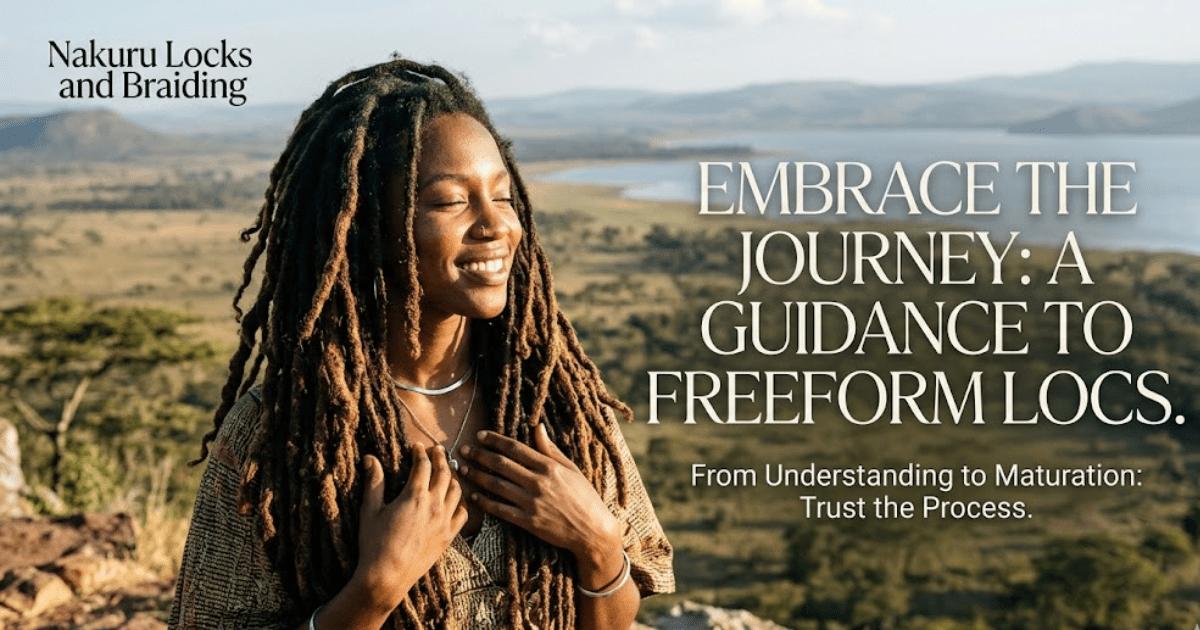
Freeform Locs: The Natural Loc Journey People Around the World Are Choosing
Freeform locs are a natural, low-manipulation way of wearing locs where the hair is allowed to lock and shape itself over time, creating a look that is unique to each person.
For Nakuru Locks and Braiding, this topic matters because clients today want styles that feel authentic, low-maintenance, and culturally expressive while still looking intentional and well cared for.
Freeform locs explained
Freeform locs are locs that form with minimal manipulation, meaning you do not regularly twist, palm-roll, or force uniform sectioning.
Instead, the hair is washed, kept clean, and left to mat and lock naturally, which is why the final look is often organic, uneven in the best way, and highly individual.
This is different from more structured loc methods because the hair decides its own pattern rather than being shaped into a prescribed one.
In simple terms, if regular locs are “guided,” freeform locs are “allowed.” That freedom is what draws many people to the style, especially those who want a more natural appearance and less frequent salon intervention.
Semi-freeform locs
Semi-freeform locs sit between fully freeform and regular locs. They start with some structure, such as twisting or parting, but later the wearer reduces retwisting and lets the locs develop more naturally while still keeping a little control over size and shape.
This makes semi-freeform a practical option for people who want the organic aesthetic of freeform locs without giving up all structure.
A simple way to think about it is this: freeform locs are mostly no-manipulation, while semi-freeform locs keep just enough maintenance to prevent the style from becoming too unpredictable.
Freeform vs regular locs
The main difference between freeform locs and regular locs is maintenance and shape control.
Regular locs are usually sectioned, retwisted, or interlocked to maintain a neater, more uniform look, while freeform locs are left to mature naturally with far less shaping.
Semi-freeform locs fall in the middle because they may begin with structure and then transition into looser upkeep.
Here is a clear comparison:

How freeform locs form
Freeform locs begin when textured hair is washed and then left alone enough for strands to tangle, knot, and eventually lock on their own.
Clean hair is important because residue-free washing helps the locking process, while heavy conditioners and product buildup can slow things down. Over time, small knots form, sections compact, and the hair starts to resemble locs more clearly.
Hair texture matters too. Coily and kinky textures usually lock faster than looser textures because they naturally create more friction and hold shape more easily. That is why two people starting freeform locs at the same time may end up with very different results.
Freeform locs stages
Freeform locs go through visible stages, although the timing varies from person to person.
Early on, the hair may look messy, puffy, or undefined before the knots begin to tighten and the locs become more recognisable. A useful stage breakdown is:
1. Starter stage: Hair is freshly washed and beginning to knot with little visible pattern.
2. Budding stage: Small knots and early locs appear as strands compact together.
3. Teen phase: The locs may look uneven, frizzy, or “messy” as they continue forming.
4. Mature phase: The locs become more defined, heavier, and more stable.
Online community discussions often describe early freeform growth as a patience test, with some users estimating roughly 6 to 8 months for clear early locking in starter journeys, though this varies widely by hair type and routine.
How long locs take
The time it takes for freeform locs to form depends on texture, length, density, and how often the hair is washed and dried properly.
Sources commonly describe a range from several months to around one to two years for full maturity. The earliest visible locking may appear sooner, but “mature” locs take longer to fully settle and hang with weight.
For SEO readers searching “how long do freeforms take to loc,” the safest answer is: some visible locking may start in months, but full maturity often takes 1 to 2 years, and sometimes longer for finer textures.
How to freeform locs your hair
To freeform locs your hair, start with clean hair and then reduce manipulation as much as possible.
Wash regularly with a residue-free shampoo, avoid combing after washing, let the hair air dry, and resist the urge to retwist or constantly separate sections.
If sections begin merging too much, gently separate them with your fingers rather than using strong mechanical grooming.
A practical beginner routine looks like this:
-
Wash hair with residue-free shampoo.
-
Dry thoroughly after each wash.
-
Avoid conditioners and heavy buildup in the early stage.
-
Do not comb or brush once you begin the freeform process.
-
Separate only when needed to prevent unwanted joining.
-
Protect the hair at night with a satin bonnet or pillowcase to reduce lint.
That routine keeps the hair clean while still allowing the locs to develop naturally.
Styling freeform locs
Freeform locs hairstyles can range from short, chunky looks to shoulder-length and long flowing locs, and they often carry a bold, artistic presence.
Popular style variations include medium freeform locs, layered freeform locs, thin freeform locs, congo-style groupings, dyed freeform locs, and freeform locs with fades or line-ups.
These styles show that freeform does not mean “unstyled”; it means the foundation grows naturally while the presentation can still be shaped through grooming choices, accessories, and haircuts.
For a global audience, this is part of the appeal: freeform locs can look spiritual, fashion-forward, cultural, or minimalist depending on how the wearer presents them.
Reddit insights
Searches for “freeform locs reddit” often surface real-life community experiences, especially from people comparing starter locs, semi-freeform growth, and maintenance challenges.
Reddit discussions commonly focus on questions like how often to wash, how to sleep without breaking forming locs, and whether to keep some front sections neat while allowing the back to freeform.
These threads are useful for understanding lived experience, but they should be treated as peer advice rather than professional guidance.
For an article like this, Reddit works best as a pulse check on what wearers are actually asking, while salon-based and educational sources should handle the main definitions and technique advice.
Care and health
Freeform locs are low-maintenance, but they are not no-maintenance. Washing is still important because clean hair locks better, and the scalp still needs attention to avoid buildup, itchiness, and odor.
Drying is also critical, because damp locs can take a long time to dry and may develop mildew if left wet too often.
Healthy freeform locs usually come from a simple pattern: cleanse, dry fully, protect at night, and avoid overhandling. That balance supports both scalp comfort and long-term loc health.
FAQ About Freeform Locs
Q: Can any hair type do freeform locs?
Yes, though coily textures loc more readily. Looser textures may take longer.
Q: Do freeform locs smell or get dirty?
No, with proper washing. Residue-free routines prevent issues.
Q: How often should I wash?
Weekly or bi-weekly, depending on lifestyle.
Q: Can I start freeform on short hair?
Yes, but longer hair (several inches) helps initial tangling.
Q: What’s the difference between freeform and semi-freeform again?
Freeform: minimal to no root maintenance. Semi: occasional maintenance.
Q: Are freeform locs professional?
Increasingly accepted, especially with neat care. Confidence matters.
Related articles
For Nakuru Locks and Braiding, these related article ideas can support internal linking and topical authority:
References
- Encyclopedia of Hair: A Cultural History by Victoria Sherrow.
- Holistic Locs resources and practitioner experiences.
- Community insights from Reddit and established locticians.
Nakuru Locks and Braiding draws from years of local and global expertise serving clients in Nakuru and beyond.
Leave a Reply