
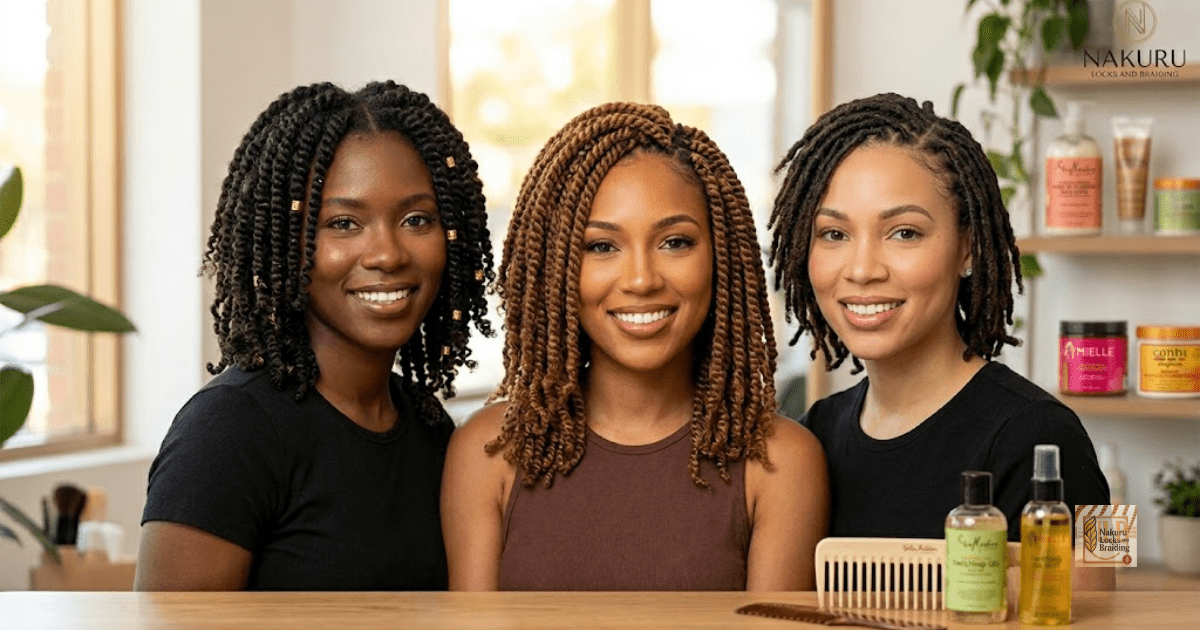
Two-Strand Twists: The Ultimate Protective Style for Natural Hair, Locs, Short Hair, Straight Hair, and More
Whether you are looking to give your natural hair a well-deserved break, want a style that celebrates your texture, or are seeking a low-maintenance look for your busy lifestyle, the two-strand twist stands as a timeless, versatile, and elegant solution.
At Nakuru Locks and Braiding, we believe your hair is your crown. Understanding the “how-to” and “why” behind your favorite styles is the first step toward achieving healthy, long-lasting hair growth.
In this guide, we’ll explore everything you need to know about two-strand twists—from the essential techniques to professional maintenance tips.
What Does a Two Strand Twist Look Like?
A two-strand twist involves dividing a section of hair into two strands and twisting them around each other in the same direction (usually clockwise or counterclockwise consistently). This creates a rope-like or spiral effect that appears neat and defined when freshly done.
- Visuals: Fresh twists look like uniform, ropey coils or mini locs. Over time (especially with natural 4C or coily hair), they may puff slightly at the roots for volume but retain shape well. On straight or looser hair, they produce smoother, wavy results. With extensions, they appear fuller and longer.
- On Locs: Twisting over mature locs or using the two-strand method to start locs creates uniform, elongated styles that blend seamlessly.
- Short Hair: Mini or medium twists on short natural hair (even 2-4 inches) frame the face beautifully and can be pinned or left free.
This style mimics the look of locs without the commitment, making it ideal for protective styling and length retention.
Benefits of Two-Strand Twists
Two-strand twists rank among the best protective hairstyles for natural hair. They minimize manipulation, reduce breakage, and retain moisture when done and maintained properly.
They work across hair types and lengths, suit global lifestyles (from humid tropical climates to dry urban environments), and offer endless styling options like updos, buns, ponytails, or twist-outs.
At Nakuru Locks and Braiding, clients love them for low-maintenance routines, versatility for work or events, and cultural connection—many styles echo traditional African twisting techniques.
Two Strand Twists Natural Hair
For two strand twists natural hair, especially types 3C-4C, this style excels. It defines coils without heat, promotes healthy growth by protecting ends, and allows easy washing (many keep them in while shampooing with care).
Tips: Use a rich cream or butter for slip and definition. Smaller twists yield more definition; larger ones offer volume and speed.
Two Strand Twists with Extensions
Two strand twists with extensions add length and fullness while keeping a natural look. Use human hair or high-quality synthetic (like pre-fluffed afro twist hair) for seamless blends.
- Installation: Part hair, add extension to the root, and twist together.
- Benefits: Fuller volume, longer wear, ideal for those with shorter or thinning hair
- Natural-Looking Results: Match textures carefully for a flawless finish.
Two Strand Twists Locs (or Starting Locs)
Two strand twists locs serve as a popular loc-starting or maintenance method. Twists encourage hair to coil and mat naturally over time into mature locs.
- Budding Stage (3-6 months): Frizz and swelling.
- Teen Stage (6-12 months): Firmer structure.
- Mature (12-18+ months): Settled locs.
Many maintain locs with periodic two-strand retwists for neatness.
Two Strand Twists Hairstyles
Versatility defines two strand twists hairstyles:
- Everyday: Free-hanging or half-up.
- Formal: High buns, halo twists, or ponytails.
- With Accessories: Headscarves, beads, or wraps.
- Twist-Out: Unravel for voluminous curls (lasts days with proper care).
Short hair styles include pinned-updos or finger-coiled edges. Longer hair supports intricate patterns or extensions.
Two Strand Twists Straight Hair
Although twists are most common on curly or coily hair, they can still be done on straight hair with some adjustments.
On straight hair, the stylist usually works on damp or lightly styled hair, uses a strong‑hold product, and sometimes pins the roots with bobby pins until the twist dries to prevent unraveling.
On straight textures, two-strand twists will not grip and hold as firmly as they do on Afro‑textured hair, so clients should expect softer, looser twists and a shorter wear time.
However, they can still create pretty, beachy waves or a “heatless curl” effect when taken down as a twist‑out.
Two Strand Twists Short Hair
Two-strand twists can absolutely be done on short hair—even on very short 4C textures—if the hair is long enough to wrap around itself.
Stylists often start with blown‑out or stretched hair, work in small sections, and use a rich cream or butter to help short strands grip together.youtube+2
For very short hair, extensions can be added to create double-strand twists that look fuller and are easier to maintain. Tutorials show this technique being used on short men’s and boys’ hair, proving it’s a unisex style that works at almost any length.youtube+1
How Long Will a 2 Strand Twist Last?
How long will a 2 strand twist last? Typically 1-4 weeks with proper maintenance, depending on hair type, size, climate, and activity.
- Natural Hair: 1-2 weeks for optimal freshness; up to 4 weeks if low-manipulation.
- With Extensions/Locs: Longer (3-6+ weeks).
- Factors: Moisture levels, tightness, washing frequency. Avoid leaving in too long to prevent matting or breakage.
Refresh edges and roots as needed. Many wash with twists in using diluted shampoo and a spray bottle.
What Do I Need for a 2 Strand Twist?
What do I need for a 2 strand twist? Essentials include:
- Spray bottle with water or leave-in conditioner.
- Moisturizing cream, butter, or twisting gel (e.g., for slip and hold).
- Hair oil or serum for sealing.
- Wide-tooth comb, rat-tail comb for parting.
- Clips for sectioning.
- Optional: Extensions, edge control, scarf for night protection.
At Nakuru Locks and Braiding, we use premium, natural-ingredient products tailored to your hair.
Two Strand Twist vs 3 Strand Twist: Which Is Better?
Both 2-strand and 3-strand twists have specific strengths, and “better” depends on your client’s priorities.
Content creators and stylists who directly compare them note:
-
Two-strand twists are quicker to do, give slightly more volume, and are easier for beginners.
-
Three-strand twists use a more braid‑like motion to create a tighter, more intricate curl pattern with more definition and less frizz in the final twist‑out.
In other words, 2-strand twists win for speed, simplicity, and fullness, while 3-strand twists win when your client wants ultra‑defined, long‑lasting twist‑outs.
Quick comparison for your clients
For Nakuru Locks and Braiding, you might position 2-strand twists as the everyday protective option and reserve 3-strand twist‑outs for premium, definition‑focused services or special occasions.
How to Maintain and Care for Your Twists
1. Moisturize Regularly: Spritz with water/leave-in, seal with oil.
2. Night Routine: Pineapple or scarf to preserve shape.
3. Washing: Gentle, with twists in; focus on scalp.
4. Refresh: Edge control and light twisting at roots.
5. Take Down: Use oil/conditioner to detangle gently for twist-out.
Proper care maximizes longevity and hair health.
What do you need for a two-strand twist?
For salon-quality two-strand twists, a basic professional kit should include:
-
Cleansing and conditioning: a gentle shampoo and moisturizing conditioner to start on clean, hydrated hair.
-
Detangling tools: wide‑tooth comb and/or detangling brush to remove knots without breakage.
-
Sectioning tools: rat‑tail combs and sectioning clips to create neat parts and keep hair organized.
-
Moisturizing base: leave‑in conditioner or hair lotion to soften the hair and add slip.
-
Styling cream/butter: curl cream or twisting butter to define and hold the twist pattern.
-
Hold product: light gel, mousse, or styling foam for frizz control and longevity, especially at the ends.
-
Oils: sealing oil like castor, jojoba, or a blend to lock in moisture and add shine.
-
Drying tools (optional): hooded dryer or blow‑dryer with attachment to set twists faster.
-
Extensions (optional): synthetic or human hair bundles for clients who want added length or volume.
-
Accessories: rubber bands, beads, hair cuffs, and satin scarf/bonnet for take‑home care.
When you publish this on the Nakuru Locks and Braiding blog, you can turn this section into a product checklist and link it to in‑salon retail or affiliate products.
Step-by-step: how a stylist does two-strand twists
While your readers may not need a line‑by‑line tutorial, showing that Nakuru Locks and Braiding follows professional technique builds trust.
A standard process from multiple reputable tutorials looks like this:
-
Prep and cleanse
-
Shampoo and condition thoroughly, then detangle from ends to roots.
-
Decide whether to work on damp curls or lightly stretched/blown‑out hair depending on the desired finish.
-
-
Section the hair
-
Divide the hair horizontally or down the middle, clip sections away, and work from the back upwards.
-
The size of the sections determines how thick or thin the final twists will be.
-
-
Apply product
-
On each small section, apply leave‑in, then a cream or butter, and finally a small amount of gel or foam if needed.
-
Comb or brush through to distribute product evenly and remove any remaining tangles.
-
-
Twist the strands
-
Split the section into two strands of equal thickness.
-
Cross one strand over the other repeatedly, keeping your hands close to the twisted area and maintaining even tension.
-
Continue to the ends and twirl or pinch them so the twist does not unravel.
-
-
Dry and set
-
Allow the hair to air dry or sit the client under a hooded dryer for 15–45 minutes depending on thickness.
-
Do not separate or manipulate the twists until they are fully dry to avoid frizz.
-
-
Finish and protect
-
Add a bit of oil or sheen spray for shine and scalp comfort.
-
Advise the client to sleep with a satin bonnet, scarf, or pillowcase every night to minimize frizz and preserve the style.
-
FAQ About Two-Strand Twists
Q: Can I do two-strand twists on short hair?
A: Yes! Mini twists work beautifully on short lengths.
Q: How long do they last before unraveling?
A: 1-4 weeks; maintenance extends wear.
Q: Are they suitable for locs?
A: Absolutely—excellent for maintenance or starting.
Q: What products are best?
A: Moisturizing creams, gels like Shine ‘n Jam, and natural oils.
Q: Painful or damaging?
A: Not if installed properly without excessive tension.
Why Choose Nakuru Locks and Braiding?
With years of experience serving clients in Nakuru and internationally, our stylists prioritize healthy hair, cultural authenticity, and personalized styles.
We use high-quality extensions and techniques for long-lasting, beautiful results. Visit us for expert two strand twists tailored to your needs.
Related Articles from Nakuru Locks and Braiding
Two-strand twists offer more than a hairstyle—they provide empowerment, protection, and endless creativity. Book your appointment at Nakuru Locks and Braiding today and experience the transformation. Your hair journey starts here!
Leave a Reply