

The Loc Retwist Schedule That Actually Protects Your Hair: A Global Guide from Starter to Mature Locs
Somewhere between month two and month six of growing locs, almost everyone hits the same moment of panic: new growth is sprouting at the root, the parts are fuzzing out, and a nagging voice starts asking,
“Am I doing this wrong?” It’s one of the most searched questions in natural hair care worldwide, from stylists in Los Angeles to locticians right here in Nakuru — and the honest answer is that there’s no single universal number.
There’s a range, a set of stages, and a handful of variables that decide where you fall in it.
This guide walks through all of it: how often to retwist at every stage, what a healthy versus unhealthy loc actually looks like, how long a retwist session takes, and the myths worth retiring for good.

What “Retwisting” Actually Does
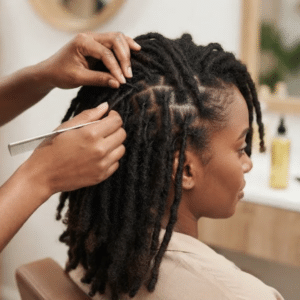
Retwisting is the process of re-forming the new hair growth at the base of each loc — usually with a comb coil, palm roll, or interlocking technique — so it locks into the rest of the strand instead of unraveling.
The purpose is to work new growth into the existing loc so you never have to start the loc process over from scratch, and locs cared for this way can last for years, or effectively indefinitely, as a low-maintenance protective style.
It is not, contrary to popular belief, what makes locs grow longer — more on that myth below.
Loc Retwist Schedule: How Often Should You Really Go In?
The most trusted general benchmark cited across the loc care industry is every four to six weeks.
Most people land in this range because it gives new growth enough time to come in fully while still letting the scalp rest between manipulation sessions.
But that window compresses or stretches depending on where you are in your loc journey.
Before: Retwist Schedule in the Starter Stage
This is the phase where the “how often” question hits hardest, because starter locs are the most fragile and the most visually chaotic between sessions.
In the starter phase, retwisting every four weeks is standard, and some people go in every two to three weeks for just the first four to six weeks to help train the pattern.
A tighter three-to-four-week cadence at this stage helps guide the hair into its locking pattern, and skipping it can slow the process or cause frizz and budding in the wrong places.
The catch: going too tight, too often, at this stage is one of the fastest routes to thinning roots later on.
Locs installed too tightly at the outset — even densely packed microlocs — can put real strain on the scalp, stunting growth or contributing to hair loss down the line. Consistency matters more than frequency here.
During: The Middle Stretch (Budding and Teen Stages)
Once locs move into the budding stage (roughly six to twelve months in) and the teen stage (around twelve to eighteen months), the schedule doesn’t change dramatically — it’s still generally every four to six weeks.
Budding and teen-stage locs typically still need a retwist every four to six weeks to hold their shape and prevent loose strands.
What does change is the risk profile: locs are sturdier now, so the temptation is to go longer between visits, but roots are still developing their long-term strength.
After: Retwist Schedule Once Locs Mature
This is where most people can finally exhale. Mature locs, generally a year or older, don’t demand nearly as much upkeep — retwisting every six to eight weeks is typically enough to keep them neat without overloading the scalp with tension. Some locticians stretch this further.
During the mature and rooted stages, eight to twelve-plus weeks between retwists is common, and traditional locs in general do well on a four-to-six-week rhythm, while larger, more established locs can often go every two to three months without issue.
Does It Matter If You’re Male or Female?
This is one of the most searched variations of the question, and the honest answer is: gender itself isn’t the deciding factor — hair texture, density, and lifestyle are.
Thinner hair strands generally call for more frequent retwists, while thicker, coarser strands can comfortably stretch the interval longer, and how often you wash and maintain your locs, plus your day-to-day lifestyle, will shift the ideal frequency regardless of gender.
Men and women with similarly textured hair and similar routines will land on similar schedules; the differences people notice are usually about hair type, sweat levels from activity, and styling preference rather than sex itself.
A Quick Reference Table
| Loc Stage | Typical Age | Retwist Frequency |
|---|---|---|
| Starter (baby) locs | 0–6 months | Every 2–4 weeks |
| Budding (sprouting) locs | 6–12 months | Every 4–6 weeks |
| Teen locs | 12–18 months | Every 4–6 weeks |
| Mature locs | 18 months+ | Every 6–12 weeks |
| Rooted locs | 2–3 years+ | Every 8–12+ weeks, or freeform |
How Often Should You Retwist Two-Strand Twist Locs?
Two-strand twists used as a starter method for locs follow the same starter-stage logic — roughly every four weeks in the early months, tightening to every two to three weeks only if the pattern needs extra reinforcement — but because two-strand twists rely on the strands wrapping around each other rather than a single coiled root, they can unravel faster in humidity or during sleep.
Many locticians in Kenya recommend satin scarves or bonnets nightly for two-strand twist starter locs specifically to stretch the interval between retwist visits without sacrificing the pattern.
How Long Does It Take to Retwist Locs?
This depends heavily on loc count, loc size, hair density, and technique. As a general expectation:
- Microlocs or Sisterlocks-style locs (100+ locs): 3–6 hours, sometimes longer for a full head.
- Medium locs (60–100 locs): 2–4 hours.
- Large or thick locs (fewer than 50): 1–2 hours.
Interlocking tends to run faster per loc than a full comb-coil retwist, but it’s typically scheduled less often. Interlocking sisterlocks or microlocs every six weeks, or larger interlocked locs every two to three months, is the general standard, since bigger locs are less prone to unraveling between sessions.
How to Retwist Locs for Beginners
If you’re handling touch-ups yourself between salon visits, the process generally follows this order:
1. Start with clean, fully dry hair. Wet retwisting invites mildew and slows the locking process.
2. Section the new growth at the root using a rat-tail comb, following your original parting pattern.
3. Apply a light, residue-free gel or cream — just enough to smooth the section, not saturate it.
4. Comb-coil or palm-roll the new growth in the same direction consistently, from root to where the mature loc begins.
5. Let it air dry or sit under a low-heat hooded dryer before styling, so the twist sets before it’s disturbed.
Beginners should resist the urge to twist tightly “for neatness.” Constant retwisting, especially when twisted too tight, can weaken the hair strand over time the same way repeatedly bending a paperclip in one direction eventually snaps it.
If you’re self-retwisting for the first time, doing a small test section and living with it for a week before committing to the whole head is a safer approach than committing immediately.
What Do Unhealthy Locs Look Like?
Knowing the warning signs matters more than knowing the perfect schedule, because tension damage and moisture problems can develop even on a “correct” timeline if technique is off. Signs to watch for:
- Persistent thinning at the root or mid-shaft. A widening part, more visible scalp, or a loc that once felt sturdy now feeling weak and prone to snapping are all signs of active thinning that needs attention before it turns into breakage.
- Musty odor, dark spots, or discoloration inside the loc. Unpleasant smells, visible dark spots, scalp itching, and excessive buildup are the classic signs of mildew developing inside locs that weren’t fully dried after washing.
- Redness, bumps, or tenderness at the scalp. Redness around individual follicles that progresses into pustules or crusting, along with a “tenting” sensation where the scalp lifts under pull, are early signals of tension damage — and this pattern is medically known as traction alopecia
- A receding or thinning hairline, especially at the temples and nape. The American Academy of Dermatology specifically flags broken hairs around the forehead, a receding hairline, patchy loss where hair is pulled tight, and scalp pain or stinging as signs that require action. This condition disproportionately affects people who wear tension-based protective styles, and it’s reversible if caught early but can become permanent if ignored.
The good news: traction alopecia caught early is non-scarring and the follicle can recover once tension is reduced — the danger is in waiting.
If you notice any of these signs, loosen your retwist pattern, extend the interval, and speak with your loctician before it progresses.
Benefits of Not Retwisting Locs (Freeform and Extended Intervals)
Not everyone wants — or needs — tight, uniform roots on a strict schedule. Some benefits of stretching or skipping retwists altogether:
- Reduced tension on the scalp, lowering the risk of traction alopecia over the long term.
- Less time and cost spent in the chair, since freeform locs need almost no root maintenance.
- A more organic, varied loc shape, which many wearers find visually appealing as locs mature.
- Stronger roots over time, since hair left undisturbed at the base isn’t repeatedly manipulated in the same direction.
Freeform locs — grown with no retwisting and no interlocking, just natural clumping over time — are a legitimate and increasingly popular choice for people who want neat roots to matter less than natural, low-intervention growth.
The tradeoff is a longer, messier-looking transition period and less uniform sizing across the head.
How Long Until Locs Fully Mature?
Full maturity is a longer process than most first-time loc wearers expect. The complete loc journey, from starter locs to strong, firm, fully mature locs, typically takes between eighteen and twenty-four-plus months, moving through five recognized stages:
1. Starter/baby stage — hair is freshly parted and coiled, twisted, braided, or interlocked; locs are fragile and prone to unraveling.
2. Budding/sprouting stage — small knots or “buds” form, signaling the hair is beginning to genuinely lock, usually starting around six months.
3.Teen stage — locs are more defined, generally forming around a year and a half into the journey, though the length may look awkward if the loc is too short to lay flat yet.
4. Mature/adult stage — locs thicken, become more defined, and settle into their structure, though they may still shrink, expand, or lump unpredictably before fully settling; most people won’t reach this stage before eighteen months.
5. Rooted stage — starting around eighteen months and continuing indefinitely, locs take on a slightly narrower, weightier profile, hang and sway naturally, and behave like fully “adult” locs.
Hair texture accelerates or delays this timeline significantly — coarser, kinkier hair textures tend to lock faster than looser curl patterns, and consistent care routines can shorten the journey somewhat, but there’s no shortcut past the biological process of hair coiling on itself over time.
Do Locs Get Longer After a Retwist?
No — and this is one of the most persistent myths in loc care. A retwist reshapes and neatens the root, but it does not stretch, lengthen, or accelerate hair growth.
Any length gain you notice after a retwist is simply new growth that was already there, now visible and incorporated into the loc instead of sitting loose at the scalp.
The average human scalp grows roughly half an inch of hair per month, so length comes from time and healthy growth, not from the retwisting technique itself.
What retwisting can do is make locs look longer temporarily, since tightly coiled new growth that was bunching up at the root gets smoothed out and elongated into the strand.

Frequently Asked Questions
How often should I retwist my locs in the beginning?
Every two to four weeks during the first four to six months, tapering to every four to six weeks as the starter locs stabilize.
How often should you retwist locs after a year?
Most mature, one-year-plus locs do well on a six-to-twelve-week schedule, depending on hair texture and lifestyle.
How often should you get a retwist for two-strand twist locs?
Roughly every four weeks in the starter phase, matching the general starter-loc schedule, with nightly protective styling to extend the interval.
How long does a retwist take?
Anywhere from one to six hours depending on loc count and size — smaller, more numerous locs (like microlocs) take significantly longer than fewer, larger locs.
What do unhealthy locs look like?
Thinning at the root or shaft, musty odors or dark spots signaling mildew, scalp redness or tenderness, and a receding hairline are the main red flags.
Are there benefits to not retwisting locs?
Yes — reduced scalp tension, lower traction alopecia risk, less maintenance time, and a more organic, freeform shape.
How long until locs are fully mature?
Generally eighteen to twenty-four months for full maturity, though the rooted stage can continue developing indefinitely after that.
Book Your Retwist With Nakuru Locks and Braiding
Whether you’re two months into starter locs or three years into rooted, mature locs, the safest retwist schedule is one built around your actual hair texture and scalp health — not a generic calendar reminder.
Our locticians at Nakuru Locks and Braiding assess loc stage, tension tolerance, and scalp condition at every visit to keep your schedule right for you.
Related reading from Nakuru Locks and Braiding:
References
- StyleSeat, How Often Should You Retwist Locs?
- Dr Locs, How Often Should I Retwist or Interlock My Locs?
- Brown Beauty Barber School, How Often Should You Retwist Locs? A Complete Guide
- Holistic Tresses, How Often Should You Do a Loc Retwist?
- Lockbraids, How Often Should You Retwist Your Locs?
- Dreadusa, How Often Should You Retwist Your Locs? / Retwist Frequency Guide
- Nae Nae’s, How Often Should You Retwist Your Locs?
- Lucky Hair Braiding & Locs, How Often Should You Retwist Your Hair Locs?
- American Academy of Dermatology, Hairstyles That Pull Can Cause Hair Loss
- Black Health, Traction Alopecia in Black Women / Braids, Weaves and Locs Without Losing Your Edges
- Advanced Dermatology PC, African Americans At Risk For Hair Loss; Explaining Traction Alopecia
- Hims, Loc Maintenance: Everything You Need to Know
- Curlcentric, Stages of Locs
Leave a Reply