
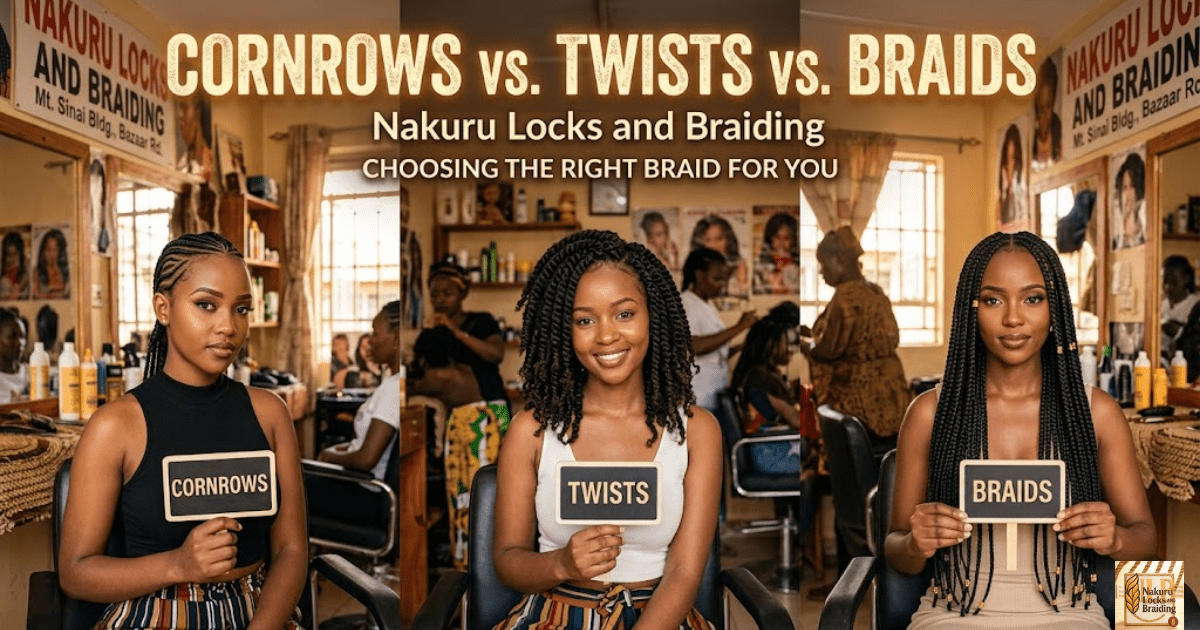
Cornrows vs. Twists: Choosing the Right Braid for You
Across Reddit threads, Instagram comments, and salon chairs from Nairobi to New York, one question keeps resurfacing: cornrows vs twists vs braids — which protective style is right for your hair?
For natural‑haired women worldwide, the choice isn’t just about aesthetics; it’s about growth retention, scalp comfort, and lifestyle.
At Nakuru Locks and Braiding, we specialize in the art of African braiding, from traditional cornrows to modern twist styles.
Whether you’re a busy professional in Nakuru, a student chasing deadlines, or a fitness enthusiast, your hair’s health and style versatility matter.
Choosing between cornrows, twists, and braids is more than a fashion choice; it is a clinical and cultural decision.
As a Lead Stylist with over 13 years of experience and a specialist in Color & Wellness, I have seen how the right choice can flourish into inches of growth, while the wrong one can lead to the heartbreak of thinning edges.
Understanding the “Big Three”: Definitions and Mechanics
To make an informed decision, we must first look at the technical architecture of these styles.
Braids: The Three-Strand Fortress
Traditional braids (plaits) are created by intertwining three sections of hair in an overlapping pattern. This structure is inherently secure and creates a durable “rope” that is resistant to unraveling (Feminine Attractions, 2024).
-
Best For: Long-term wear (4–8 weeks) and active lifestyles.
-
Mechanism: The three-strand overlap provides high structural integrity, making it the “State-of-the-Art” (SOTA) choice for longevity.
Cornrows: The Scalp-Anchored Path
Cornrows are a specific type of braiding where the hair is braided flat against the scalp using an underhand, upward motion. In Nakuru, we often refer to these as Milazo or straight lines (TRT Afrika, 2021).
-
Best For: Protective bases under wigs, professional “neat” looks, and intricate artistic designs.
-
History: Historically, cornrows were used in West Africa to signify social status and even functioned as “maps” to freedom during the transatlantic slave trade (TRT Afrika, 2021).
Twists: The Two-Strand Gentle Giant
Twists (two-strand twists) involve intertwining two sections of hair around each other. Because they lack the third “locking” strand of a braid, they have a softer, more flexible appearance (Elom Africain Braids, n.d.).
-
Best For: Coily Type 4 hair, sensitive scalps, and those who want a “twist-out” later.
-
Mechanism: Twists exert significantly less “Scalp Load Density” than braids.
Cornrows vs. Twists vs. Braids: The Scientific Comparison
We look at the trichological data behind these styles.
| Feature | Cornrows | Braids (Box/Knotless) | Twists (Marley/Senegalese) |
| Strand Count | 3 (on scalp) | 3 (off scalp) | 2 |
| Tension Level | High to Moderate | Moderate to High | Low |
| Longevity | 2–4 weeks | 4–8 weeks | 2–3 weeks |
| Installation Time | 1–3 hours | 4–8 hours | 2–4 hours |
| Active Lifestyle | Excellent | Excellent | Moderate (can frizz) |
The Trichology of Tension
A 2021 study comparing high-tension braids and low-tension twists found a 40% reduction in follicular stress markers in individuals wearing twists (Better Scalp Company, 2025). This is critical for clients at Nakuru Locks and Braiding who are concerned about Traction Alopecia—a form of hair loss caused by chronic pulling on the roots (The Trichological Society, n.d.).
Pro Tip: If you feel “raised bumps” or “sore spots” along your hairline after an install, your tension threshold has been exceeded. This is a sign of early folliculitis and requires immediate attention (Better Scalp Company, 2025).
Deep Dive: Cornrows vs. Twists Hairstyles
The Versatility of Braids
Braids are the “transformative” champions. They can be bent, tucked, or styled into buns and ponytails with ease (Carol’s Daughter, n.d.).
-
Amingo & Stitch Braids: Modern variations of cornrows that use precision parting for a “snatched” look.
-
Knotless Braids: The current gold standard for reducing immediate tension at the root.
The Beauty of Twists
Twists are ideal for those with Type 4 (coily/kinky) hair. The more coily the hair, the better the twist stays without unraveling (Carol’s Daughter, n.d.).
-
Passion Twists: A bohemian, water-wave look.
-
Flat Twists: A hybrid style that looks like a cornrow but uses the two-strand twist technique, offering the “neatness” of a cornrow with the “gentleness” of a twist.
The “Reddit” Perspective: Real Talk on Maintenance
Searching “Cornrows vs Twists Reddit” reveals a common consensus among the natural hair community:
-
Tangle Factor: Many users find that while twists are easier to install, they can lead to more “single-strand knots” (SSKs) and tangling if left in too long (BGLH Marketplace, 2025).
-
Moisture: Braids are often cited as being better for “locking in moisture” over long periods, whereas twists allow for easier daily re-moisturizing (BGLH Marketplace, 2025).
FAQ: Your Questions Answered
Q: Which style is best for hair growth?
A: Both can promote growth by reducing “daily manipulation.” However, twists are scientifically shown to cause less tension, making them safer for long-term follicle health (Better Scalp Company, 2025).
Q: Can I wash my hair while it’s in these styles?
A: Yes. We recommend washing every 2–3 weeks to remove oil buildup. Braids hold up better to washing; twists may frizz or unravel if not handled gently (Feminine Attractions, 2024).
Q: How do I prevent “thinning edges”?
A: Avoid “snatched” styles that pull the fine vellus hairs at the temple. Opt for “knotless” techniques or larger partings to distribute the weight.
Related Articles at Nakuru Locks and Braiding
Conclusion: Choosing Your Crown
Your hair is a canvas for self-expression. If you need a style that survives a trek up Mt. Longonot, choose Braids. If you want a soft, romantic look that prioritizes scalp comfort, choose Twists.
And if you want to honor the intricate history of African artistry with a crisp, professional finish, Cornrows are your calling.
Visit us at the Mt. Sinai building, Bazaar Road, Nakuru, where our team—including specialists like Faith Achieng and Ann Wagema—is ready to help you choose the right braid for your journey.
References
-
Better Scalp Company. (2025). Tight Braids vs Low-Tension Twists: Comparing Tension, Traction, and Scalp Load.
-
BGLH Marketplace. (2025). Braids vs Twists.
-
BraidStop. (2025). SCIENCE MEETS STYLE: What Real Research Says About Braiding, Combing & Hair Health.
-
Carol’s Daughter. (n.d.). Braids vs. Twists: What’s The Difference?
-
Elom Africain Braids. (n.d.). Braids vs. Twists: Which Style is Best for Your Hair?
-
Feminine Attractions. (2024). Braids vs Twists: Choosing the Best Protective Style.
-
The Trichological Society. (n.d.). Traction Alopecia.
-
TRT Afrika. (2021). Cornrows: Traditional African hairstyle with a history of defiance endures worldwide.
Leave a Reply