
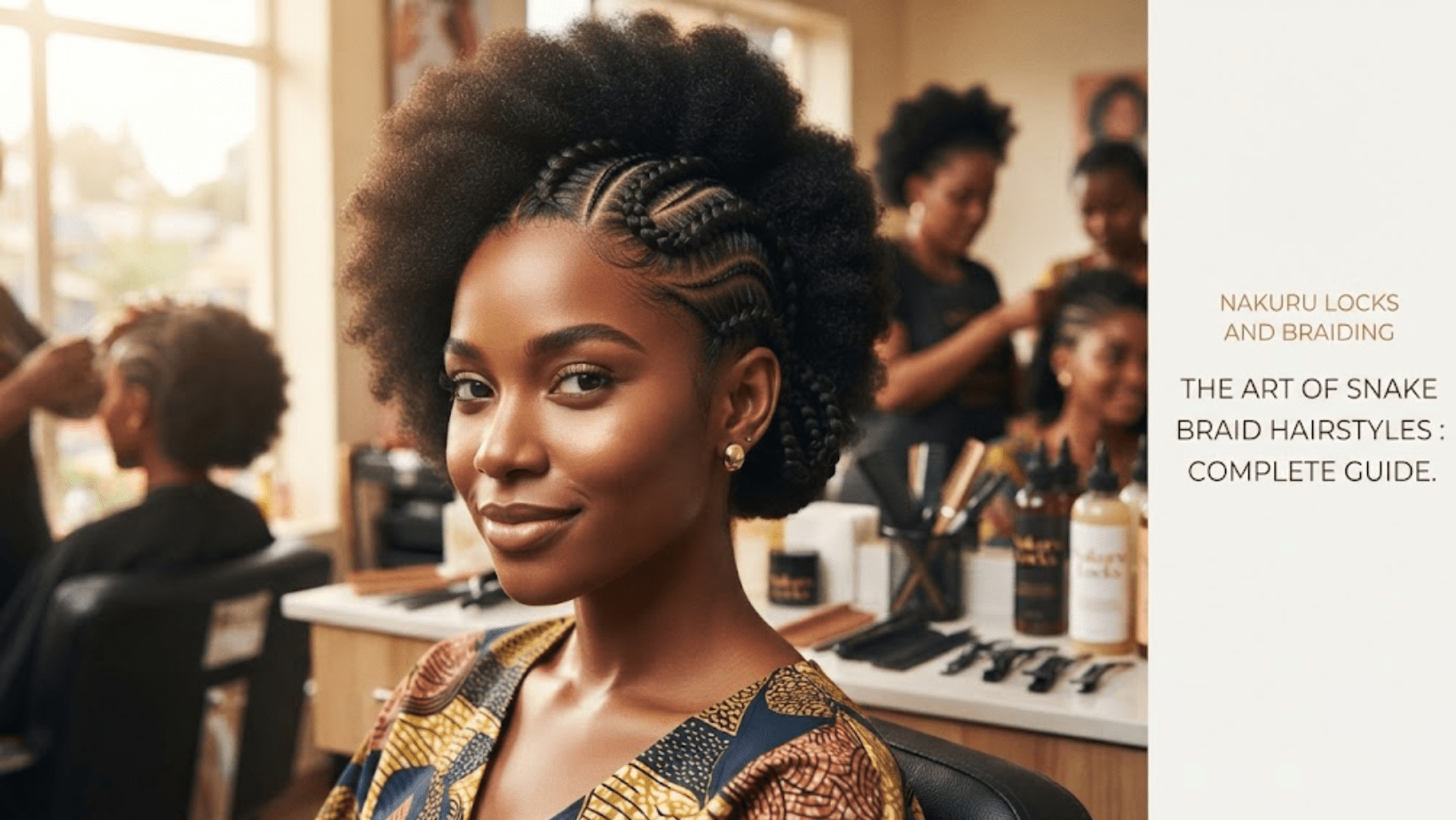
Snake Braid Hairstyles: How to Do Snake Braids on Black Hair, Men, Girls and More
Picture this: You’re scrolling through social media from a café in Nairobi, a festival in Coachella, or a quiet evening in Lagos, and a hairstyle stops you mid-scroll.
It twists and curves like a living serpent across the scalp or down the length of the hair—elegant, unexpected, and impossible to ignore.
That is the snake braid. What looks like hours of intricate work is often a clever transformation of a simple three-strand braid, or, in the world of protective styles and men’s designs, a series of precise zigzag cornrows that mimic a snake’s path.
At Nakuru Locks and Braiding in Nakuru, Kenya, we see this style requested by clients from every background—Black women seeking protective looks that celebrate texture, men wanting sharp, cultural designs, and everyone in between drawn to its global versatility.
Snake braids bridge continents and cultures: they appear in red-carpet moments, everyday protective styling for natural hair, and even in the precise world of paracord craftsmanship.
This guide breaks down every major variation of the snake braid, explains the techniques behind the keywords that people search most, and shows why this look remains timeless yet fresh.
What Exactly Is a Snake Braid Hairstyle?
A classic snake braid starts as an ordinary three-strand braid. Once the braid is nearly complete, the two outer strands are slid upward along the center strand, then gently pulled back down.
This creates the signature S-shaped, coiled appearance that resembles a snake. The more you lengthen the coils, the more pronounced the serpentine effect becomes.
The style can sit as a single accent braid along the side of the head, form a halo or headband, or appear as multiple rows.
It works on medium to long hair and can be adapted with extensions. For many, the appeal is the illusion of complexity achieved with relatively simple steps—exactly why it became a festival and celebrity favorite.
There are also several styles that people call “snake braids,” including:
-
A loose snake-shaped accent braid worn along the side of the head.
-
A pancaked snake braid created from a regular three-strand braid.
-
A snake braid bun formed by wrapping braids around a small bun.
-
A curved cornrow or feed-in design that travels across the scalp.
-
A decorative snake braid made with paracord, rope or cord.
-
A snake braid knot used in jewellery, crafts, camping and ropework.
These versions may look related, but they use different techniques. The hair version is a hairstyle; the paracord version is a cord-braiding pattern; and the knot version is a method of interlacing or securing cord.
Snake Braid Hairstyles To Try
A snake braid can be subtle or dramatic depending on the braid size, placement, texture and accessories. Here are practical ideas for different hair types and occasions.
1. Side snake braid
Create one braid near the front hairline and shape it into a loose S pattern. Pin it behind the ear or sweep it toward the back of the head. This is one of the easiest versions for beginners and works well as an everyday accent.
2. Snake braid with a puff
On natural Black hair, create a snake braid along one side or across the front. Leave the remaining hair in a rounded afro puff, puff ponytail or stretched-out natural texture. The contrast between the structured braid and voluminous puff creates a modern Afrocentric look.
3. Double snake braids
Part the hair down the middle and make one snake braid on each side. The braids can be left loose, pinned into two buns or joined at the back. For children, use smooth parting and gentle tension rather than pulling tightly around the temples.
4. Snake braid bun
Make one or two snake braids, then wrap them around a small low bun. This creates an elegant hairstyle for weddings, formal events, church, school functions or professional settings. A snake braid bun combines the visual interest of a sculpted braid with the neatness of an updo.allthingshair
5. Snake braid ponytail
Create the braid at the front or side and direct it into a low or high ponytail. You can also make several small snake braids and gather them into one ponytail. Keep the base loose enough to avoid excessive pulling on the hairline.
6. Colourful snake braids
Add a small amount of coloured braiding hair, yarn or temporary hair colour. Burgundy, copper, honey blonde, blue and purple can highlight the curves of the braid. For extensions, choose a lightweight amount so the finished style does not become unnecessarily heavy.
7. Beaded snake braid
Decorate the ends with beads, cuffs or small metallic accessories. Beads look particularly attractive on dark natural hair because they emphasize the movement of the braid. Avoid accessories that are too heavy or sharp, especially for children or fragile edges.
8. Snake-inspired cornrows
A stylist can create curved cornrows that travel in a snake-like direction across the scalp. This is different from the simple scrunched snake braid because it requires controlled scalp braiding, clean parting and consistent tension. The pattern may be worn as one curved row, several parallel rows or a design combined with feed-in braids.
9. Snake braids on locs
Mature locs can be arranged into a snake-like wrap or decorative loop. However, locs are heavier than loose hair, so avoid tight styling at the root. A stylist should assess the strength of the locs and the condition of the edges before creating an elaborate updo.
How Do You Do a Snake Braid?
The following method creates a classic snake braid from a three-strand braid.
What you need
-
Rat-tail comb or wide-tooth comb.
-
Spray bottle with water or a light moisturising mist.
-
Detangling product or leave-in conditioner.
-
Small elastic, thread or discreet hair tie.
-
Sectioning clips.
-
Bobby pins, if you plan to pin the braid.
-
Light styling cream or gel, used sparingly.
Step-By-Step Method
1. Prepare the hair. Start with clean, detangled hair or a refreshed style. Natural hair can be stretched gently with banding, threading, African threading or low heat if appropriate. Do not force a comb through dry, tangled hair.
2. Choose the section. Take a medium-sized section from the front, side or crown. A smaller section produces a delicate accent braid, while a larger section creates a bold snake pattern.
3. Smooth the section. Apply a small amount of leave-in conditioner, styling cream or gel. The aim is to control flyaways, not to saturate the hair or create a hard, sticky surface.
4. Divide into three strands. Separate the section into three reasonably equal pieces. Keep the strands distinct throughout the braid.
5. Create a regular braid. Cross the right strand over the middle, then the left strand over the middle. Continue until you are close to the ends. A simple three-strand braid is enough, although a French or Dutch braid can also be used as the foundation.
6. Leave a small unbraided section. Stop before the very ends if you need room to secure the shape. Hair that is too short or heavily layered may unravel while being reshaped.
7. Hold the middle strand. Identify the middle strand and hold it firmly but gently. Keep the two outer strands together or allow them to move upward along the middle strand.
8. Push the braid upward. Slide or scrunch the two outer strands toward the top of the braid while stabilising the middle strand. The braid should compress and gather into a wavy, coiled form.
9. Adjust the curves. Gently pull the compressed sections apart until the braid forms a balanced S pattern. Avoid tugging individual hairs aggressively; shape the braid gradually with your fingertips.
10. Secure the style. Use a small elastic at the end or pin the braid behind the ear, across the back or around a bun. Add pins underneath the braid so they remain hidden and do not scratch the scalp.
11. Finish lightly. Smooth loose hairs with a small amount of product. If the braid feels painful, tight or uncomfortable, remove it and recreate it with less tension.
A published tutorial from All Things Hair describes the same core process: form a three-strand braid, hold the middle piece, push the outer sections upward, gently separate the compressed braid and secure it with a clip or hairpins.
How to Make a Snake Hairstyle on Black Hair
Snake braids can work beautifully on Black hair, but the preparation should match the hair’s texture and condition.
Coily and kinky hair often provides excellent grip, meaning the braid can hold its shape without excessive product.
At the same time, dry or fragile hair can be vulnerable to breakage during detangling and manipulation.
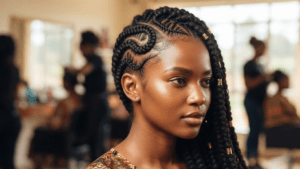
For Natural Hair
Begin by lightly moisturising and detangling the chosen section. If the hair is very shrunken, stretch it gently first so the strands are easier to divide. You can work on a twist-out, blow-dried hair, braid-out or loose natural hair, depending on the desired finish.
For a softer appearance, keep some natural texture visible. For a sleek appearance, use a small amount of edge control or styling gel along the parting. Avoid repeatedly brushing the same section, especially around the temples and front hairline.
For Short Hair
A short snake braid may not have enough length to create large curves. Try one of these alternatives:
-
Make a small accent braid and pin it flat.
-
Add a limited amount of lightweight extension hair.
-
Create several mini snake braids rather than one large braid.
-
Use a curved cornrow pattern performed by an experienced stylist.
-
Combine the braid with a taper, fade, afro or short natural style.
For Medium or Long Hair
Longer hair gives the braid more room to compress and form visible curves. It can also make the finished style heavier. If extensions are added, keep the length and volume proportionate to the natural hair and scalp.
For Children
Snake braids can make attractive snake braids Black girl hairstyles for birthdays, school events and family celebrations. Use wide parts, soft elastics and minimal tension. Avoid placing tight braids repeatedly in the same direction, and check that accessories are not heavy.
A child should never have to tolerate pain for a hairstyle. Stinging, headache, scalp tenderness or visible pulling around the edges are signs that the style needs to be loosened or removed.
Snake Braids for Men
Snake braids men searches often refer to masculine, gender-neutral or barber-inspired versions of the style. The technique is not limited to women. Men with natural hair, longer hair, locs, undercuts or fades can wear snake-inspired braids in several ways.
Popular options include:
-
One small snake braid on top of a fade.
-
Two or four curved snake braids with a clean taper.
-
A snake-like cornrow design across the crown.
-
A braided accent leading into a bun or ponytail.
-
Short feed-in braids with geometric or curved partings.
-
A loc updo shaped into a loose serpentine pattern.
For shorter hair, the look is usually created through cornrows or feed-in braids rather than by compressing a long free-hanging braid. A professional barber or braider can design the parting pattern to suit the head shape, hair density and preferred level of maintenance.
Men with thinning edges, scalp sensitivity or a history of traction-related hair loss should choose wider parts and lower-tension styles. The same hair-health principles apply regardless of gender.
Snake Braid Paracord
A snake braid paracord is not a hairstyle. It is a decorative cord-braiding pattern made using paracord, rope or another flexible cord. People use it for keychains, bracelets, lanyards, zipper pulls, handles and outdoor accessories.
The paracord version may be made by repeatedly crossing strands or wrapping cord around a central section. It can resemble a snake because the finished cord is rounded, compact and patterned. The exact method depends on whether the project uses one cord, two cords, a core or a multi-strand setup.
When making paracord crafts:
-
Follow a pattern designed for the specific number of strands.
-
Keep the tension even so the braid looks consistent.
-
Use scissors or a heated tool carefully when sealing synthetic cord.
-
Do not place unfinished or sharp cord ends against a child’s skin.
-
Remember that a decorative paracord braid is not automatically suitable for climbing, rescue or load-bearing use.
A hair snake braid and a paracord snake braid share a visual idea, but they should not be confused. One reshapes hair; the other interlaces cord.
Snake Braid Knot
The phrase snake braid knot can describe several cord or craft techniques rather than one universally standard knot. In jewellery and paracord work, a snake-like knot may create a compact, rounded braid used for bracelets, necklaces or decorative ties.
For hair, people may use “snake braid knot” to describe a braid that is folded, looped or secured into a knot-like bun. It is not necessarily a separate recognised braid category. If you are searching for a tutorial, identify the material first:
-
Search “snake braid hairstyle” for human hair.
-
Search “snake braid paracord” for cord projects.
-
Search “snake knot paracord” or “snake knot bracelet” for knotting instructions.
-
Search “snake braid bun” for a folded hairstyle.
This distinction makes it easier to find the correct tutorial and avoid applying a cord technique to hair.
Is a Snake Braid a Protective Style?
A snake braid can be low-manipulation when it is loose, lightweight and worn for a reasonable period. However, the name of a hairstyle does not automatically make it protective. A style becomes safer when it reduces daily handling without placing continuous stress on the hairline.
The American Academy of Dermatology warns that tightly braided hair, cornrows, locs, extensions and other styles that pull can contribute to traction alopecia. Dermatologists recommend loosening braids around the hairline, choosing thicker or shorter styles, removing painful styles and generally wearing braids for no longer than six to eight weeks.
For a healthy snake braid:
-
Avoid painful tension at the roots.
-
Do not make the braid excessively heavy with extensions.
-
Keep pins and elastics away from irritated areas.
-
Avoid repeatedly styling the same edges in the same direction.
-
Give the hair a break between tight or structured styles.
-
Cleanse and moisturise the scalp according to your hair’s needs.
-
Remove the style if you notice stinging, bumps, crusting or scalp tenderness.
Pain is not evidence that a braid is secure. It is a warning that the technique should change. If you notice persistent thinning, broken hairs, a receding hairline or shiny patches, consult a qualified dermatologist. Traction-related hair loss can become permanent when the pulling continues.
Snake Braid Maintenance
A snake braid usually looks best when protected from friction and unnecessary handling. At night, cover it with a satin or silk scarf or sleep on a satin pillowcase. This can help reduce friction compared with rougher fabrics.
Refresh the style with a light mist rather than repeatedly applying thick gel. If the scalp becomes itchy, flaky or uncomfortable, do not mask the problem with more product. Cleanse gently or remove the braid, depending on the condition of the hair and scalp.
The length of time the style lasts depends on the braid pattern, hair texture, products, weather and whether the hair is natural or extended. A temporary loose snake braid may last for a day or a few days, while a carefully installed cornrow design may last longer. A stylist should assess the hair before recommending an extended wear period.
Why Snake Braids Continue to Captivate a Global Audience
The style succeeds because it is adaptable. A side snake braid elevates everyday hair; zigzag cornrows offer protection and artistic expression; the paracord version satisfies makers who enjoy tactile craft.
Celebrities and influencers have worn versions of it, yet the technique remains accessible enough for home practice or salon refinement.
At Nakuru Locks and Braiding we approach every snake-braid request with attention to hair health.
We assess texture, length, and lifestyle, choose appropriate tension and products, and educate clients on aftercare so the style lasts without compromising the scalp or edges.
Our eco-conscious approach and focus on African-inspired artistry mean clients leave with looks that feel personal and sustainable.
Care and Longevity Tips
- Sleep with a silk or satin scarf or bonnet.
- Moisturize the scalp lightly; avoid heavy product buildup.
- For cornrow versions, keep parts clean and re-edge as needed.
- Remove the style after 4–8 weeks (depending on tension and hair type) to give the scalp a break.
- When using synthetic extensions, choose quality hair and monitor for any irritation.
Why Choose Nakuru Locks and Braiding?
Nakuru Locks and Braiding offers customised braiding, locks, extensions and scalp-focused services at Mt. Sinai Building on Bazaar Road in Nakuru City.
The salon highlights hygienic tools, customised designs and African-inspired hair artistry as part of its service approach.
For a snake braid consultation, share:
-
Your preferred reference image.
-
Your natural hair length and texture.
-
Whether you want a temporary style or extensions.
-
Any history of thinning, breakage or scalp sensitivity.
-
Your preferred colour, accessories and finish.
-
The date and occasion for the hairstyle.
The salon’s published contact details are 0723 168 188 for calls or WhatsApp, with appointments available from Monday to Saturday and on Sundays by arrangement.
FAQ
How long does a snake braid take to do?
A single accent braid can take 5–15 minutes once the technique is learned. Full zigzag cornrow designs for men or women typically take 1–3 hours depending on complexity and hair density.
Can snake braids be done on short hair?
The classic slid version needs enough length to braid and slide. Zigzag cornrows work on shorter hair as long as there is enough length to grip and braid.
Are snake braids protective?
Yes, when installed with moderate tension and proper parting. They reduce daily styling stress, especially on natural Black hair.
What’s the difference between a snake braid and a fishtail?
A fishtail uses two sections with alternating small pieces. A snake braid begins as a three-strand braid that is then manipulated into S-curves.
Can men wear the classic slid snake braid?
Yes, though most men prefer the zigzag cornrow interpretation for a sharper, closer-to-the-scalp look.
Related Articles from Nakuru Locks and Braiding
Explore more expert guidance on our site:
Whether you want a quick side snake braid for an evening out, bold zigzag designs that turn heads, or simply to understand the craft behind the name, the snake braid offers something for everyone.
Visit Nakuru Locks and Braiding on Bazaar Road in Nakuru, or reach us on WhatsApp at +254 723 168 188.
Our stylists are ready to create a version that fits your hair, your lifestyle, and your story—because great braids should feel as good as they look.
References
- Detailed step-by-step technique: wikiHow “How to Make a Snake Braid”
- Celebrity and festival context: Marie Claire and Brit + Co tutorials
- Protective styling considerations and health notes drawn from broader discussions of synthetic hair and traction (Consumer Reports reporting and trichology literature)
- Paracord knot instructions from established craft sources (Paracord Guild-style tutorials and The Bear Essentials)
Leave a Reply