
Wrapped Locs Hairstyles: The Complete Guide to Styles, Hair Choices and How to Wrap Locs
Picture three women on one ordinary Saturday. One is in a Nakuru salon chair as the afternoon light comes through the window, watching her stylist wind soft strands around a braid.
One is in a London flat, scrolling a tutorial at midnight with a pack of braiding hair beside her.
One is in Toronto, trying to decide whether her short natural hair is long enough for the style she saved last week.
All three are chasing the same look: wrapped locs. The style has a lived-in, textured softness, and it lets you wear a loc look without the multi-year commitment of growing your own.
Braiding has long been described as a community practice passed between generations, and African hair braiding salons now operate in cities worldwide as a marker of the diaspora, as OkayAfrica reported on artist Nontsikelelo Mutiti’s research. Wrapped locs are one of the newest chapters of that story.
This guide answers the questions we hear most, whether the person asking is sitting in our salon or reading from the other side of the world.
We cover what wrapped locs are, the main wrapped locs hairstyles, how to do wrapped locs, what hair to use, the best head wrap for locs, and what works for short hair.
We also tell you where the risks are, because a beautiful style should never cost you your hairline.
What Are Wrapped Locs?
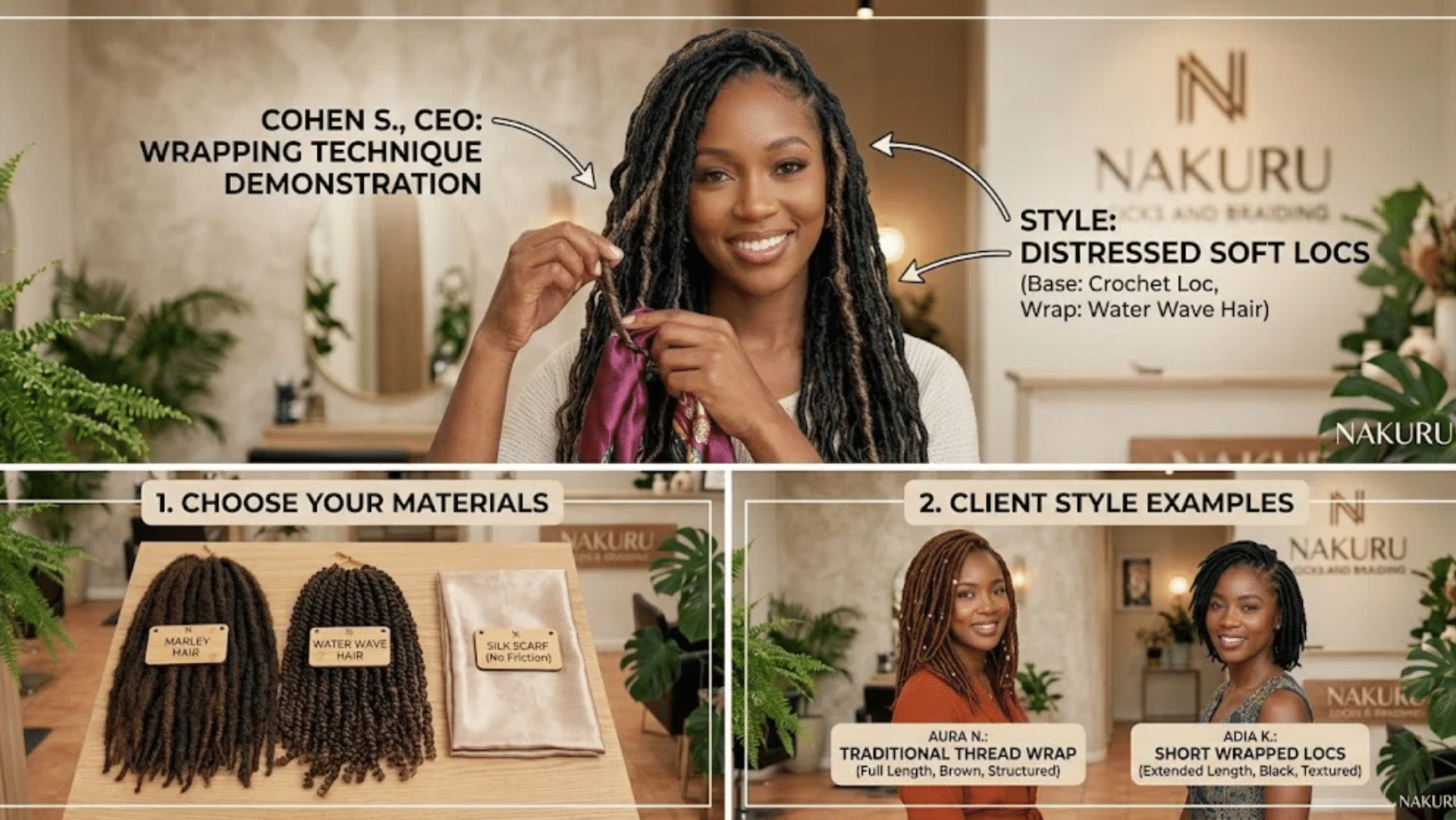
Wrapped locs are a protective style in which extension hair is wound around a braided or twisted base, or around a crocheted loc, so it looks like a loc.
Most stylists group them under the wider “faux locs” family. The term can cause confusion, so here is how the vocabulary breaks down:
- Faux locs is the umbrella term. Per America’s Beauty Show, faux locs blend synthetic extensions with your natural hair, and they can be applied by a braid-in or crochet method.
- Soft locs, also called butterfly locs, are a lighter, softer variation with less tension and more movement when first installed. The same source notes they can be made by crocheting pre-made locs into cornrows or by wrapping hair individually.
- Wrapped locs describes the technique: hair is wrapped around the base. It is how many soft locs and traditional faux locs are built.
The difference is mostly one of finish. StyleSeat’s guide explains that faux locs are usually wrapped tighter, so they can feel heavier and take a few days to soften, while soft locs look relaxed straight out of the chair.
Wrapped locs are also a different thing from real locs. Traditional locs are created by palm rolling or matting medium to large sections of natural hair with a balm or wax, as Capital FM Kenya describes in its coverage of the Kenyan locs scene. Wrapped locs are temporary and removable.
Wrapped Locs Styles: Ideas to Wear Now
The attraction is versatility. Here are the wrapped locs styles our clients ask for most.
1. Classic soft wrapped locs. Medium-thickness locs with a slightly frayed, natural texture. They sit between formal and casual, so they work for the office and for weekends.
2. Bohemian (boho) wrapped locs. The wrapped base is left deliberately imperfect, with loose curly strands hanging out along the length and at the ends. This is the style most people picture when they search wrapped locs hairstyles. It suits anyone who wants a romantic, relaxed look.
3. Goddess or butterfly locs. The wrapped sections have curly pieces of hair woven through them for a fuller, windswept finish. They are the most photographed version.
4. Wrapped loc bob. The locs are cut at chin or shoulder length. A bob also lessens weight, which matters for scalp health (see the safety section below).
5. Wrapped locs updos. A high bun, a half-up top knot, or a low twisted chignon. Soft locs can be put up immediately after installation, whereas heavier faux locs can feel uncomfortable for a few days, according to StyleSeat.
6. Colored and ombré wrapped locs. Honey blonde, burgundy, copper or two-tone blends. Because colour comes from the extension hair, you can try a bold shade without chemically processing your natural hair.
7. Wrapped locs with beads, cuffs or threads. Gold cuffs, wooden beads or wrapped yarn at the ends add a personal touch and echo the adornment traditions that have long been part of African braiding.
8. Jumbo wrapped locs. Fewer, thicker locs. They install faster and place less tension per follicle than a head of tiny ones.

What Hair Is Used to Wrap Locs?
This is one of the most searched questions, and the honest answer is that it depends on your budget, texture goal and scalp sensitivity.
1. Kanekalon and other synthetic braiding hair. Pre-stretched synthetic braiding hair is the most common choice for the base and the wrap. It is light, inexpensive and holds a shape well. Some people with sensitive scalps react to the coating on certain synthetics, so soak or rinse it in diluted apple cider vinegar and water before use if you are prone to itching.
2. Marley hair (kinky or springy twist hair). Textured, slightly coarse and matte, it gives the most authentic loc look. Many stylists reach for marley-type hair when clients ask for what is called “wrapping hair for soft locs.” Its grip makes wrapping easier, but it can feel heavier, so choose shorter lengths for comfort.
3. Human hair. Premium and realistic, with a natural drape. It can be washed, dyed and reused, but it costs considerably more and is heavier. We recommend it only for shorter styles.
4. Yarn. Wool or acrylic yarn creates a rustic, textured finish. It is soft and cheap, but it absorbs water slowly and can take a long time to dry, which can lead to a damp scalp and odor if you are not careful.
5. Pre-made crochet locs. Ready-made locs are attached to cornrowed hair with a crochet hook, which is faster than wrapping from scratch. The crochet route is one of two main installation methods, alongside braid-in, per StyleSeat.
6. What hair do you use to wrap soft locs specifically? Fine, soft, lightweight hair is the usual answer. Soft locs depend on a gentle texture rather than a stiff, tight wrap, so we choose lighter synthetic or marley-style hair and a looser wrapping tension than we would for classic faux locs.
7. Our rule of thumb at Nakuru Locks: match the hair to your lifestyle. If you want low weight and quick install, choose synthetic. If you want realistic texture and are willing to pay more, consider human hair. And if you are unsure, ask your stylist to hold both against your natural hair in daylight before you decide.
How Do You Wrap Locs? A Step-by-Step Guide
The steps below are for the braid-in wrap method, the technique most associated with the question “how do you wrap locs?” Always consider having a trained stylist do the install. Wrapping is not difficult, but where the tension goes is a detail that matters for your scalp.
What you need
- Pre-stretched braiding or marley hair (roughly 6–8 packs for a full head, depending on length and thickness)
- Rat-tail comb and hair clips
- Edge control or light gel (optional)
- Rubber bands
- Hot water for sealing synthetic ends (use with care)
- A crochet hook (optional)
Step 1: Prep your natural hair
Wash, deep condition and fully dry or stretch your hair. Detangle gently. Wrapped locs are not a repair job for damaged hair. They hold best on hair that is clean, moisturised and not over-processed.
Step 2: Section the hair
Use a rat-tail comb to part clean squares or rectangles. Section size decides loc thickness and weight, so do not part them too small. The American Academy of Dermatology advises choosing thicker braids and locs to limit tension on the scalp.
Step 3: Make the base braid
Braid each section, adding a bit of extension hair at the root so that the base feels secure but not tight. Keep the braid loose at the hairline.
Step 4: Add the wrapping hair
Take a length of your chosen extension hair, fold it or attach it over the base braid, and begin wrapping. Wind the wrapping hair down the braid in even, overlapping turns, keeping the tension relaxed so the loc does not squeeze your natural hair. Work from the root to the tip.
Step 5: Secure the ends
Tuck the last turns into the end of the loc, or seal synthetic ends with a quick dip in hot water. Take care here, because hot water can burn skin. Some stylists prefer a small thread tie or needle and thread.
Step 6: Soften and distress
For a boho finish, gently pull a little of the wrap out in places and add curly strands. Do this lightly so the loc does not become frayed at the root.
Step 7: Finish the edges
Smooth the hairline with a light product. Skip heavy glue-like gels, which may add to build-up and make removal harder.
How to wrap locs with hair: the crochet shortcut
If you are asking how to wrap locs with hair and do not want to wrap every loc by hand, the crochet shortcut is: cornrow your hair flat, then thread pre-made soft locs through the cornrows with a crochet hook, and wrap a little loose hair around the base to hide the join. It is faster and often lighter than the braid-in route.

Best Head Wrap for Locs
A good head wrap serves two purposes: it protects your style while you sleep, and it dresses it up in the daytime.
For sleeping: satin or silk. Cotton absorbs moisture and creates friction that can fuzz up wrapped locs. A satin-lined bonnet, a silk scarf or a satin sleeping cap reduces both. Pick one that is spacious enough that it does not squeeze your locs against your scalp.
For daytime: lightweight cotton or jersey wraps. Breathable fabrics work best. A wide, stretchy turban-style wrap works well on longer locs.
For events: structured wraps and bold prints. Traditional African head wraps in strong prints, such as the ones many Kenyan women wear to weddings and church, look striking against wrapped locs.
What to look for:
- A smooth inner lining (satin or silk)
- An adjustable fit so there is no tight band at the hairline
- Enough volume to hold the locs without crushing them
- Washable fabric
One caution: a wrap tied too snugly across the hairline adds tension in the area most vulnerable to traction. If a wrap leaves a mark or feels sore, loosen it.
Wrapped Locs for Short Hair
Short hair often feels like a barrier, but it is not necessarily one. There are three realistic approaches.
1. Crochet soft locs on cornrows. If your hair is long enough to cornrow, even in short sections, crocheting pre-made locs is generally the most practical option for wrapped locs on short hair.
2. Wrapped locs on small braids. If your hair is roughly a few inches long, a stylist can braid it into sections and wrap over them. Extension hair is usually added at the root so the braid is long enough to hold.
3. Shorter loc lengths. A bob or shoulder-length style keeps weight down. This matters because the AAD recommends keeping braids and locs short, since longer hair is heavier and pulls more.
A caution for very short hair: if your natural hair is too short to hold a braid securely, we would rather tell you to wait or choose a different style than risk a poor install. A trustworthy stylist will say so, even if it costs the booking.
Wrapped Locs and Scalp Safety: What the Research Says
Protective styles are not automatically protective. The AAD says locs, braids and other styles can lead to traction alopecia when they are too tight, and that advanced traction alopecia can become permanent.
A review summarised by Practical Dermatology found a strong association between scalp-pulling styles and traction alopecia, with braids, dreadlocks, weaves and extensions among the highest-risk styles. It also found that loose, low-hanging styles carried lower risk.
Our practical checklist:
- Pain is a signal. If your scalp aches, tell your stylist immediately. Do not “wait it out.”
- Keep the hairline loose. Edges are the most fragile area.
- Wear them for a limited time. The AAD recommends no more than 6–8 weeks for braids. StyleSeat and America’s Beauty Show both give a similar 4–6 week window for soft and faux locs, after which they begin to slip and pull on the roots.
- Choose a lighter weight. Thicker, shorter and lighter is kinder to your follicles.
- Check monthly. Look for broken hairs at the forehead, a receding hairline or bald patches where hair is pulled tight.
If you notice persistent thinning, see a dermatologist. Traction alopecia can be reversed in its early stages, but only if the tension stops.

Aftercare: Keeping Wrapped Locs Fresh
- Wash gently every one to two weeks with diluted shampoo applied to the scalp, then rinse thoroughly. Wrapped locs trap moisture, so dry them completely.
- Moisturise the scalp lightly with a lightweight oil or spray. Avoid heavy butters that can build up.
- Protect at night with a satin bonnet or scarf.
- Avoid overstyling. Constant pulling into tight buns undoes the benefit of a protective style.
- Take them out on time. Old wrapped locs can lead to matting at the root. Remove them slowly, with conditioner, and detangle before washing.
Why Choose a Professional Installation?
Doing wrapped locs at home is possible, and there is a lot of beginner content online. But the quality of the install shapes how your hair feels in week four.
Capital FM’s coverage of the Kenyan locs industry notes that stylists have had to undo badly installed locs done by people who were not trained. Section size, base tension, product choice and removal technique are all skills, and each affects how your hair ages under the style.
At Nakuru Locks and Braiding Salon, we focus on installs that look good and feel comfortable, and we will tell you honestly if a style does not suit your hair length or condition.
Frequently Asked Questions
What are wrapped locs hairstyles?
Wrapped locs hairstyles are protective styles in which extension hair is wrapped around a braided base, or around a crocheted loc, to imitate the look of locs. They are part of the faux locs family and include soft locs, butterfly locs, boho locs and goddess locs.
How long do wrapped locs last?
Most sources suggest about 4–6 weeks. America’s Beauty Show notes that after that point soft locs can begin to slip and place tension on the roots. The AAD advises limiting braided styles to 6–8 weeks.
Are wrapped locs bad for your hair?
Not inherently, but they can be if they are too tight, too heavy or worn too long. The AAD identifies tight locs and braids as a cause of traction alopecia. Ask for a looser install and thicker, shorter locs.
Can I wrap locs on my own hair at home?
Yes, many people do, but it takes practice. Start with a few locs, keep the tension loose, and have a professional redo any that feel tight.
What is the difference between soft locs and wrapped locs?
Soft locs describe a finish: lighter, more flexible, more movement. Wrapped locs describe a technique: winding hair around a base. Soft locs are often made with wrapping, so the terms overlap.
Can wrapped locs be done on short hair?
Often, yes. Crochet soft locs on cornrows, or wrapped locs on small braids with added extension hair, are the usual methods. Your stylist will check whether your hair is long enough to be braided securely.
Can I wash wrapped locs?
Yes. Wash your scalp with diluted shampoo, rinse well, and dry them completely so moisture does not stay trapped.
How much do wrapped locs cost?
Prices depend on length, thickness and hair type. Contact the salon for a current quote rather than relying on a general figure.

Related Articles from Nakuru Locks and Braiding
References
- American Academy of Dermatology Association
- Practical Dermatology
- Dermatology Times
- StyleSeat
- America’s Beauty Show
- OkayAfrica
- Capital FM Kenya
Book Your Wrapped Locs at Nakuru Locks and Braiding
If you are ready for wrapped locs, or still deciding which style, hair type and length suit you, visit us at Sinai Building, Bazaar Road, Nakuru, or message the salon to book a consultation. Bring a photo of the style you like, and we will tell you honestly what will work on your hair.
This article is for general information and is not medical advice. If you notice persistent hair loss, scalp pain or irritation, consult a qualified dermatologist.
Leave a Reply