
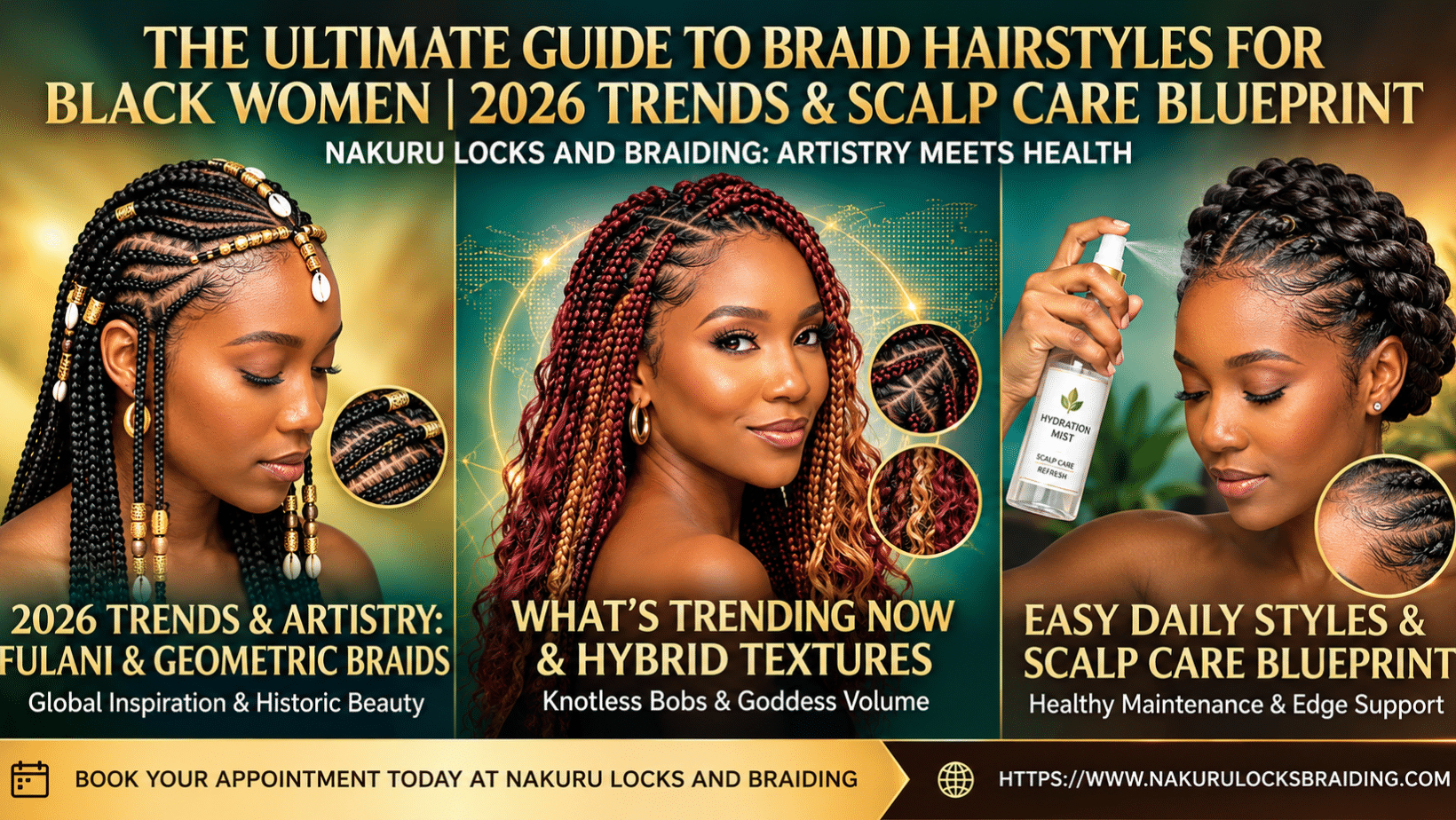
Braid Hairstyles for Black Women With Natural Hair: 2026 Trends, Easy Styles, and What’s Trending Now
Braids have always been more than a hairstyle for Black women—they are heritage, protection, self-expression, and a practical way to care for natural hair.
In 2026, the biggest shift is toward low-tension, lightweight, texture-forward braids that look effortless while keeping coils, curls, and kinks protected.
Knotless braids, boho braids, stitch cornrows, Fulani-inspired styles, and mini twists are leading the season, with a strong emphasis on scalp health and customization.
At Nakuru Locks and Braiding, we see braids as both art and hair care. Whether you want an easy everyday style, a wedding-ready look, or a protective install that supports length retention, the right braid should suit your natural texture, lifestyle, scalp sensitivity, and personal style.
Why Braids Remain a Go-To Protective Style
Braids help tuck natural hair away from daily manipulation, friction, weather exposure, and excessive styling.
For many women with 3C to 4C hair, they offer a way to retain length while still enjoying a polished, versatile look.
Protective braiding is especially useful during hot or humid seasons, when hair can benefit from being kept contained and moisturized.
That said, a protective style only protects when it is installed and maintained correctly. The 2026 approach is less about ultra-tight, perfectly sleek braids and more about comfort, natural movement, and healthy edges.
Stylists are increasingly prioritizing reduced scalp tension, breathable parts, and styles that allow cleansing without completely disrupting the install.
The Braid That Travels the World
It is Saturday morning in Nakuru. A mother sits on a low stool between her daughter’s knees, a wide-tooth comb in one hand and a section of freshly detangled hair in the other.
The radio hums, the conversation drifts from school fees to football, and three hours later a neat row of cornrows is finished. A girl walks out feeling taller.
Now move the same scene to Atlanta, London, Lagos, Johannesburg, Toronto or Kingston. The kitchen changes. The music changes. The gesture does not. Hands part the hair, tension is balanced, and a pattern that African communities have worn for centuries takes shape again.
That is the story behind every braid, and it is why the question “what are the braid trends for 2026?” matters far beyond fashion.
Braids are heritage, protection, self-expression and, increasingly, a global style language. At Nakuru Locks and Braiding, we spend our days braiding natural hair for clients who want styles that look beautiful and keep their hair healthy.
This guide pulls together what is trending now, which styles are easy to wear and maintain, and how to protect your hair while you enjoy them.
Why Braids Work So Well for Natural Hair
Braids are one of the most trusted protective styles for Black women with natural hair. By tucking your ends away and reducing daily combing, heat and manipulation, a well-installed braid style can help you retain length and give your hair a rest.
Luxe Digital’s 2026 guide to braids for Black women groups the whole category into two families: individual braids that hang free, and braids that lie flat against the scalp. That is a useful way to think about your options:
- Free-hanging braids include box braids, knotless braids, goddess braids and micro braids.
- Flat-to-scalp braids include cornrows, feed-in braids, Fulani braids and stitch braids.
Both families can be worn with natural hair alone or with braiding extensions added for length, volume or color.
A note from our stylists: Protective does not automatically mean harmless. A style only protects your hair if it is installed with the right tension on properly prepared hair. We return to this in the care section below, because it is the most important part of this article.
What Are the Braid Trends for 2026?
If you have been scrolling through saved photos wondering what to bring to your appointment, here is what stands out in 2026 across publications, red-carpet looks and what we see in the chair.
1. Softer, Looser, More Textured Braids
The clearest shift is away from rigid, sealed, uniform braids and toward softer styles. A late-2025 trend roundup describes the movement as a turn toward softer, more voluminous, less rigid braids, with loose curly ends and mixed textures replacing blunt, sealed tips.
The same source notes that varying braid sizes within one style is part of the appeal, because it allows extreme personalization.
In the chair, this shows up as boho knotless braids, goddess braids with curly human-hair or curly synthetic accents, and braids with deliberate wisps and curls left out for movement.
2. Cowgirl Braids and Porch-Style Nostalgia
CurlyNikki’s summer 2026 trend report names cowgirl braids among the top natural hair trends Black women are embracing this year, alongside voluminous blowouts, wash-and-fros and heat-free curls set with rollers or flexi rods.
The article frames the season as a reclaiming of older, softer, joyful styles, from porch braids to press ‘n curls. If you love a look that feels relaxed and a little vintage, this is your lane.
3. Big, Statement-Making Braids
Big braid styles are having a visible moment. AOL’s roundup of striking big braid styles turning heads on red carpets and beyond is one of several 2026 features pointing the same way, and ESSENCE’s coverage of the 2026 Black Women in Hollywood event also highlighted braided looks.
Jumbo knotless braids, oversized cornrows and sculptural up-styles are the practical versions of this trend. Larger parts also mean less weight per section, which is a real comfort advantage.
4. Unconventional Parting and Pattern Work
ESSENCE’s Girls United section describes a 2026 shift toward unorthodox box braid patterns, edgy layered cuts and creative ways to honor natural texture for formal occasions.
Think curved parts, zigzags, asymmetry and braids cut into layers rather than left one length.
5. Accessories: Clear Beads, Silver Cuffs and Metallic Details
The same ESSENCE feature points to 2026 details such as clear beads and silver cuffs layered over a 90s-inspired look.
Beads and cuffs are an easy, low-commitment way to make a classic style feel current. They also echo older African braiding traditions, where adornment carried meaning.
6. Fulani Braids, Reinvented
Fulani braids remain in constant rotation. Luxe Digital’s list of 20 braid styles puts them alongside box braids as core options. In 2026 we see them with a bold center braid, beads at the ends, or a curly bundle added for volume.
7. Braided Bangs and Face-Framing Pieces
Braided bangs, curtain pieces and face-framing tendrils are appearing across 2026 style roundups, including coverage of braids paired with bangs. They are a gentle way to try a trend without redoing your whole style. One caution from us: the hairline is the most fragile area, so face-framing pieces should be left fine and loose, never tight.
8. Braids for Every Age and Lifestyle
Braids are no longer treated as a young person’s style. Luxe Digital’s guide includes a section on the best braids for women over 50, and we braid clients from students to retirees. The 2026 message is simple: choose the size, length and finish that suit your life.
Which Braids Are Trending Now?
Here is a quick snapshot of the styles our clients are requesting and that major beauty outlets are featuring this season.
| Style | What it looks like | Best for |
|---|---|---|
| Knotless braids (including boho) | Braid starts flat from the scalp, extension is fed in gradually, curly ends optional | Comfort, natural look, lighter feel |
| Box braids | Individual square-parted braids, secured at the root | Classic look, durability |
| Fulani braids | Cornrows at the front or side, free braids at the back, beads | Statement style, cultural pride |
| Cowgirl braids | Soft, relaxed, often two braids with a vintage-modern feel | Low-effort, casual wear |
| Feed-in cornrows and stitch braids | Flat rows that start thin and build thickness | Sleek, graphic look, easy upkeep |
| Goddess braids | Braids with curls or wavy pieces left out | Romantic, voluminous finish |
| Jumbo or big braids | Fewer, thicker braids | Fast installs, less tension per section |
| Micro braids | Very small, lightweight braids | Versatile styling, highly detailed look |
Luxe Digital notes that box braids can hold slightly longer because the knot keeps each braid secure. That is true, but it is a trade-off: knots add tension at the root. Knotless methods, which feed hair in gradually, are why so many clients now ask for them.
What Are Some Trendy Hairstyles for Black Women in 2026?
Braids dominate this conversation, but they sit inside a wider natural hair movement. Beyond braids, the 2026 trend list includes:
- Wash-and-fros and defined curls: celebrating natural texture without heavy styling. CurlyNikki highlights wash-and-fros as a major 2026 comeback.
- Heat-free curls: roller sets and flexi rods in place of daily heat tools.
- Voluminous blowouts: stretched, full-bodied natural hair.
- Gentle color: CurlyNikki’s report notes that many Black women are choosing semi-permanent dyes, glosses and henna-based tints to add color while protecting curl pattern.
- Silk press and sleek formal looks: still timeless, though ESSENCE notes that standing out at formal events in 2026 takes a bit more personality.
- Short styles and twist-outs: a strong option for those who want low maintenance.
You can also combine them: a braided style for a month, then a wash-and-fro or twist-out when you take the braids down. Rotating styles is one of the kindest things you can do for your hair.
Easy Braid Hairstyles for Black Women
Not every braid style needs a six-hour appointment. If you want something simple, these are the styles we recommend most for beginners and busy schedules.
Two Flat Twists or Two Braids
Part your hair down the middle and braid or twist each side. It takes minutes, works on most lengths and is gentle on the hairline. Add a satin scrunchie or a few beads for polish.
Simple Cornrows Straight Back
Four to eight straight-back cornrows are one of the oldest and most practical styles in existence. Keep them medium in size, never skin-tight, and wear them for a short window.
Jumbo Knotless Braids
Because there are fewer braids, installation is faster, and each braid carries less weight per section. This is one of the most beginner-friendly protective styles, particularly if you have never worn braids before.
Half-Up Braids
Braid the top section into a few cornrows or feed-in braids and leave the back in natural twists or a stretched fro. It looks styled but is easy to undo.
Braided Low Bun or Ponytail
Gather your braids into a low bun, avoiding a high, tight ponytail that pulls the edges. This is a go-to for work, school and weddings.
Braid-Out for Natural Hair
If you want the look of braids without an extension install, braid damp, moisturized hair at night and take it down in the morning for defined waves.
Quick pre-appointment checklist:
1. Arrive with clean, moisturized, fully detangled hair.
2. Bring two or three reference photos that show the size and length you want.
3. Tell your stylist about any tender areas, past hair loss or scalp conditions.
4. Say clearly: “Please keep it comfortable.”
Choosing the Right Braid for Your Hair, Face and Life
1. Your hair type and density. Fine or fragile hair does better with lighter extensions, larger parts and shorter wear time. Thick, resilient hair can take smaller braids, but still needs care.
2. Your lifestyle. If you work out often, swim or sweat a lot, flat styles and shorter lengths are easier to manage. If you want to wear your hair up daily, medium-sized braids are more practical.
3. Your budget and time. Smaller braids cost more and take longer. Jumbo and medium styles are quicker and often more affordable.
4. Your face shape and personal style. Face-framing curls soften angular features, while a sleek center part with a high braid pattern elongates a rounder face. Your stylist can tailor it.
5. Your scalp health. If your scalp is itchy, flaky or sore, treat that first. Braids can trap problems rather than solve them.
The Health Side of Braids: What Dermatologists Want You to Know
This section matters more than any trend. Beautiful braids should never cost you your hairline.
The American Academy of Dermatology (AAD) explains that traction alopecia is hair loss caused by tight hairstyles and repeated stress on the scalp, and that people of African descent can be more vulnerable because of the shape of the hair follicle and the prevalence of tight styling in many communities. The AAD advises that you:
- Loosen braids, especially around the hairline.
- Choose thicker braids and locs rather than very thin, heavy ones.
- Avoid wearing braids for longer than roughly 6 to 8 weeks.
- Make sure cornrows are not tight.
A review reported by Practical Dermatology found a strong association between scalp-pulling styles such as braids and traction alopecia.
It also found that heat styling is not by itself strongly associated with traction alopecia but can weaken hair shafts when traction is added, and that loose, low-hanging styles carry lower risk.
Public-media health coverage from Indiana University summarises another warning: if you feel pain from a tight style, change it immediately, and check monthly for broken hairs near the forehead, a receding hairline or patches where hair is pulled.
Some sources describe how common this condition is among women of African descent, with one frequently quoted estimate suggesting around one in three women who wear tight protective styles for long periods develop it. Treat that as a reminder, not a scare: the risk is largely controllable through technique and timing.
Luxe Digital puts it plainly: if a braid hurts or gives you a headache, it is too tight.
A Word on Synthetic Braiding Hair
PBS has reported on questions about how synthetic braiding hair may affect Black women’s health.
If you have a sensitive scalp, ask your stylist about pre-stretched, low-irritant options, and consider rinsing synthetic hair before use.
If you notice burning, rash or persistent itching, remove the style and see a dermatologist.

How to Care for Braids at Home
1, Cleanse your scalp gently. Use a diluted shampoo or braid-specific cleanser every one to two weeks, focusing on the scalp, not the lengths.
2. Moisturize lightly. A light leave-in mist or oil on the scalp and braids prevents dryness. Heavy products can cause buildup.
3. Protect at night. A satin bonnet, scarf or pillowcase reduces frizz and friction.
4. Do not over-stretch the timeline. Take braids down by week six to eight. Overgrown roots tangle and strain the follicle.
5. Detangle with patience. When removing braids, work slowly with conditioner and a wide-tooth comb, starting from the ends.
6. Give your hair a break. Wait a week or two between installs, deep condition and trim ends.
7. Avoid adding weight. Heavy beads, very long extensions and tight edges all add strain.
How Nakuru Locks and Braiding Approaches Every Appointment
Our philosophy is simple: your hair health comes first, then the style.
- Consultation first. We look at your scalp, density and goals before we pick a style or size.
- Tension-aware installation. We adjust parting size, extension weight and edge handling to keep you comfortable.
- Honest recommendations. If a style will not suit your hair right now, we will tell you and suggest something better.
- Aftercare guidance. You leave with clear instructions for washing, nighttime care and removal timing.
To book an appointment, contact Nakuru Locks and Braiding using the details on our website. Bring your reference photos and come with clean, detangled hair.
Frequently Asked Questions
What are the best braid hairstyles for Black women with natural hair?
The best choice depends on your hair density, lifestyle and comfort. Knotless braids, cornrows, Fulani braids and jumbo braids are popular because they can be installed with less tension. Choose a size your hair can comfortably carry and wear it within a safe time frame.
What are the braid trends for 2026?
The leading trends are softer, boho-style braids with loose curly ends, cowgirl and porch-inspired braids, big statement braids, unconventional parting patterns, beads and metallic accessories, and refreshed Fulani styles. Sources include CurlyNikki, ESSENCE and Luxe Digital, cited above.
Which braids are trending now?
Knotless and boho knotless braids, goddess braids, Fulani braids, jumbo braids and feed-in cornrows are the most requested. Braided bangs and face-framing pieces are also growing.
What are some trendy hairstyles for Black women in 2026?
Beyond braids, expect wash-and-fros, heat-free curls, voluminous blowouts, gentle semi-permanent color, silk presses, and creative formal styles.
What are easy braid hairstyles for Black women?
Two-strand braids or flat twists, simple straight-back cornrows, jumbo knotless braids, half-up braids and braid-outs are the easiest to install and maintain.
How long can I keep braids in?
The AAD recommends no more than about six to eight weeks for braids. Some stylists allow slightly longer for very light, low-tension styles, but earlier removal is safer for your hairline.
Do braids cause hair loss?
They can if they are too tight or worn too long. Traction alopecia is linked to repeated pulling, and in advanced stages the hair may not grow back. Loose installation, thicker braids and regular breaks lower the risk.
How do I know if my braids are too tight?
Pain, headaches, bumps at the roots or a stretched-looking hairline are warning signs. Ask your stylist to loosen or remove the braids right away.
Can I wear braids if my hair is short?
Often yes, with the right technique. Your stylist may recommend smaller sections, lighter extensions or a different style until your hair grows.
How do I prepare for a braiding appointment?
Wash, deep condition, fully detangle and stretch your hair. Bring reference photos and tell your stylist about any scalp sensitivity.
References
- American Academy of Dermatology Association. Hair loss: Hairstyles that cause traction alopecia.
- Practical Dermatology. Tight Ponytails, Braids Linked to Traction Alopecia.
- Dermatology Times. Helping Patients with Traction Alopecia: Basics, Treatment, and Prevention.
- Indiana Public Media, A Moment of Science. Hairstyles That Lead to Hair Loss.
- Luxe Digital (September 30, 2026). Braids for Black Women: 20 Styles, From Box Braids to Fulani.
- CurlyNikki. 5 Natural Hair Trends Black Women Are Bringing Back This Summer 2026.
- ESSENCE Girls United (Niya Doyle, updated March 10, 2026). Beyond The Blowout: 6 Prom Hairstyles That Are Redefining Black Glamour In 2026.
- Late-2025 trend roundup: 15+ Braided Hairstyles For Black Females Dominating 2025.
Medical disclaimer: This article is for general education and is not medical advice. If you notice hair loss, scalp pain or irritation, consult a dermatologist.
Leave a Reply