
Fulani Braids: The Timeless Beauty, Beads & Modern Twists in 2026
Fulani braids with beads, beaded Fulani braids, short Fulani braids with beads, types of Fulani braids, Fulani with weave – real stories & tips from Nakuru Locks.
Thursday mornings in Nakuru usually begin slowly — the town stretching awake under the soft morning sun. Outside, matatus rumble past, shopkeepers lift their shutters, and the smell of fresh mandazi drifts through the streets.
That was the morning Zawadi walked in. Early 20s, university student from London Road, carrying a small bag of wooden beads she’d bought from a Maasai mama at the market. She sat in my chair, pulled out her phone, and showed me a photo of intricate Fulani braids cascading down with tiny gold beads glinting in the light.
“Ann,” she said, eyes bright, “I want Fulani braids. With beads — lots of them. But I’ve heard they take forever… and I’m scared they’ll hurt. What are Fulani braids really? And can you make them look modern but still feel like my culture?”
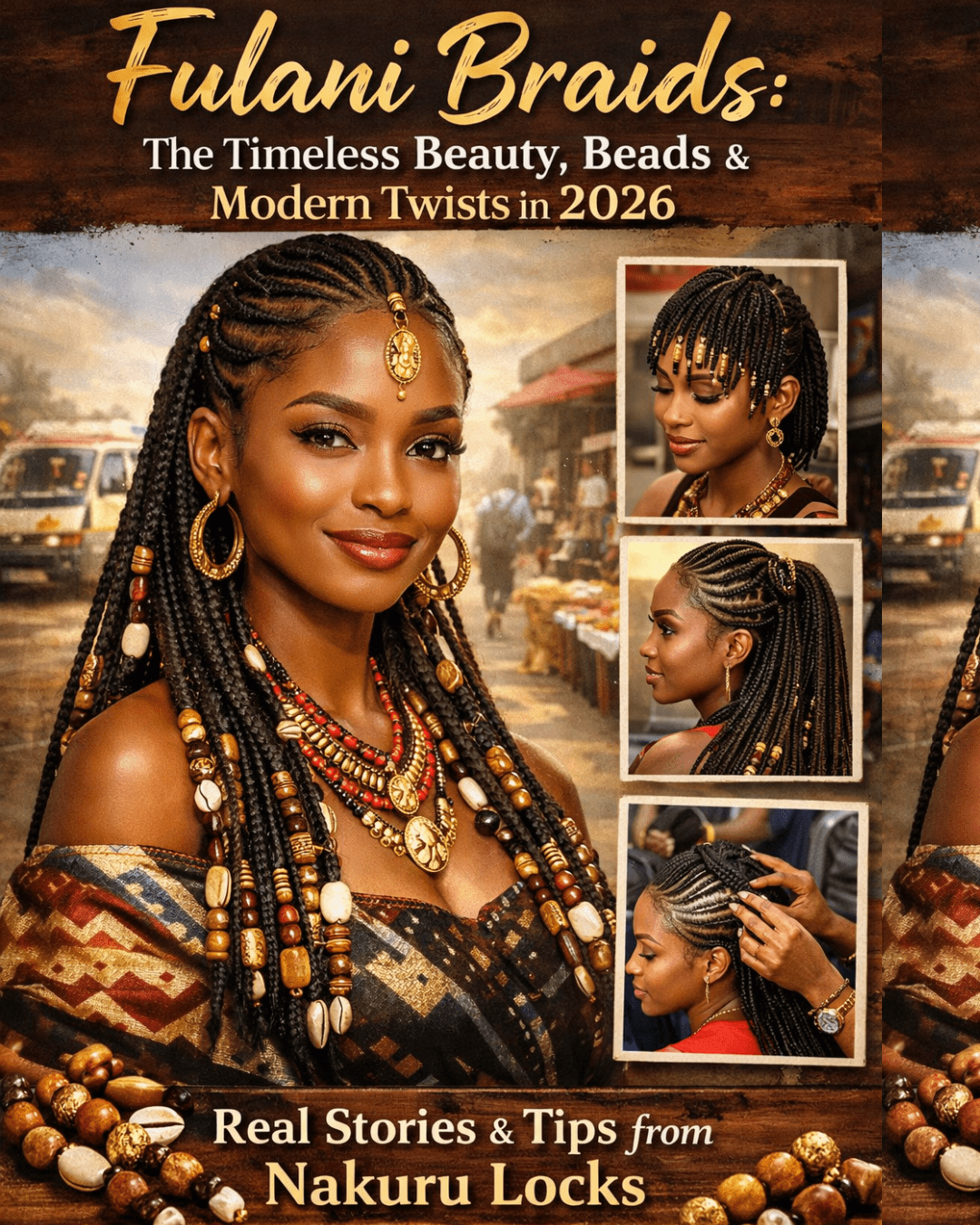
I smiled and started sectioning her hair as we talked. That day we created one of my favorite sets — thin cornrows mapping elegant lines across her scalp, a high ponytail of braids flowing down her back, and rows of delicate beads clicking softly every time she moved. When she looked in the mirror, her whole face lit up. That quiet transformation — from nervous curiosity to radiant pride — is why I still get emotional after 13 years behind this chair.
What Are Fulani Braids? The Cultural Roots & Modern Magic
Fulani braids are a traditional African hairstyle originating from the Fulani (Fulbe) people of West Africa — particularly Nigeria, Senegal, Guinea, and Mali. They are characterized by thin, neat cornrows that create geometric patterns across the scalp, often with a high ponytail or cascading braids, and almost always adorned with beads, shells, or metal accents.
Unlike box braids or knotless styles that focus on uniform thickness, Fulani braids emphasize artistry — the lines are precise, the patterns intentional, and the beads tell a story. In Kenya, especially in Nakuru, they’ve become a powerful fusion: traditional Fulani technique meets local Swahili and Maasai beadwork, creating looks that feel both ancient and completely now.
At Nakuru Locks and Braiding, we’ve observed that Fulani braids are the most requested style for cultural events, graduations, and weddings in 2026 — women want to honor heritage while still looking editorial and fresh.
Types of Fulani Braids: From Classic to Contemporary
1. Classic Fulani (Traditional)
Thin cornrows in curved or zigzag patterns, high ponytail of braids, heavy beading (cowrie shells, wood, gold). Rooted in Fulani tradition — regal, meaningful, timeless.
2. Beaded Fulani Braids
The signature look — every braid tip or mid-section adorned with beads. Modern twist: mix wooden, acrylic, and metallic beads for dimension. Most popular in Nakuru right now.
3. Short Fulani Braids with Beads
Chin-length or bob-length braids with cornrow base and beaded ends. Perfect for low-maintenance queens who still want the Fulani elegance.
4. Fulani with Weave
Human or synthetic hair added for length and volume. Keeps the signature Fulani patterns but allows waist-length or longer styles — ideal for special occasions.
5. Modern Fusion Fulani
Knotless base + Fulani patterns + colored extensions or ombre + chunky beads. Edgy, youthful, TikTok-famous version we do a lot in 2026.
Difference Between Fulani and Tribal Braids
Fulani braids are a specific cultural style from the Fulani people — thin cornrows, geometric patterns, high ponytail, heavy beading.
Tribal braids is a broader, modern umbrella term — any intricate African-inspired cornrow design (e.g., Ghana braids, Senegalese patterns, Maasai-inspired). Fulani is one type of tribal braid, but not all tribal braids are Fulani.
In Nakuru salons, “tribal braids” often means bold, colorful designs — while clients specifically asking for Fulani want the classic thin lines and bead-heavy aesthetic.
How Long Do Fulani Braids Take? Realistic Timeline
Classic/Traditional Fulani: 4–7 hours (thin cornrows + beading takes time).
Short Fulani Braids with Beads: 2.5–4 hours.
Fulani with Weave (long): 6–9 hours.
Modern Fusion: 5–8 hours depending on complexity.
At Nakuru Locks and Braiding, we always do a consultation first — we’ll give you an exact time based on your hair length, thickness, and bead choice. Beading adds 1–3 hours but makes the style last longer (6–10 weeks with care).
Fulani Braids with Beads: How We Make Them Special
Beads are the soul of Fulani braids. We use:
- Wooden & cowrie shells — cultural, earthy
- Gold & metallic — modern luxury
- Acrylic & crystal — playful, trendy
- Custom mixes — client’s birthstone or wedding colors
We’ve seen clients cry happy tears when they see the finished look — the beads click softly when they move, like a personal soundtrack of pride.
Nakuru Locks 3-Step Fulani Care Routine
1. Daily moisture — light oil spritz on scalp & braids.
2. Night protection — satin bonnet to prevent frizz & bead tangling.
3. Weekly refresh — edge control + bead tightening if needed.
Many clients report vibrant beads and neat lines lasting 8–10 weeks.
Before/After: What You’ll Really See
Week 1: Fresh, tight, beads shining.
Month 3: Still neat, new growth minimal, beads intact.
Month 6+: Time to remove — edges healthy, length retained.
Warnings & When to See a Pro
Pain >3 days, redness, bald patches? Remove immediately — traction alopecia risk. See dermatologist if persistent. We always check scalp health first.
Your Fulani Braids Checklist
- Daily: Oil spritz, bonnet at night
- Weekly: Edge refresh, bead check
- Monthly: Salon retouch if needed
- Week 8–10: Book removal
FAQ – Fulani Braids Questions We Hear Every Day
Thin cornrows in artistic patterns, high ponytail, heavy beading — traditional Fulani style.
4–9 hours depending on length, thickness, and beading.
Fulani is specific Fulani pattern + beads; tribal is broader African-inspired braids.
Yes — chin-length or bob Fulani with beaded ends looks stunning.
Very — adds length/volume while keeping signature Fulani patterns.
Ready for Your Own Fulani Masterpiece?
Book Your Fulani Braids Today
WhatsApp Us NowAddress: Mt. Sinai building, Bazaar Rd, Nakuru City, Kenya
Phone: 0723 168 188
WhatsApp: +254 723 168 188
Email: ann@nakurulocksandbraiding.com
References
- Journal of Cosmetic Dermatology (2023). Protective styles and traction alopecia.
- American Academy of Dermatology (2024). Protective hairstyles guide.
- Byrd & Tharps (2014). Hair Story – cultural significance of African braiding traditions.
Leave a Reply