
German Braid: What It Is, How to Do It & Why Nakuru Loves It in 2026
What is a German braid? Easy German braid tutorial, history, styles, and German braid vs Dutch braid vs French braid – real salon guide from Nakuru Locks.
It was one of those breezy Nakuru afternoons — the kind where the wind slips softly through the windows and the salon feels calm, almost unhurried.
Then Sarah walked in. Early 20s, university student from London, home for the holidays. She sat in my chair, pulled out her phone, and showed me a photo of a sleek, raised braid running down the center of a girl’s head. “Ann,” she said, “I keep seeing this everywhere — they call it a German braid? Can you do it for me? I want something different for my cousin’s wedding, but I don’t even know what it really is.”
I smiled and gently ran my fingers through her thick, freshly washed 4C hair. “Let me show you,” I said. “It’s not actually German — but it’s beautiful, and it’s perfect for Nakuru weather.”
That afternoon we created her first German braid — raised, clean, elegant. She left glowing, and I’ve lost count of how many brides, students, and working women have asked for the same style since. This is the story of the German braid — what it is, where it came from, how to do it right, and why it’s having a moment in 2026.
What Is a German Braid? (And Why It’s Not Actually German)
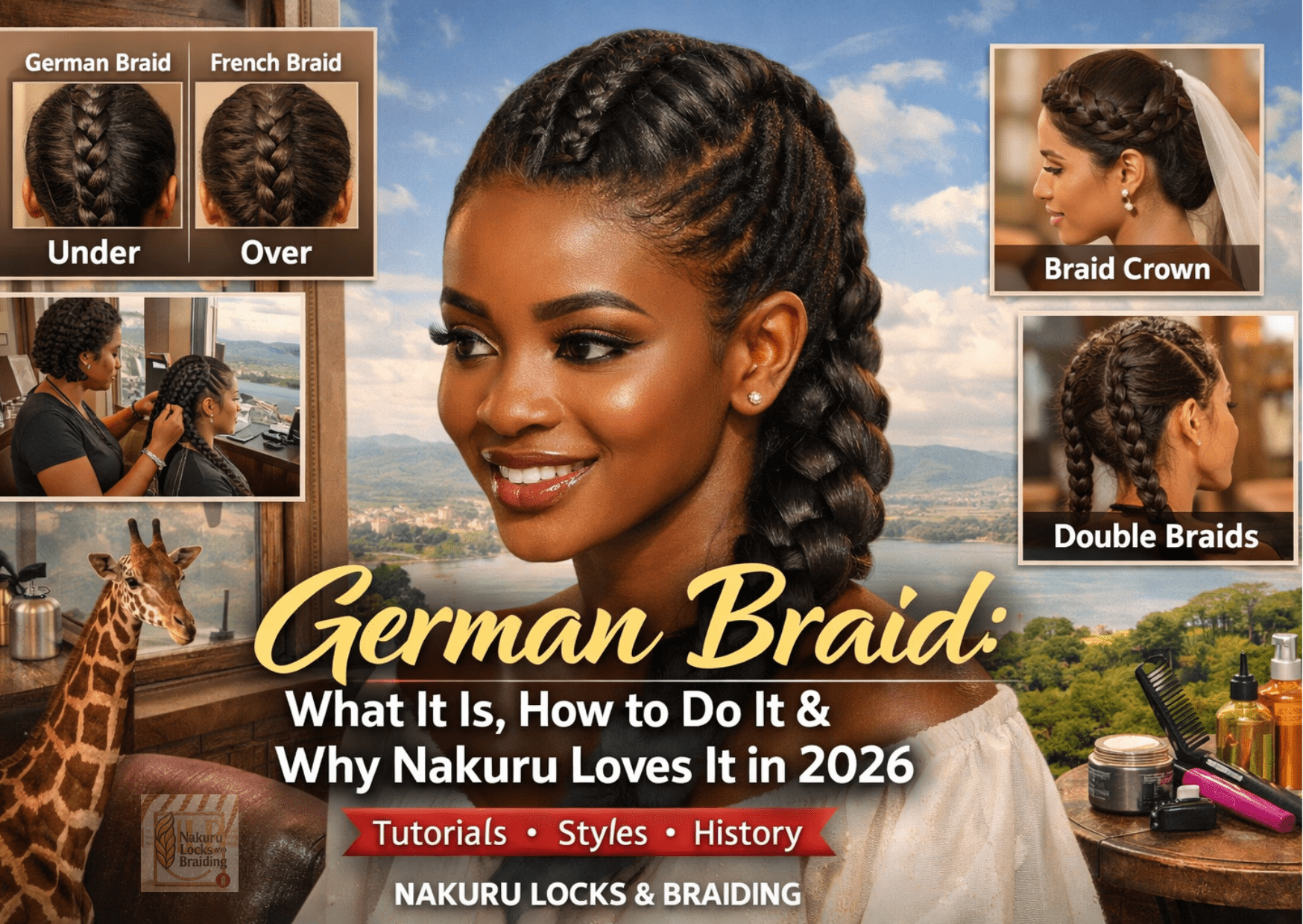
A German braid is a raised, inverted braid — similar to a Dutch braid but with a key difference: the strands are crossed **under** the middle strand instead of over. This creates a 3D, rope-like effect that sits proudly on top of the head rather than lying flat like a classic French braid.
Despite the name, the “German braid” has no documented origin in Germany. It’s most likely a modern English-language term that emerged in beauty blogs and YouTube tutorials in the 2010s, possibly as a way to distinguish it from the flat French braid and the similar-but-not-identical Dutch braid. In many parts of the world (including Kenya), stylists simply call it a “raised braid” or “inside-out braid.”
At Nakuru Locks and Braiding, we’ve observed that the German braid has become especially popular among younger clients who want a style that looks intricate and elegant but takes only 10–15 minutes once you master the technique.

German Braid History: From Folklore to Modern Trend
While the exact “German braid” label is recent, the technique of raised, inverted braiding has roots in many cultures. Similar styles appear in traditional Scandinavian, Eastern European, and even some African braiding practices where raised plaits were used for ceremonial or practical purposes (keeping hair off the neck in hot climates).
The modern resurgence began around 2012–2015 when beauty influencers started posting “Dutch braid” and “German braid” tutorials, creating a naming distinction that didn’t exist in traditional hairstyling books. Today, it’s one of the most requested protective-yet-decorative styles in salons across Kenya — especially for school events, weddings, and casual chic looks.
German Braid Tutorial: Step-by-Step for Beginners
You’ll need: detangled hair, a tail comb, small clear elastics, and a mirror (or friend).
- Prep the hair: Brush thoroughly. Optional: add light mousse or gel for grip.
- Section a triangle: Take a triangle of hair from the front hairline (forehead to just behind the ears).
- Start the braid: Divide into three equal sections. Cross the **right** strand **under** the middle, then the **left** strand **under** the new middle.
- Add hair: Each time you cross under, pick up a small section from the side and add it to the strand before crossing under again. Keep adding consistently.
- Continue to nape: Keep tension even. When you reach the nape, continue braiding normally (no more adding hair).
- Finish: Secure with elastic. Tug gently on the sides to “pancake” and make it look fuller.
- Pro tip from Nakuru Locks: For thicker hair, start with slightly damp hair — holds better in humid Nakuru weather.
How long does it take? Beginners: 15–25 min. Experienced: 8–12 min.
German Braid Styles: Everyday & Special Occasion Looks
1. Classic Single German Braid
One thick raised braid down the center — clean, timeless, perfect for work or school.
2. Double German Braids (Pigtails)
Two parallel raised braids — sporty, youthful, very popular among Nakuru campus girls.
3. German Braid Crown
Two German braids wrapped around the head like a halo — elegant for weddings or church.
4. German Braid Ponytail
German braid from front to crown, then ponytail — modern, chic, great for photoshoots.
5. German Braid with Extensions
Add Kanekalon for length — dramatic, long-lasting, perfect for events.
German Braid vs Dutch Braid vs French Braid: Quick Comparison
| Feature | German Braid | Dutch Braid | French Braid |
|---|---|---|---|
| Crossing direction | Under middle | Under middle | Over middle |
| Appearance | Raised, 3D, rope-like | Raised, 3D, rope-like | Flat, embedded |
| Difficulty | Medium | Medium | Easiest |
| Best for | Statement looks, volume | Braids that pop | Everyday, sleek |
Quick rule: If it sits on top and looks raised → German or Dutch. If it sits flat → French.
Nakuru Locks Best Practices for German Braids
Our 3-step approach: Prep with light gel for grip, braid with even tension (never too tight), finish with light oil spray for shine. Many clients report their German braids last 5–7 days longer when we use this method. We personalize: finer hair gets smaller sections; thicker hair gets looser tension to avoid headaches.
Warnings & When to See a Pro
Too-tight braids can cause traction alopecia — loosen immediately if painful. Redness, itching, or bumps? Remove and see a dermatologist. Always start with clean, detangled hair.
Practical Checklist: Master Your German Braid
- Before braiding: Detangle, apply light gel
- During: Keep tension even, add consistent sections
- After: Pancake gently, spray shine mist
- Daily care: Satin bonnet at night, light oil on edges

Read More Related Articles
Ready to Try Your First German Braid?
Book Your German Braid Appointment Today
WhatsApp Us NowAddress: Mt. Sinai building, Bazaar Rd, Nakuru City, Kenya
Phone/WhatsApp: 0723 168 188
Email: ann@nakurulocksandbraiding.com
Leave a Reply