
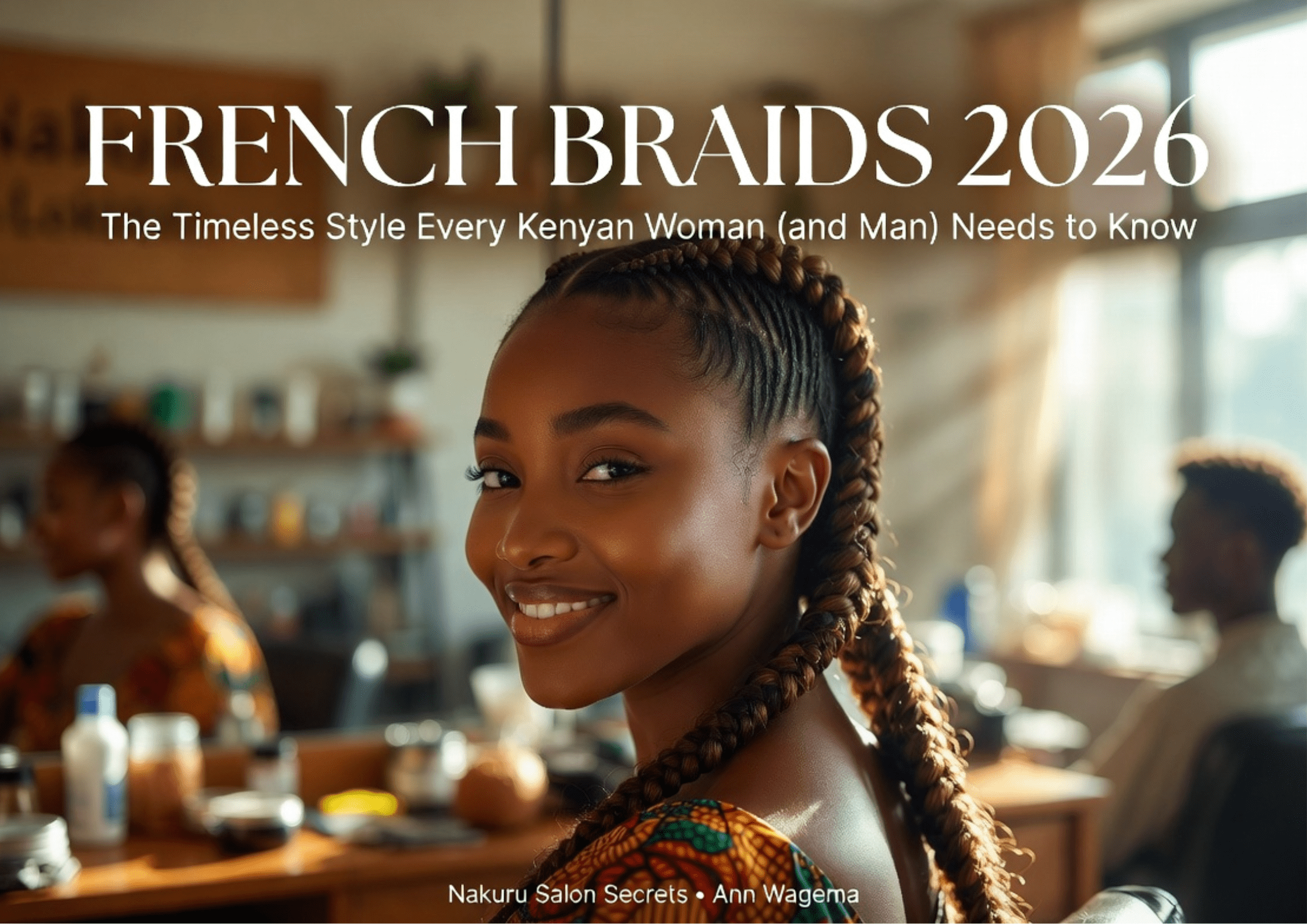
French Braids 2026: The Timeless Style Every Kenyan Woman (and Man) Needs to Know
French braids, braided french braids, how to do french braids step by step, 2 french braids, dutch vs french braids, french braids on curly hair – real Nakuru salon secrets.
The salon was filled with the soft afternoon light of Nakuru, the scent of fresh coconut oil, and the gentle sound of fingers weaving through hair. A young teacher from Kiamunyi sat in my chair, holding her phone up with a photo of elegant double french braids cascading down her back.
“Ann,” she said with a mix of excitement and nervousness, “I want to learn how to do french braids on myself. I see everyone doing braided french braids, french braids in a ponytail, even french braids half up half down. But every time I try, it looks messy. Can you teach me the real way — the Nakuru way?”
I smiled. Thirteen years at Nakuru Locks and Braiding have taught me that French braids are more than just a hairstyle — they are a skill that gives women confidence, versatility, and that effortless “I woke up like this” elegance. From simple french braids to elaborate styles with extensions, this classic technique has never gone out of fashion in Kenya.
What Are French Braids? The Classic That Never Ages
French braids (also called French plaits) are a three-strand braid that starts at the crown and incorporates small sections of hair from each side as you move down. Unlike a regular braid, new hair is added with every stitch, creating a seamless, tight, and beautiful pattern that lies flat against the scalp.
At Nakuru Locks and Braiding, we’ve observed that french braids hairstyle are loved because they are protective, long-lasting (5–7 days with proper care), and work beautifully on all hair types — straight, wavy, curly, and even coily 4C hair.
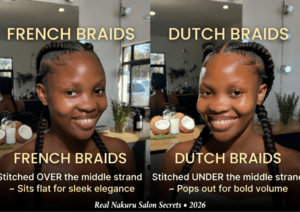
Dutch vs French Braids – What’s the Difference?
Many clients ask us: “What’s the difference between dutch braids vs french braids?”
French braids are stitched “over” the middle strand (the braid sits flat against the head). Dutch braids are stitched “under” the middle strand (the braid pops out, creating a raised, 3D effect). Both are beautiful — French for sleek elegance, Dutch for bold volume.
How to Do French Braids Step by Step – Easy Tutorial
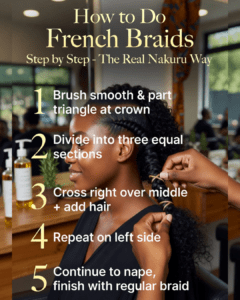
How to french braids step by step (for beginners):
- Brush hair smooth and part a small triangle at the crown.
- Divide into three equal sections.
- Cross the right strand over the middle, then left over middle.
- Add a small section of loose hair to the right strand, cross over middle.
- Repeat on the left side, adding hair each time.
- Continue to the nape, then finish with a regular braid.
Practice on yourself using a mirror or ask a friend to help the first few times. We teach this exact method in our salon workshops.
Beautiful Styles with French Braids You’ll Love in 2026
French braids are incredibly versatile. Here are the most popular looks we create at Nakuru Locks:
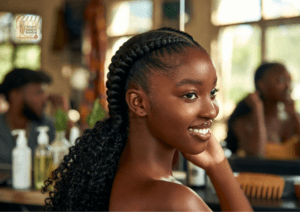
- 2 French Braids (Double French Braids) – Two parallel braids down the back or pigtails. Perfect for school, sports, or casual days.
- French Braids in a Ponytail – Braid from the front, gather into a high or low ponytail. Elegant and practical.
- French Braids Half Up Half Down – Two side braids meeting at the back, with the rest flowing free. Romantic and wedding-ready.
- French Braids into a Bun – Braid to the nape then twist into a neat bun. Sophisticated for work or events.
- French Braids with Extensions – Add length and volume for dramatic waist-length looks.
- French Braids on Curly Hair – Works beautifully on 3C–4C textures — just use a bit more gel for definition.
- French Braids on Guys – Crown or side-swept french braids for men who want a clean, modern Viking-inspired look.
- French Braids Pigtails – Playful double braids with beads or ribbons for younger girls or fun weekends.
Practical Tips for Long-Lasting French Braids
– Use a light gel or edge control for neat parts.
– Keep tension even — too tight causes headaches and breakage.
– Sleep with a satin bonnet or scarf.
– Mist lightly with water + leave-in daily to prevent frizz.
Nakuru Locks 3-Step French Braid Care Routine
1. Moisturise scalp daily with our rosemary spray.
2. Gentle wash every 7–10 days (diluted shampoo on cotton pads).
3. Retouch or redo every 5–7 days for freshness.
Many clients report their french braids stay neat and scalp-healthy for a full week.
Before/After Expectations & Timeline
Week 1: Fresh, tight, polished look.
Week 4: Still neat with minimal new growth showing.
Month 3: Edges protected, hair healthier from less manipulation.
Warnings & When to See a Pro
If you feel pain, itching, or notice bumps, loosen the braids immediately. Persistent tension can cause traction alopecia — see a dermatologist if edges thin or scalp becomes inflamed.
Your French Braids Checklist
- Morning: Light mist + edge refresh
- Weekly: Gentle cleanse + satin bonnet
- Every 5–7 Days: Retouch or redo

FAQ
Start at crown, add hair to each strand as you braid down. Practice on yourself or a friend.
French braids sit flat; Dutch braids pop out for 3D effect.
Yes! Use gel for definition and braid slightly looser.
5–7 days with good care; up to 10 days with extensions.
Yes — start with 2 french braids and practice daily.
Ready to Master French Braids?
Book Your French Braid Session Today
WhatsApp Us NowAddress: Mt. Sinai building, Bazaar Rd, Nakuru City, Kenya
Phone/WhatsApp: 0723 168 188
Email: ann@nakurulocksandbraiding.com
Read More from Nakuru Locks
Natural Afro Hair Styles | Lush Braids Kenya | Arafa Braids Price in Kenya
References
- Journal of Cosmetic Dermatology (2023). Protective braiding techniques.
- American Academy of Dermatology (2024). Traction alopecia prevention.
- International Journal of Trichology (2022). Scalp tension in braided styles.
Leave a Reply