
First Dreadlocks Hairstyles: How to Start, What They Look Like, and the History Behind Locs
At Nakuru Locks and Braiding, we often hear the same question from clients sitting in our styling chairs: “Will my hair ever look like that, or am I stuck in this ‘awkward’ phase forever?”
It is a moment of vulnerability—the beginning of a transformation. Whether you are driven by a desire to embrace your natural texture, a spiritual connection to your heritage, or simply the search for a low-maintenance, high-impact aesthetic, starting your first set of dreadlocks is a journey. It is a transition from the structured world of loose hair to the organic, sculptural beauty of locked hair.
This guide is designed to walk you through the history, the science of the “starter” phase, and the professional techniques we use here in Nakuru to help you bloom into your best, most authentic self.
The Timeless Tapestry: When Did Dreadlocks Begin?
Dreadlocks, or “locs,” are one of the oldest hairstyles in human history. They are not a modern invention but a global, cross-cultural phenomenon.
Who Had Dreadlocks First?
The question of who “owned” the style first often pits cultures against one another, but history shows us that locks are a universal human expression.
-
Ancient Evidence: Artifacts suggest that dreadlocks were worn by people in the Sahara as early as 3000 BCE. Similarly, ancient Egyptian mummies, including those of nobles like Maiherperi (c. 1400 BCE), have been found with locked hairstyles.
-
Religious Significance: In India, the Vedas (1500–1000 BCE) provide the earliest written evidence of locks, worn by sadhus (holy men) as a sign of renouncing vanity. In the Mediterranean, early Christian priests and various figures in Judaism (such as the Nazarites) were also known for maintaining their hair without cutting or combing it.
-
The Viking vs. African Debate: While popular media often portrays Vikings with rugged, matted hair or specific “elflocks,” there is no historical consensus that they wore full-head dreadlocks as a cultural standard. Conversely, African traditions—from the Maasai of Kenya to the Ethiopian Coptic priests—have maintained unbroken lineages of locked hair for millennia.
Ultimately, locs are a human story—a testament to hair in its most raw, natural state.
What Do Dreadlocks Look Like at First?
If you are just beginning, manage your expectations: The “starter” phase is an adjustment.
In the first few weeks, your scalp may feel more exposed, and your locs may feel delicate. Because the hair is not yet fully matted, it is prone to unraveling. You will notice that your roots might feel tighter than the ends, and your hair will likely go through a “fuzzy” stage.
What to expect in the early months:
-
The Fuzz Phase: As your hair begins to tangle and mat, it will naturally create frizz. This is not “bad” hair; it is the formation process.
-
Sensitivity: Your scalp may be tender. We recommend gentle, moisturizing care rather than heavy manipulation.
-
Growth Spurt: Paradoxically, many clients notice their hair feels like it grows faster in the first few months because the roots are holding tighter than they will once the locs reach full maturity.
Best Hairstyles for Starting Dreadlocks
How you start your locs dictates your journey. Here are the most effective ways to initiate the process:
-
Comb Coils: Best for hair that is 2–3 inches long. This method creates clean, cylindrical locs that eventually mature into a uniform look.
-
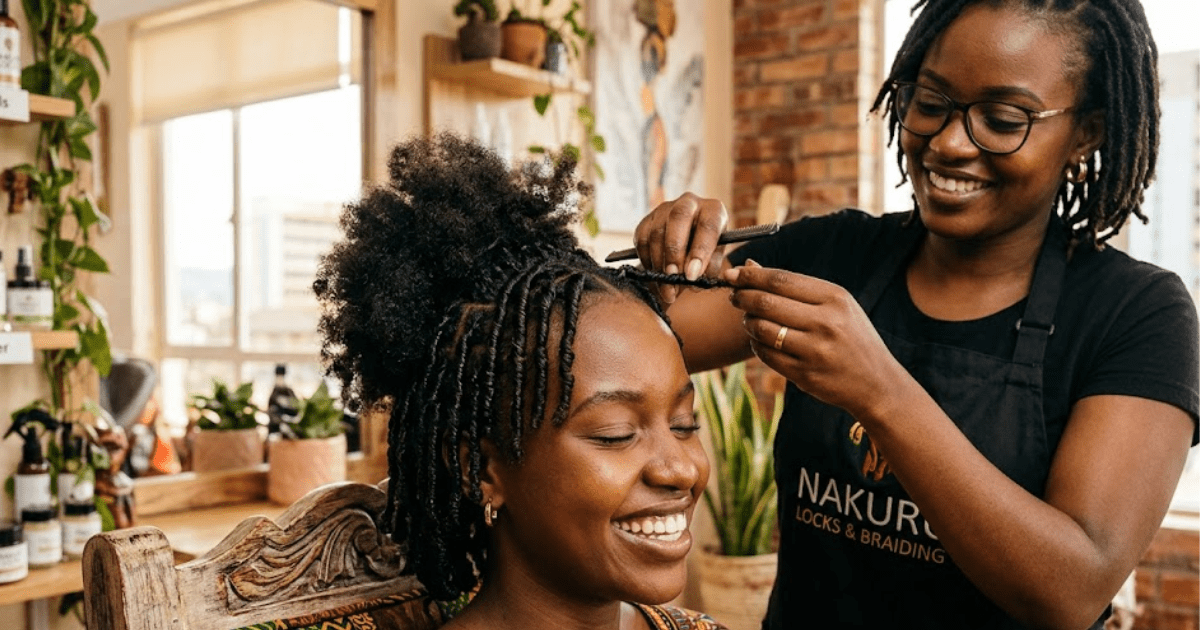
Two-Strand Twists: A favorite at Nakuru Locks and Braiding. They offer a polished look from day one and hold together better than coils for many hair textures.
-
Braided Locs: Perfect for those who want a more secure foundation. The hair is braided from root to tip, providing a pattern for the hair to lock around.
-
Freeform Locs: The most organic method. By using little-to-no manipulation or product, you allow your hair to find its natural locking pattern. This is a journey of patience and self-acceptance.
The 7 Types of Locs You Should Know
The term “dreadlocks” is an umbrella for a world of variety. Depending on your lifestyle and aesthetic, here are seven common ways to define your style:
-
Traditional/Classic Locs: Formed by twisting, interlocking, or palm rolling. These are the “standard” rope-like locs.
-
Freeform Locs: Allowed to grow and mat naturally with minimal interference.
-
Semi-Freeform Locs: A balance between structure and nature; you get them retwisted occasionally, but allow the mid-lengths to lock at their own pace.
-
Sisterlocks/Micro-locs: Tiny, uniform locs created with a specialized interlocking tool. They are extremely versatile and look like loose hair in terms of styling options.
-
Faux Locs: A protective style where extensions are wrapped around your natural hair to mimic the look of mature locs without the long-term commitment.
-
Braided Locs: Created by starting with a braid base, often used for those with softer hair textures that don’t hold a twist easily.
-
Wavy/Crinkle Locs: Achieved by braiding wet locs and letting them dry, creating a textured, voluminous appearance.
Professional Tips for Your First Year
At Nakuru Locks and Braiding, our philosophy is rooted in trichology-informed care. We believe your locs should never cost you your scalp health.
-
Moisture is Key: Dry hair breaks. Use light, natural oils like locally sourced Kenyan shea butter or jojoba oil to keep your scalp and hair hydrated.
-
The Sunday Appointment: Life is busy. We now offer Sunday sessions by appointment only to ensure you get the focused, one-on-one attention your hair deserves.
-
Mobile Users: If you are booking through our portal, please rotate your device to landscape mode. Our system is optimized for a wider view!
Frequently Asked Questions (FAQ)
Q: How long does it take for locs to mature?
A: Typically, it takes 10–24 months for locs to become fully “rooted” and mature.
Q: Can I wash my hair while starting locs?
A: Yes! Regular washing with a gentle, residue-free shampoo is essential to prevent buildup. Just be careful not to scrub too vigorously, which can cause unraveling.
Q: Do white people historically have dreadlocks?
A: Historically, yes. Various European cultures, such as the Irish (Glib hairstyle) and Slavic cultures (Polish plait), have documented traditions of matted or locked hair, often associated with spiritual or protective symbolism.
Q: How often should I retwist?
A: Generally, every 2–4 weeks is sufficient. Over-manipulation can lead to thinning at the root.
Ready to Begin?
Your hair is a crown, and at Nakuru Locks and Braiding, we are here to help you cultivate it with precision and care. Whether you are coming in for your first set of coils or a professional retwist, we are located at the Mt. Sinai Building, Bazaar Road, Nakuru City.
Let’s start your journey today.
Related Articles by Nakuru Locks and Braiding:
Disclaimer: This article is for informational purposes. For personalized hair care advice, please visit us in Nakuru for a professional consultation.
Leave a Reply