
Bob Loc Styles: The Complete Global Guide to Loc Bob Cuts, Curls, Bangs, and More
There’s a moment every loctician knows well. A client sits down, hands resting in her lap, hip-length locs pooled around the chair like a curtain she has spent a decade weaving.
She’s not here for a retwist. She’s here to ask the question that makes even seasoned stylists pause: “Can you cut them into a bob?”
It sounds simple. It isn’t. Locs aren’t hair extensions you can trim and reshape at will — each strand is years of commitment, hydration routines, scalp care, and patience matted into a single rope of identity.
Cutting into that history takes technical skill and an honest conversation about what the client actually wants: less weight on the neck, a fresher silhouette, easier washing, or simply a new chapter after years of the same look.
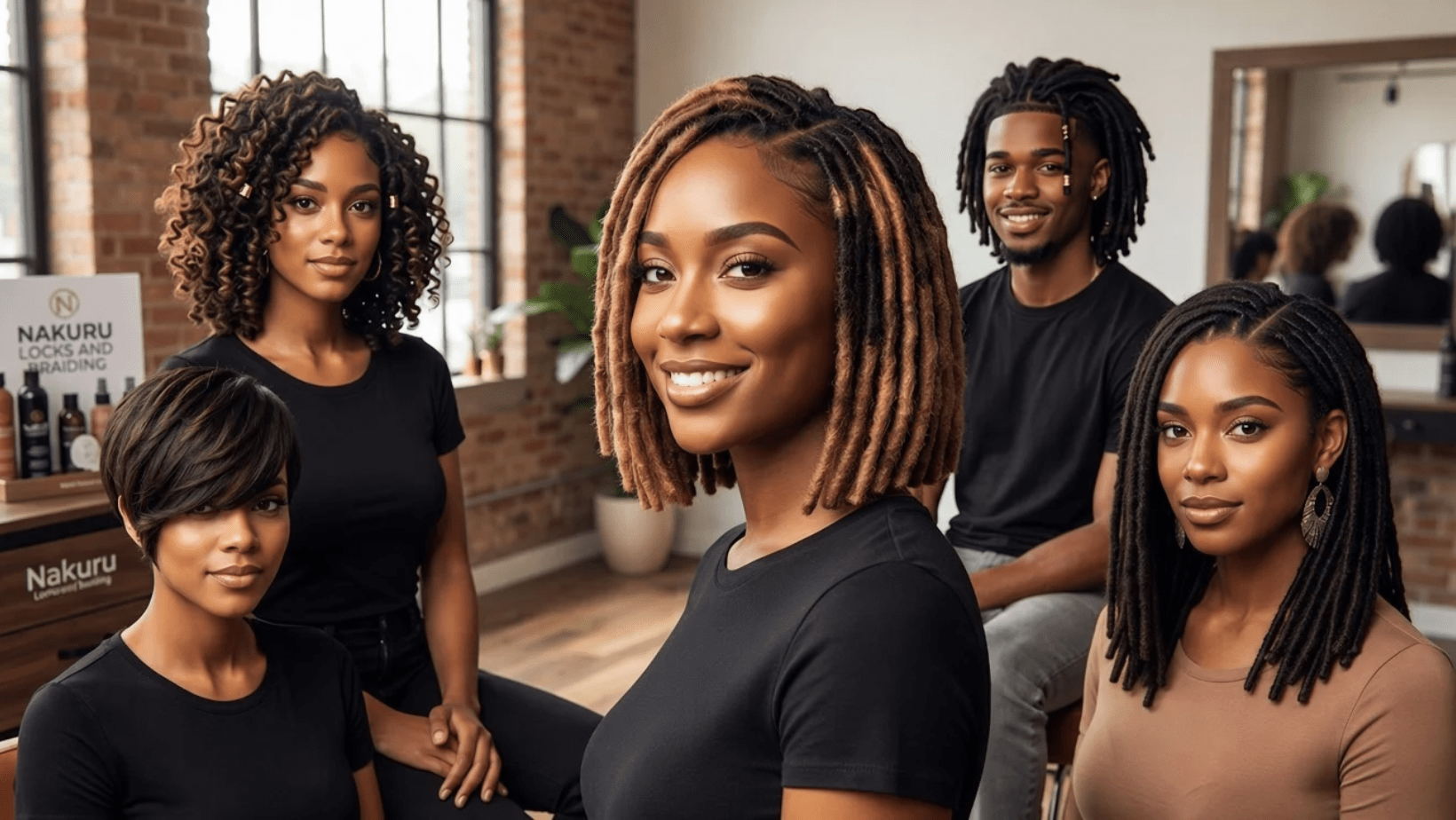
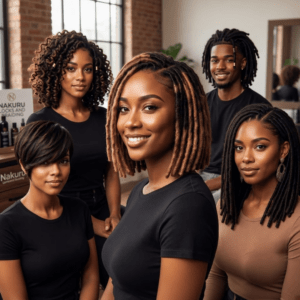
This is the story behind one of the fastest-growing requests we get at Nakuru Locks and Braiding: bob loc styles.
Across Nairobi, Nakuru, London, Atlanta, and Toronto, the loc bob has quietly become one of the defining protective hairstyles of the decade — a style that borrows the clean, face-framing geometry of the classic bob and fuses it with the texture, culture, and low-maintenance appeal of locs.
Industry trend reports describe it as one of the most sought-after protective styles of the year, prized because it bridges the gap between short, cropped looks and long, flowing locs while remaining easy to maintain through the week.
In this guide, we’ll walk through every major bob loc variation our clients ask for — from short loc bob cuts to shoulder-length looks, curled ends, bangs, long loc bobs, and the increasingly popular bob dreads for men — with practical guidance, styling context, and the research behind healthy loc maintenance.
Whether you’re a first-time visitor to Nakuru or a long-time client planning your next cut, consider this your reference before you sit in the chair.
What Exactly Is a Loc Bob?
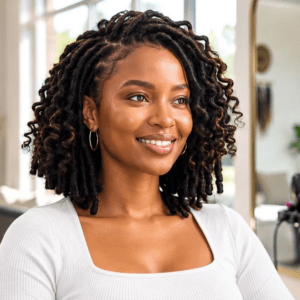
A loc bob (also called a dreadlock bob, bob dreads, or “locs bob”) is any dreadlock or loc hairstyle cut and styled to sit at or above shoulder length, mimicking the silhouette of a traditional bob haircut.
Rather than growing locs indefinitely, clients choose a chin-length, jaw-length, or shoulder-grazing cut that frames the face while keeping the length manageable.
One detailed style guide describes it well: the loc bob combines the timeless elegance of a bob haircut with the cultural depth and texture of locs, and it works whether you’re rocking natural, mature locs or trendy extensions like butterfly or faux locs — the bob length simply offers a refreshing change that frames the face while remaining easy to maintain throughout the week.
The appeal isn’t purely aesthetic. Locticians and salon-trend analysts note that clients today want movement — the days of uniformly blunt, static loc lengths are fading, replaced by cuts that add volume and shape, especially for women wanting a softer silhouette.
That single shift in demand is what has pushed loc-specific cutting services — not just installation — into salon menus everywhere, Nakuru Locks and Braiding included.
Short Loc Bob Cuts
The short loc bob is the boldest expression of the trend: locs cut to chin length or above, often paired with a defined shape around the face.
It’s popular among clients transitioning out of very long, heavy locs who want to preserve their loc texture while dramatically reducing weight, wash time, and styling effort.
Short bob loc styles work particularly well for:
- Clients recovering from tension-related scalp sensitivity, since shorter, lighter locs place less pull on the hairline.
- Professionals who want a polished, low-maintenance look for office or client-facing settings.
- Anyone re-starting their loc journey after a “loc detox” or big chip (a partial cut rather than a full loc removal).
Micro and small-diameter locs are especially well-suited to short bob shapes right now.
Fine, precision-crafted locs are frequently cut into chic, chin-length shapes that mimic the movement of loose hair — a style popular specifically because it allows for intricate styling while keeping the hair off the shoulders.
You can tuck a few pieces behind the ear for a casual look, or wear it full for a dramatic finish.
Bob Loc Styles For Ladies
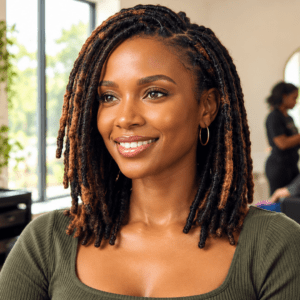
While men absolutely wear bob-length locs too (more on that below), “bob loc styles for ladies” has become its own search category because women make up the overwhelming majority of loc-bob clients — and the styling options for women are considerably broader, spanning color, parting patterns, and accessory work.
For our female clients, we typically build the consultation around four questions:
1. Length — chin, jaw, or shoulder?
2. Texture — sleek and defined, or soft and curled at the ends?
3. Fringe — do you want bangs framing the face, or a middle/side part?
4. Maintenance rhythm — how often can you realistically come in for a retwist or refresh?
Popular ladies’ bob loc variations include the sisterlocks bob (fine, uniform micro-locs styled into a bob for a sophisticated, professional finish), the faux locs bob (synthetic hair wrapped around natural strands for a temporary loc effect without the long-term commitment), and the classic freeform bob (locs allowed to mat naturally, then cut and shaped, embracing texture variation strand to strand).
Shoulder Length Loc Bob Cuts and Styles
The shoulder-length loc bob is the most requested length at Nakuru Locks and Braiding, and for good reason — it’s the “goldilocks” length.
Long enough to style into buns, half-updos, or side-swept looks; short enough to avoid the washing and detangling fatigue that comes with waist-length locs.
Shoulder-length loc bobs also age gracefully with the loc-thickening process.
As locs mature, they naturally become denser and slightly shorter in visual “hang,” so a cut that lands at the shoulder today often settles into a flattering collarbone-grazing length within a few months — a detail we walk clients through during consultation so nobody is surprised by natural loc shrinkage.
This length is also the easiest to transition in and out of. Clients who eventually want to grow their locs longer again can simply let a shoulder-length bob grow out without another dramatic cut, while clients who want to go shorter can trim up from here in small increments rather than committing to a drastic chop.
Loc Bob Styles With Curls
Soft, curled ends are one of the biggest movements in loc styling this year. Instead of blunt, straight-cut tips, stylists are increasingly finishing bob locs with curled or wavy ends — a look achieved through perm rods, flexi-rods, curl-defining creams, or careful use of low heat on the last inch or two of each loc.
This technique works especially well with lightweight synthetic blends and human-hair loc extensions, giving the bob a bouncier, more romantic finish that contrasts nicely with the structure of the cut itself.
For clients who want the tidiness of a bob but the softness of curls, this is consistently our most-photographed finish.
A few tips we give clients maintaining curled loc-bob ends at home:
- Re-curl only the ends, not the full loc, to avoid stressing the root and scalp.
- Use a light, water-based curl cream rather than heavy butters, which can weigh curls down and cause premature dropping.
- Sleep with a satin or silk bonnet/pillowcase to preserve curl definition and reduce frizz and friction — a basic hair-health habit dermatology-focused hair guidance consistently recommends for textured and treated hair.
Loc Bob With Bangs
Bangs (a fringe) bring a completely different energy to a loc bob — softer, more youthful, and highly customizable depending on face shape. We typically style loc bangs in one of three ways:
- Curtain bangs: parted in the center and swept to either side, softening the forehead while keeping the rest of the bob’s structure intact. Flattering for round and square face shapes.
- Blunt, full bangs: a straight line of shorter locs across the brow — a striking, editorial look best suited to oval or longer face shapes.
- Side-swept bangs: a diagonal fringe blended into the rest of the bob, ideal for clients who want a fringe without fully committing to one across the whole forehead.
Because bangs sit closest to the hairline and face, they require slightly more frequent maintenance than the rest of the bob — the ends are visible and grow out of shape faster than longer sections. We recommend a check-in every four to six weeks to keep the fringe crisp.
Long Loc Bob Styles
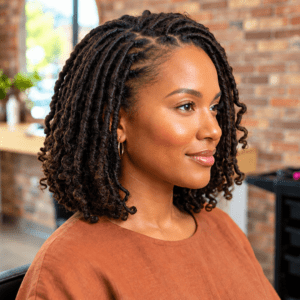
“Long loc bob” sounds like a contradiction, but it refers to a bob-length cut on locs that were previously very long — meaning the cut still lands at or below the shoulder, but the locs themselves are thick, mature, and full-bodied from years of growth.
The result is a bob with significantly more volume and visual weight than a bob started from shorter, younger locs.
Long loc bobs are popular with clients who have invested years into their locs and want a length change without losing the density and maturity their locs have developed.
Because mature locs already have solid, well-formed cores, a long loc bob also tends to hold its shape and curl pattern (if styled with curled ends) longer between salon visits than a bob cut from newly-started locs.
Bob Dreads Male: Styles for Men
Bob-length dreadlocks aren’t exclusive to women. Men’s dreadlock trends have moved well beyond uniform, waist-length locs, and bob-length cuts are now a firm part of that evolution — modern styles increasingly blend classic loc techniques with contemporary haircut elements for a bold, updated look, including pairing bob-length locs with fades, tapers, or lined-up hairlines.
For men, the loc bob usually falls into one of three categories:
- Bob with a fade or taper: locs left longer and bob-length on top, tapered or faded at the sides and back for a sharp, contemporary contrast.
- Blunt bob dreads: an even, chin-to-jaw length cut straight across, popular for a clean, professional look that still allows locs to be worn down.
- Textured bob dreads: locs of slightly varying lengths cut into a rough, undone bob shape for a more casual, lived-in aesthetic.
Salon-floor experience backs this up too — loctician content across social platforms regularly features “male loc bob” transformations, underscoring that this is a mainstream men’s request, not a niche one.
Why Clients Choose the Loc Bob: The Real Benefits
Beyond the aesthetics, there are practical reasons the loc bob has become a go-to protective style:
- Reduced tension on the scalp. Shorter, lighter locs place less pulling weight on the hairline than long, heavy locs, which matters for scalp comfort and long-term hair health.
- Faster wash and dry days. Less length means significantly less time spent washing, rinsing product out, and air-drying or diffusing — a real quality-of-life improvement for busy professionals.
- Easier retwisting and maintenance schedule. Shorter locs are quicker to retwist section by section, which can reduce your time in the chair per visit.
- A refresh without starting over. For clients who love their loc journey but want a change, a bob cut offers a genuine style reset without cutting locs out entirely or starting from scratch.
Doing It Right: Scalp Health Comes First
At Nakuru Locks and Braiding, every bob loc consultation starts with the scalp, not the scissors. This isn’t just salon philosophy — it’s backed by dermatological guidance.
The American Academy of Dermatology notes that tight hairstyles can cause traction alopecia, a form of hair loss caused by repeated pulling on the hair that can become permanent, and recommends asking your stylist to loosen any style that feels painfully tight, keeping the scalp clean, and giving hair periodic breaks from tension-heavy styles.
Research reviewing hair-practice risk categories has also classified dreadlocks, braids, weaves, and extensions — particularly on chemically treated hair — among the higher-risk styles for follicle stress from tension, weight, and heat, while stressing that the resulting hair loss is largely preventable with proper technique and early intervention.
That’s precisely why a licensed, experienced loctician matters: correct sectioning, appropriate loc thickness for your hair density, and sensible retwist intervals dramatically reduce this risk.
Trichologists specializing in braid and loc care also emphasize an important distinction: unlike braids, which can be fully taken down for a deep cleanse, locs remain in place and need more frequent detoxing since they can’t be loosened to clean every strand the way loose hair can — making a consistent wash schedule and scalp-focused products essential, not optional, for anyone wearing locs long-term, bob-length or otherwise.
Our simple house rules for anyone wearing a loc bob:
1. Wash on a consistent schedule (roughly every one to three weeks, depending on scalp oil production and activity level) rather than stretching washes indefinitely.
2. Never allow a stylist to install or retwist locs so tightly that you feel pain, throbbing, or headaches — speak up immediately if you do.
3. Keep the scalp moisturized between visits; a dry, flaking scalp is often the first sign something needs adjusting.
4. Book a professional consultation before any major length change, especially a dramatic cut into short bob territory.
Frequently Asked Questions About Bob Loc Styles
Can any loc length be cut into a bob?
Generally, yes — locs can be cut to bob length regardless of their starting length, though very young locs (under six months) may not yet have a fully formed, secure core, so we recommend waiting until locs have matured before a dramatic cut.
Will cutting my locs into a bob cause them to unravel?
A clean cut from an experienced loctician using proper tools shouldn’t cause unraveling. Locs are typically sealed at the cut point with a light rebinding or crochet technique to keep the ends secure.
How often do I need to maintain a loc bob?
Most clients return every four to eight weeks for a retwist of new growth at the root, though this varies with hair growth rate and desired neatness. Bangs, if included, may need touch-ups slightly more often.
Can I still curl or straighten the ends of my loc bob?
Yes. Curled ends are one of the most popular loc-bob finishes right now, typically achieved with perm rods or flexi-rods rather than high heat, to protect the loc’s structural integrity.
Is a loc bob a good option for men?
Absolutely. Bob dreads for men are a well-established style, especially paired with a fade or taper on the sides for a sharp, modern contrast.
Do loc bobs work for thinning or fragile hair?
A shorter, lighter loc places less tension on the scalp than a long, heavy loc, which can be helpful for clients managing traction concerns — but always start with a scalp consultation, since underlying hair loss should be assessed by a professional or dermatologist before any new protective style is installed.
How do I choose between bangs and no bangs?
It comes down to face shape and maintenance tolerance. Bangs sit closest to your hairline and need trimming more frequently than the rest of the bob; if you want the lowest-maintenance option, a middle or side part without bangs is simpler to maintain.
Book Your Bob Loc Consultation at Nakuru Locks and Braiding
Every loc bob on this list — short, shoulder-length, curled, fringed, long, or styled for men — starts the same way: a conversation about your hair’s history, your scalp’s health, and the look you’re chasing next.
Our team at Nakuru Locks and Braiding has spent years perfecting the cut, care, and styling techniques behind healthy loc bobs for clients across every hair type and texture.
If you’re ready for a length change, book a consultation with us and bring reference photos of the bob loc style that caught your eye — we’ll tell you honestly whether it will work with your current loc thickness, maturity, and hair density before a single cut is made.
Related Articles from Nakuru Locks and Braiding
- Artificial Dreadlocks & Locs: Styles, Prices & Removal Guide
-
Island Locs Hairstyles: Styles, Curls, Crochet and Maintenance Guide
References
- American Academy of Dermatology — “How to Prevent Hair Damage,”
- Johns Hopkins University — “Risky Hairstyles: Traction Alopecia,”
- Fabbon — “35 Stunning Dreadlocks for Men Trending,”
- The Right Hairstyles — “60 Hottest Men’s Dreadlocks Styles to Try,”
- Lovelyish — “20 Stunning Loc Bob Hairstyles for Women,”
- Essence — “How to Maintain Locs: Tips from Natural Hair Experts,”
This article is for general educational and styling guidance. It is not a substitute for a professional dermatological or trichological consultation. If you notice pain, persistent itching, redness, or unusual hair loss, consult a licensed dermatologist or trichologist before continuing any protective hairstyle.
Leave a Reply