
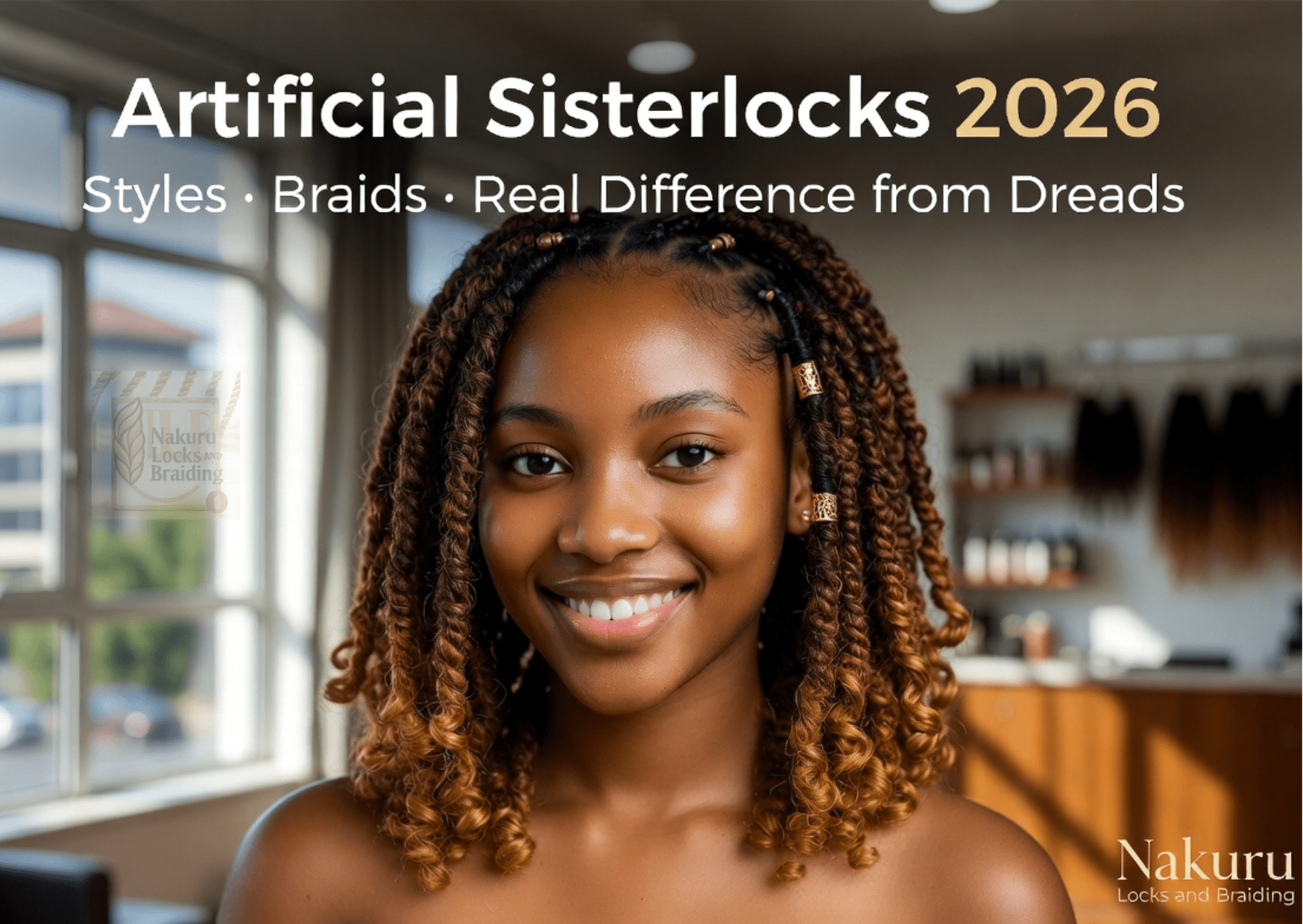
Artificial Sisterlocks 2026: Styles, Braids & the Real Difference from Dreads
Artificial sisterlocks styles, tutorial, microlocs, artificial sisterlocks braids, styling artificial sisterlocks – expert Nakuru salon guide with before & after.
The salon was quiet that Saturday morning, sunlight streaming through the windows onto the Mt. Sinai Building sign outside. The familiar scent of shea butter and fresh Kanekalon filled the air as clients chatted softly. Then she walked in — a young teacher from Nakuru West, clutching her phone with photos of perfectly uniform micro-locs.
“Ann,” she said, eyes bright but nervous, “I want artificial sisterlocks. Not real locs yet — I’m not ready for that commitment. But I love the look. Can you explain artificial sisterlocks styles, which braids are used, and how they differ from dreadlocks? I’ve heard they’re permanent… is that true?”
Her question is one we hear almost every week at Nakuru Locks and Braiding. Artificial sisterlocks have become the bridge many women and men in Nakuru are crossing — the elegant, uniform look of sisterlocks without the years-long locking process.
What Are Artificial Sisterlocks?
Artificial sisterlocks are a modern protective style that mimics the neat, uniform appearance of traditional sisterlocks using synthetic or human hair extensions crocheted or braided into small, precise sections. Unlike natural sisterlocks that form organically over time through interlocking, artificial sisterlocks are installed quickly (usually 4–8 hours) and can be maintained or removed.
At Nakuru Locks and Braiding, we’ve observed that clients choose artificial sisterlocks for their low-maintenance beauty, versatility, and the confidence boost of a polished loc look without waiting 2–3 years for natural locking.

Difference Between Sisterlocks and Dreadlocks
Sisterlocks are tiny, uniform micro-locs created with a specific interlocking technique. Dreadlocks (dreads) are thicker, more organic matted sections that form naturally or with twisting.
Key differences: – Size: Sisterlocks are much smaller and more uniform. – Maintenance: Sisterlocks need professional retightening every 4–8 weeks; dreads can be self-maintained longer. – Look: Sisterlocks have a refined, grid-like pattern; dreads are more free-form. – Artificial sisterlocks give you the sisterlock aesthetic instantly using extensions.
Types of Sisterlocks & Artificial Sisterlocks
– Traditional Sisterlocks: Natural hair only, very small uniform locs. – Microlocs Artificial Sisterlocks: Tiny sections with added hair for instant length and volume. – Medium Artificial Sisterlocks: Slightly larger sections for faster installation. – Soft Curl Artificial Sisterlocks: With added curly texture for volume and movement.
Artificial Sisterlocks Styles Popular in Nakuru 2026
– Classic Grid Artificial Sisterlocks – Artificial Sisterlocks with Beads & Cuffs – High Ponytail or Bun Artificial Sisterlocks – Ombré or Colored Artificial Sisterlocks (darling shades like 613 blonde tips) – Artificial Sisterlocks Braids Hybrid (front braids blending into locs)

Which Braids Are Used for Artificial Sisterlocks?
We typically start with small, precise cornrows or individual braids as the base. Knotless braids or very thin two-strand twists work best because they create a clean foundation for crocheting the loc extensions. The base braids must be uniform and gentle on the scalp to avoid tension.
Artificial Sisterlocks Tutorial: How We Install Them at Nakuru Locks
1. Consultation & sectioning (grid pattern).
2. Small base braids or twists.
3. Crochet or wrap synthetic/human hair extensions into each section.
4. Tighten and shape for uniform look.
5. Final styling (curls, beads, or straight).
The entire process usually takes 4–8 hours depending on length and density.
Styling Artificial Sisterlocks: Daily & Special Occasion Ideas
– Daily: High puff, side-swept ponytail, or loose with headband.
– Special: Bantu knots, braided crown, or updo with accessories.
Artificial sisterlocks darling styles include soft curls at the ends for romantic movement.
Are Sisterlocks Permanent?
Traditional sisterlocks are semi-permanent — they can be taken down but require time to revert. Artificial sisterlocks are fully removable and not permanent. They can last 6–12 months with proper maintenance before a refresh or removal.
Practical Care Tips for Artificial Sisterlocks
Nakuru Locks Best Practices
Our 3-step routine for artificial sisterlocks: Gentle base braiding, precise crochet installation, monthly professional retightening — observed to keep locs neat and scalp healthy for 8–12 months.
Before/After Expectations & Timeline
3 Months: Loc edges settle, style looks polished.
6 Months: Fuller appearance, easy styling.
12 Months: Mature, beautiful artificial sisterlocks look with minimal maintenance.
Warnings & When to See a Pro
Excessive tightness or itching? Remove or loosen immediately. Persistent issues may indicate traction alopecia — consult a dermatologist.
Your Artificial Sisterlocks Checklist
- Daily: Light oil on scalp, satin bonnet at night
- Weekly: Gentle cleanse on base
- Monthly: Professional retightening
FAQ
Instant loc look using extensions crocheted into small braids.
Artificial versions are removable; traditional ones are semi-permanent.
Small knotless braids or thin two-strand twists as the base.
Sisterlocks are smaller, uniform, and more refined; dreads are thicker and more organic.
6–12 months with proper care and monthly maintenance.
Read More from Nakuru Locks
• Natural Afro Hair Styles & Twists
• Dread Braids vs Twists: Which is Right for You?
• Scalp Massage for Hair Growth: Does It Work?
Ready for Your Artificial Sisterlocks Transformation?
Book Your Consultation Today
WhatsApp Us NowAddress: Mt. Sinai building, Bazaar Rd, Nakuru City, Kenya
Phone: 0723 168 188
WhatsApp: +254 723 168 188
Email: ann@nakurulocksandbraiding.com
References
- Journal of Cosmetic Dermatology (2023). Protective styles and traction alopecia.
- International Journal of Trichology (2022). Faux locs and scalp health.
- American Academy of Dermatology (2024). Protective hairstyles guide.
Leave a Reply