
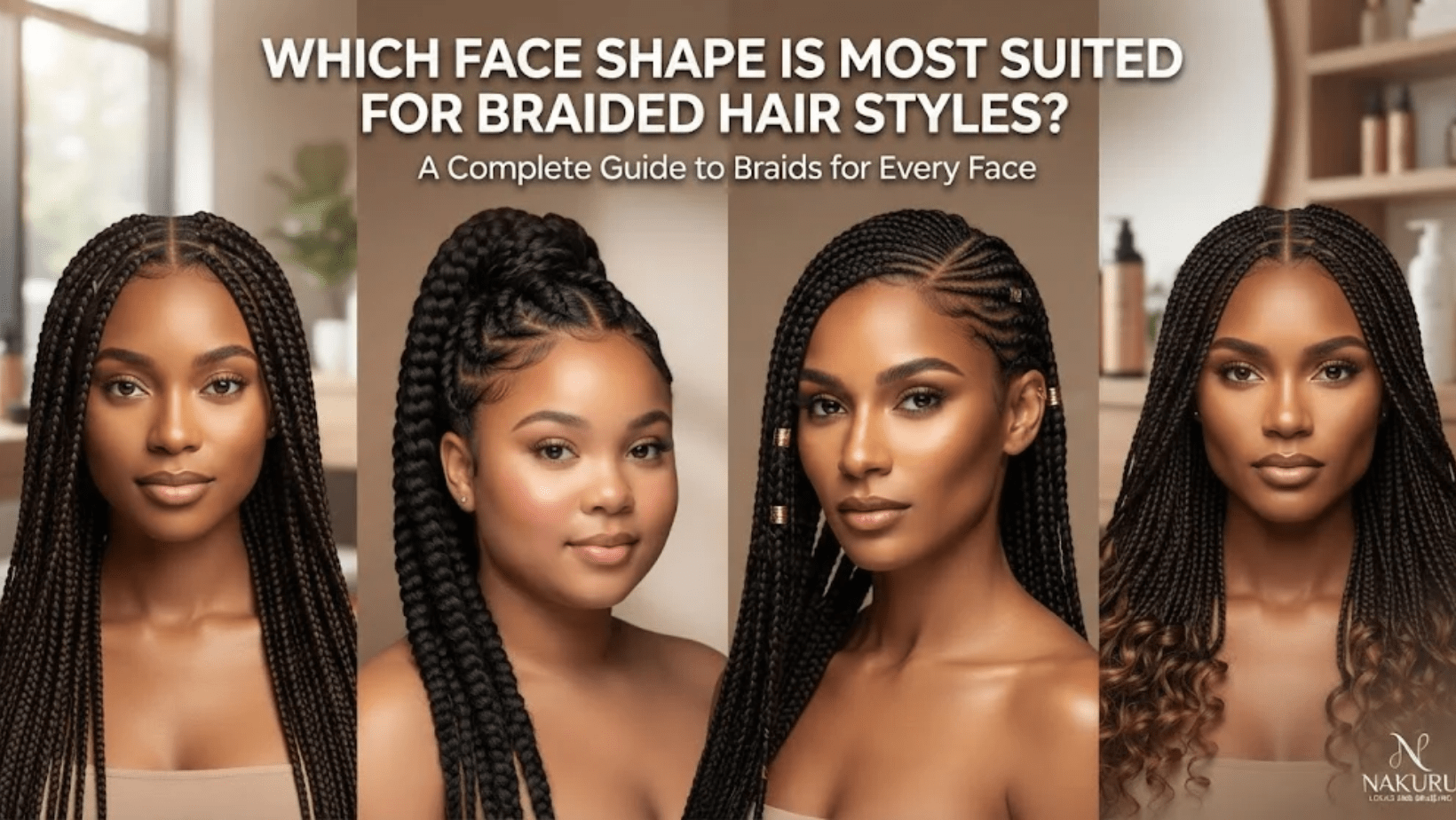
Which Face Shape Is Most Suited for Braided Hairstyles? The Complete Nakuru Locks and Braiding Guide
In Nakuru, on any given Saturday, a small braiding stall can hold six chairs, six clients, and six completely different stories.
A university student home for the holidays wants knotless braids for a graduation shoot. A mother is getting cornrows before a two-week trip upcountry.
A groom-to-be wants a clean, tapered style for his wedding photos. They all ask the braider the same question in different words: “Will this actually suit my face?”
It’s a fair question, and it’s one people ask from Nairobi to Lagos to London to Atlanta — because braids are no longer a “back home” style tucked away for holidays.
They are runway hair, boardroom hair, wedding hair, and everyday hair, worn by people with every conceivable face shape, skin tone, and hair texture on earth.
The good news, and the short answer to the headline question, is this: there is no single face shape reserved for braids.
Braids are one of the most adaptable hairstyling categories that exist, precisely because braid size, parting, length, and direction can all be adjusted to work with your bone structure rather than against it.
That said, some face shapes have an easier time of it than others, and knowing your shape — plus a few simple styling rules — turns “will this suit me?” into “here’s exactly what to ask my braider for.”
This guide walks through the science of face shapes, which shapes braids flatter most naturally, the honest truth about “attractive” face shapes, and a practical, size-by-size braid guide for both men and women.
Why Face Shape Matters More Than Trend
Before getting into which braid suits which face, it helps to understand why face shape matters at all. Hairstyling, at its core, is an exercise in visual balance.
Every face has a natural width-to-length ratio, defined by four measurements: the forehead, the cheekbones, the jawline, and the overall length from hairline to chin.
A stylist (or a good AI face-shape detector) compares these four measurements to figure out which is widest and how long the face is relative to its width, and that comparison is what determines your face shape.
Hair — braided or otherwise — sits directly beside these measurements, which means it can visually stretch a wide jaw, shorten a long forehead, or soften an angular chin, all without touching a single feature.
Braids are especially powerful for this because, unlike a single haircut, a braided style gives you control over multiple variables at once: the size of each braid, the direction of the parting, where the style sits (crown, temple, nape), and how much volume falls at the jawline versus the cheekbone.
That level of control is exactly why braiding is often called one of the most face-shape-adaptable style categories in the industry.
The 7 Basic Face Shapes, Explained
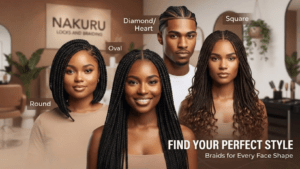
Most professional style guides and modern AI face-shape detectors agree on seven standard categories: oval, round, square, heart, diamond, oblong (rectangle), and triangle (pear).
A few sources merge triangle and pear or split diamond and heart slightly differently, but seven is the widely used industry standard.
1. Oval — The face is roughly one-and-a-half times longer than it is wide, the cheekbones are the widest point, and the jaw curves gently to a slightly tapered chin. Because the proportions are naturally balanced, almost every hairstyle — braided or not — looks good on an oval face.
2. Round — Width and height are nearly equal, cheeks are full, and the jawline is soft with very little angle. The goal with styling is usually to add vertical length.
3. Square — Forehead, cheekbones, and jaw are all roughly the same width, with a strong, angular jawline and a straight hairline. Styling usually aims to soften the angles.
4. Heart — The forehead and cheekbones are wider than the jaw, which narrows to a pointed chin, often with a visible widow’s peak. The goal is to add width or volume near the jaw to balance the broader forehead.
5. Diamond — The cheekbones are the widest point, with a noticeably narrower forehead and jaw. This is considered one of the rarer shapes, and styling generally aims to add width at both the forehead and chin.
6. Oblong (Rectangle) — Similar to oval but longer, with the forehead, cheekbones, and jaw close in width. Styling generally aims to add width at the sides and reduce the impression of extra length.
7. Triangle (Pear) — The jawline is the widest point, with a narrower forehead. Styling generally aims to add fullness or width at the temples and crown to balance the jaw.
Interestingly, one 2026 analysis of over 3,800 AI-based face scans found that oval was by far the most commonly detected shape, at roughly 46%, followed by diamond at about 22% and heart at 19%, while square and triangle each made up under 1% of the sample.
That’s a useful reminder that “textbook” square or triangle faces are less common than people assume, and that most people are a blend of two shapes rather than a perfect match to one category — something modern face-shape detectors and professional stylists both point out.
So, Which Face Shape Is Most Suited for Braided Hairstyles?
If we’re being strict about it, the oval face shape has the easiest relationship with braids, for the same reason it’s considered the most flattering shape for hairstyling in general: the proportions are already balanced, so braids don’t have to correct anything — they can simply enhance.
An oval face can wear crown braids, side-swept styles, waist-length Fulani braids, or bold jumbo box braids without needing to compensate for width or length anywhere.
But “easiest” doesn’t mean “only.” Every one of the seven face shapes has braid styles built specifically to work in its favour:
- Round faces look longer and more sculpted in long, thin, vertical braids worn with a centre part, which draws the eye downward and adds the illusion of length.
- Square faces soften beautifully with smaller, longer braids or soft waves woven through box braids, which introduce curves against the naturally angular jaw.
- Heart-shaped faces benefit from styles that add volume near the chin — waterfall braids, lemonade braids swept to one side, or a braided ponytail — to visually widen the lower face and balance a broader forehead.
- Diamond faces shine with styles that widen the forehead and chin, such as feed-in braids (which let the braider control volume as they go) or a voluminous braided crown.
- Oblong faces do well with styles that add width at the sides rather than more length, such as fuller braided bobs or styles with side volume, avoiding anything that stretches the face further.
- Triangle/pear faces are flattered by extra fullness at the crown and temples — a braided updo or voluminous top section — which balances a wider jawline.
The honest, E-E-A-T-friendly answer, then, is this: oval faces have the most “wiggle room” with braids, but every face shape has a braid category built for it.
The real skill — the one a trained braider brings to the chair — is matching braid size, parting, and volume placement to your individual proportions, not just picking a trending style off Pinterest.
What Are the Top 3 Most “Attractive” Face Shapes?
This is one of the most-searched questions in the beauty space, and it deserves an honest, non-hyped answer: attractiveness is not a fixed scientific ranking of face shapes.
It’s shaped by symmetry, cultural context, personal taste, and even the era you’re living in.
What research does consistently show is that facial symmetry and proportion — not one specific shape — are the strongest predictors of perceived attractiveness across cultures.
A 3D facial-modelling study published in the orthodontic research literature found that faces with more angular, well-defined contours and less soft-tissue fullness tended to receive higher attractiveness ratings, with one notable exception: fuller, more prominent upper lips scored consistently well regardless of overall angularity.
With that scientific caveat in place, three face shapes are the ones most consistently cited across style and beauty publications as culturally “ideal,” largely because of their proportion and symmetry:
1. Oval — Frequently described as the benchmark shape because its length-to-width ratio sits close to the so-called golden ratio (roughly 1.6:1), giving it a naturally balanced, symmetrical look that suits nearly any style.
2. Heart — Often praised for its soft taper from a wider forehead down to a delicate chin, a shape associated with youthful, “sweetheart” proportions in Western beauty media.
3. Diamond (with square close behind) — Valued for high, sculpted cheekbones and a striking, photogenic bone structure, though it’s also one of the rarer shapes.
The important caveat: these rankings come from beauty-industry consensus and popular media, not from a single definitive scientific study, and they reflect largely Western aesthetic conventions.
Round, square, oblong, and triangle faces are just as capable of being considered stunning — often it comes down to styling, confidence, and how features are framed, which is exactly where a good braider earns their keep.
How Do I Know What Hairstyle Fits My Face Shape?
You don’t need an app to get a reasonably accurate read on your face shape — though modern AI face-shape detectors can achieve 85–95% accuracy when the photo is well-lit, front-facing, and taken with hair pulled fully back. Here’s the low-tech version any braider or client can do in five minutes:
1. Pull your hair back completely and stand in front of a mirror in good, even lighting.
2. Measure your forehead at its widest point (temple to temple).
3. Measure your cheekbones at their widest point.
4. Measure your jawline at its widest point, just below the ears.
5. Measure your face length, from the centre of your hairline to the tip of your chin.
6. Compare the four numbers. Which is widest? Is your face notably longer than it is wide, or close to equal? That comparison — not any single feature on its own — is what determines your shape. A strong jaw alone doesn’t make a face “square,” and a long face isn’t automatically “oblong”; it’s the relationship between all four measurements that counts.
Once you know your shape, translate it into a styling goal rather than a rigid rule: round faces generally look for length, square and diamond faces look for softness, heart and triangle faces look for balance between the upper and lower face, and oval and oblong faces have room to play with volume and boldness.
A skilled braider will always do a quick version of this assessment before recommending a size, parting, or length — which is exactly the consultation approach we use at Nakuru Locks and Braiding for every new client.
How to Choose the Right Braid Size for Your Face Shape — Male
Men’s braid guides generally follow the same face-shape logic as women’s, with one addition: beard shape often gets factored in alongside hairstyle, since a beard can visually widen or narrow the jaw just as much as a hairline does. A few practical, face-shape-based pointers for men:
- Round faces: Medium-sized cornrows or box braids styled straight back, or with slight height at the crown, help create the illusion of length. Avoid very short, blunt styles that hug the whole head evenly, as they emphasise roundness.
- Square faces: Medium-to-small braids with a slightly textured or wavy finish soften a strong jaw. Straight-back cornrows in a fan or curved pattern also work well, as the curved lines contrast the face’s natural angles.
- Diamond faces: Feed-in braids or designs that add fullness near the temples and hairline help balance a narrow forehead against wide cheekbones.
- Oblong faces: Medium or jumbo braids with visible width — rather than sleek, flat, close-to-the-head styles — help counter extra face length. A braided style with a fringe or forward-swept front section can also shorten the appearance of the face.
- Triangle faces: Fuller styles at the crown and a lower-maintenance, tapered pattern near the jaw help offset a wider jawline.
- Oval faces: The most flexible category — jumbo, medium, or micro braids in almost any pattern will work, so this is where personal style and maintenance preference (micro braids last longer between touch-ups but take more time to install; jumbo braids install faster and suit a bolder look) should drive the decision.
How to Choose the Right Braid Size for Your Face Shape — Female
For women, braid size decisions usually weigh face shape against three other factors: hair density, desired length, and how the braids will be worn day-to-day (down, in an updo, half-up). Applying face-shape logic:
- Round faces: Long, thin (small to medium) braids worn with a centre part elongate the face. A low ponytail or letting the braids fall loose adds further vertical length. Avoid super-chunky jumbo braids gathered at chin height, which add width exactly where a round face already has plenty.
- Oval faces: The most versatile shape for braid size — large, chunky braids add proportional volume, while micro braids highlight symmetry. This is the shape where trend-driven choices (colour, length, jumbo statement styles) are safest to experiment with.
- Square faces: Smaller, longer braids, or box braids finished with soft waves, help introduce curves that soften an angular jaw.
-
Heart faces:
Styles that build volume at the jaw and below — a chin-length braided bob, a half-up half-down style, or waterfall and lemonade braids swept to the side — balance a wider forehead against a narrower chin.
- Diamond faces: Feed-in braids let a braider control volume placement precisely, adding fullness at the forehead and chin where the diamond shape is naturally narrow. A voluminous braided crown works for the same reason.
- Oblong faces: Braids with width — a fuller braided bob, or styles with waves and layers rather than sleek straight-back patterns — help balance extra length; centre-parted, waist-length straight styles should generally be avoided, since they add even more visual length.
- Triangle/pear faces: A voluminous crown or braided updo that builds height and fullness above the jaw creates balance against a wider chin and jawline.
As several braid specialists put it well: face shape is a genuinely useful starting point, but it should never be the only consideration — hair density, desired length, lifestyle, scalp sensitivity, and how much maintenance you’re willing to do all factor into the final size and pattern a good braider recommends.
Frequently Asked Questions
Can any face shape wear braids?
Yes. Braids are one of the most adjustable hairstyle categories that exist. Size, parting, length, and volume placement can all be tailored, which is why every one of the seven basic face shapes has braid styles designed specifically to flatter it.
What braid size is the most universally flattering?
Medium-sized box braids or knotless braids tend to be the safest universal choice, since they can be styled straight back, side-swept, or half-up to suit almost any face shape, and they’re easier to adjust after installation than very large or very small sizes.
Do braids make a round face look thinner?
Long, thin braids worn with a centre part and a low or loose style can visually elongate a round face by drawing the eye downward, though “thinner” is really an illusion created by added vertical length rather than an actual change in face width.
Should men choose braid size differently than women?
The underlying face-shape principles are the same for everyone, but men’s styling often factors in beard shape alongside braid size, since the two work together to frame the jaw and forehead.
Is there a scientifically “best” face shape for braids or for beauty in general?
No single face shape is scientifically proven to be objectively best. Symmetry and proportion, not shape category, are the strongest research-backed predictors of perceived attractiveness, and oval, heart, and diamond faces are simply the shapes most often cited as culturally “ideal” in Western beauty media.
Related Articles from Nakuru Locks and Braiding
References
- Face-Shapes-Detector.com
- Detect-FaceShape.com
- Maximum FX Salon
- CK Studio Salon
- Locs by Us
- Zealous Braids
- Antwerpen Braiders
- Braiding Palace
Note on the “attractiveness” section: findings on facial angularity and attractiveness referenced above summarize research reported in the journal Progress in Orthodontics, as discussed in third-party coverage; readers interested in the primary data should search that journal directly for the original study.
Leave a Reply