
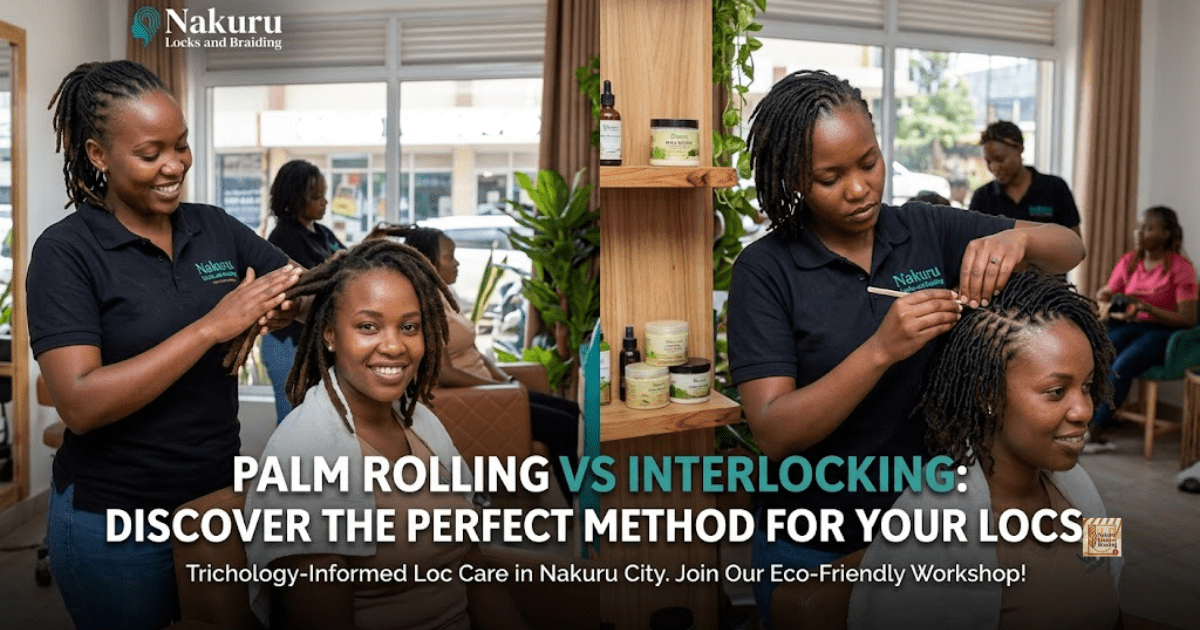
Palm Rolling vs. Interlocking: Finding the Perfect Maintenance Method for Your Locs
For many, the loc journey is more than just a hairstyle—it is a deeply personal commitment to hair health, growth, and cultural expression.
Whether you are a newcomer starting your first set of locs at Nakuru Locks and Braiding or a seasoned veteran managing a mature crown, the question of maintenance inevitably arises: Palm rolling or interlocking?
In the bustling world of hair care, these two techniques often feel like opposing philosophies. One is a traditional, tactile rhythm; the other is a precise, technical craft.
As a trichology-trained lead stylist, I often hear clients ask, “Can I switch between the two?” or “Which one is actually better for my hair?”
In this guide, we will break down the differences, debunk the myths, and help you choose the maintenance path that aligns with your lifestyle and hair goals.

What is the Meaning of Palm Rolling?
Palm rolling is a classic, traditional retwisting method. It involves taking the new growth at the root of the loc, applying a light, natural hold product (such as organic shea butter or a water-based setting gel), and rolling the loc between your palms in a clockwise or counter-clockwise direction to “twist” the hair into the existing loc structure.
-
The Feel: It is a gentle, soothing process that emphasizes the natural maturity of the loc.
-
The Finish: It provides a smooth, rounded appearance and is highly favored by those who enjoy the “fresh retwist” aesthetic.
-
Best For: Those with medium-to-coarse hair textures who want to maintain a uniform, rounded shape and prefer a less “mechanical” look.
What is Interlocking?
Interlocking (often called “latching” or “retie”) is a mechanical technique where a specialized tool is used to pull the ends of the loc through the root of the new growth.
Unlike palm rolling, which relies on friction and product to hold the hair, interlocking creates a knot-like structure that secures the hair at the base.
-
The Feel: It creates a firm, tight hold at the root.
-
The Finish: It leaves the root feeling “locked” and secure, even after washing or vigorous activity.
-
Best For: Active individuals, those with fine hair textures, or clients who struggle with unraveling roots and prefer longer intervals between salon visits.
Palm Rolling vs. Interlocking: A Side-by-Side Comparison
| Feature | Palm Rolling | Interlocking |
| Technique | Manual twisting between palms | Threading through the root with a tool |
| Durability | Lower; can unravel with moisture/activity | High; holds firm through washing |
| Maintenance Frequency | Every 4–6 weeks | Every 6–8+ weeks |
| Texture Impact | Maintains smooth, rounded aesthetic | Can create a “braided” or textured root |
| Tension Risk | Low (if done correctly) | Moderate (risk of thinning if over-tightened) |
Palm Rolling Microlocs: Is it Possible?
While palm rolling is excellent for standard locs, microlocs—due to their tiny parting size—are almost exclusively maintained via interlocking.
Because microlocs have less hair volume per section, the mechanical security of interlocking is usually required to prevent the hair from unravelling or breaking at the point of attachment.
Can You Interlock and Palm Roll at the Same Time?
A common debate in the natural hair community, frequently echoed on forums like Reddit, is whether you can mix these methods. The short answer is yes, but with caveats.
Many stylists perform a “hybrid” maintenance. For example, some clients use interlocking to secure the root for longevity, while they occasionally palm roll the length of the loc to maintain a smooth, frizz-free appearance.
However, if you choose to alternate:
-
Do not over-tighten: Over-interlocking in the same direction can lead to thinning or “holes” in the loc.
-
Consistency is key: If you are prone to breakage, choose one primary method and stick to it for the majority of your maintenance to keep the internal “matrix” of the loc uniform.
Can you interlock after palm rolling?
Yes. Many clients who have spent years palm rolling eventually switch to interlocking as their lifestyle demands lower maintenance.
If you decide to make the switch, ensure your loctician is aware of your history so they can select the appropriate rotation (2-point vs. 3-point) to suit your existing loc density.
Is Palm Rolling Good for Locs?
Palm rolling is a pillar of traditional loc care. It is “good” because it is a low-tension technique that respects the natural growth cycle of the hair.
Unlike methods that pull or braid the hair into tight knots, palm rolling uses the natural tendency of locs to compress.
Pros:
-
Promotes a rounded, mature appearance.
-
Gentle on the scalp and follicles.
-
Allows for natural movement and softness.
Cons:
-
Requires more frequent salon visits.
-
Sensitive to humidity and moisture (roots can unravel easily).
-
Can lead to product buildup if too much gel or wax is used.
Can You Interlock and Palm Roll at the Same Time? Can You Interlock After Palm Rolling?
Yes, you can interlock and palm roll at the same time or alternate, but with strategy. Many practitioners interlock the roots for security and palm roll the shafts for smoothness, or alternate appointments (e.g., interlock every 2-3 months, palm roll in between).
Switching after palm rolling is common and feasible. Transition gradually to avoid stress. Constant back-and-forth can cause inconsistencies or weakness, so plan with a professional. Starting with one and moving to the other works well for evolving needs (e.g., from starter phase to active lifestyle).
Our team at Nakuru Locks and Braiding assesses hair health, texture, and goals before recommending hybrids—many clients thrive with this balanced approach.
Choosing the Right Method: Factors to Consider
- Hair Texture and Density: Softer/curlier hair may need interlocking’s hold; coarser hair benefits from palm rolling’s volume.
- Lifestyle: Active? Interlock. Low-maintenance aesthetic focus? Palm roll.
- Stage of Journey: Starters often use palm rolling or coils; mature locs offer flexibility.
- Health Goals: Prioritize low tension to prevent traction alopecia.
Consult experts like those at Nakuru Locks and Braiding for personalized plans.
Frequently Asked Questions (FAQ)
Q: What is the difference between palm rolling and interlocking?
A: Palm rolling shapes via hand-rolling for cylindrical locs; interlocking weaves roots for tighter hold and durability.
Q: Is palm rolling good for locs?
A: Yes, in moderation—it promotes shape and fullness but avoid excess to prevent thinning.
Q: Can you interlock after palm rolling?
A: Absolutely, with proper technique and spacing between sessions.
Q: Palm rolling microlocs—worth it?
A: Yes for flexibility and volume, often combined with selective interlocking.
Q: Which lasts longer?
A: Interlocking generally requires less frequent visits.
Related Articles from Nakuru Locks and Braiding
Beginner’s Guide to Starting Locs in Kenya
Microlocs Maintenance: Tips for East African Textures
Natural Hair Care in Humid Climates
Transitioning Between Loc Styles Safely
Expert Care from Nakuru Locks and Braiding
At Nakuru Locks and Braiding, located at the Mt. Sinai Building on Bazaar Road, Nakuru City, we believe in trichology-informed braiding. Whether you choose the soft touch of palm rolling or the technical precision of interlocking, our focus is always on your follicle health and scalp integrity.
-
Ready to start your journey? Book your consultation today via our Online Booking Portal.
-
Need advice? Check out our latest workshop, the Eco-Friendly Dreadlocks & Locking Workshop, where we teach you how to maintain your crown using natural, locally sourced ingredients.
Remember: Sunday services are available strictly by appointment only. Please contact us in advance to secure your spot.
References
- Mukisa Locs: Detailed comparison dispelling myths.
- Curly Nikki and community insights on real experiences.
- The Kinky Apothecary and Digital Loctician for technique depth.
We at Nakuru Locks and Braiding align with industry best practices, emphasizing education and client-centered care
Disclaimer: This article is for informational purposes and does not constitute medical advice. For specific concerns regarding hair loss or scalp conditions, please consult with a professional trichologist.
Leave a Reply