
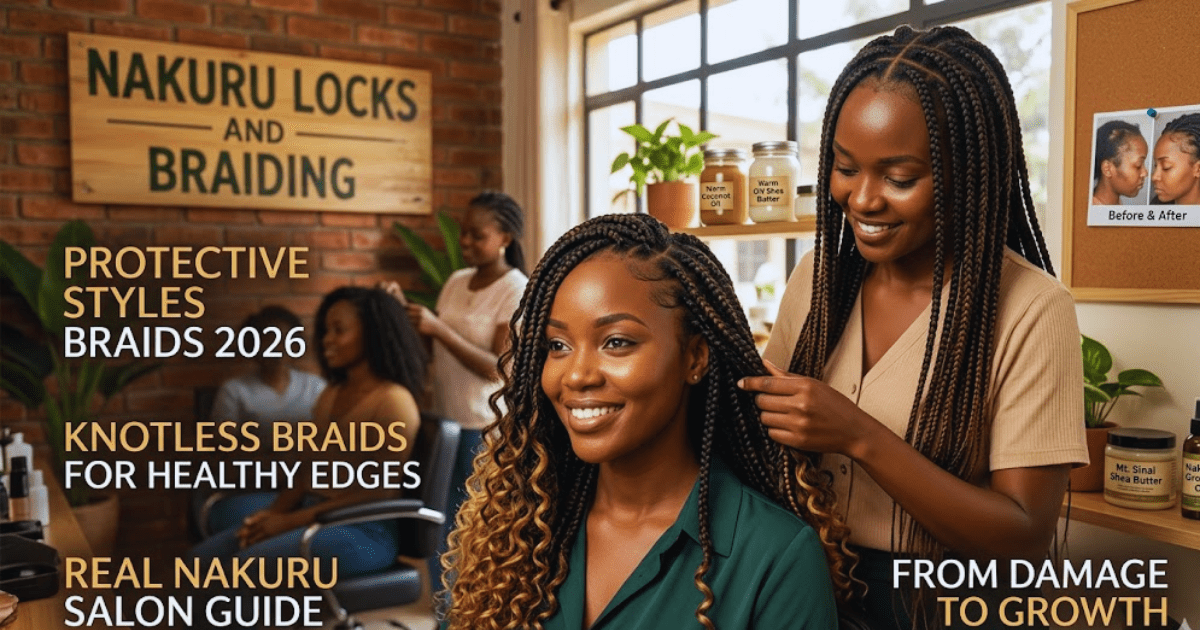
Protective Styles Braids: The Best Braids for Healthy Hair in 2026
Protective styles with braids, types of protective braids, protective braid styles for alopecia, easy protective styles with braiding hair – real Nakuru salon guide.
It was a quiet Wednesday morning in the salon. The scent of warm coconut oil and fresh shea butter filled the air as the first rays of Nakuru sun streamed through the windows of Mt. Sinai Building. A young teacher named [Wanjiku, anonymized] sat in my chair, her shoulders tense, edges visibly thinned from years of tight weaves and relaxers. She looked at me with tired eyes and said, “Ann, I need something that protects my hairline but still looks beautiful. Are knotless braids a protective style? Or are box braids better? I just want my hair to grow back.”
Her story is one we hear almost every week at Nakuru Locks and Braiding. After 13 years braiding in Nakuru, I’ve learned that protective styles braids are not just hairstyles — they are healing. They give your hair a break from daily manipulation, shield fragile edges, and create the perfect environment for growth. Today, I’m sharing everything we’ve learned about protective styles with braids — from types of protective braids to how they help damaged hairlines and alopecia.

What Are Protective Styles Braids?
Protective styles braids are braided hairstyles designed to minimize daily handling, reduce tension on the scalp, and protect the ends and edges of your natural hair. They allow your hair to grow longer and healthier by shielding it from environmental damage, friction, and over-styling. Unlike regular braids that can sometimes cause breakage, true protective styles with braids are installed with low tension and proper technique.
At Nakuru Locks and Braiding Salon, we’ve observed that clients who switch to protective styles braids consistently see less shedding, stronger edges, and better length retention within 3–6 months.
Are Box Braids a Protective Style? Are Knotless Braids a Protective Style?
Yes — when done correctly. Both box braids and knotless braids can be excellent protective styles. The key difference is in tension and installation:
- Box Braids: Classic and versatile, but can be heavy if too thick or tight. They protect when installed loosely with proper parting.
- Knotless Braids: Gentler on the scalp because they start with your own hair and feed in extensions gradually. They cause less tension and are often the better choice for damaged hairline or alopecia-prone clients.
We recommend knotless braids for anyone with a sensitive or thinning hairline — they’re lighter and kinder to edges.
Types of Protective Braids We Love at Nakuru Locks
Here are the most effective protective braid styles we install daily:
- Knotless Box Braids — Low tension, lightweight, ideal for long-term wear.
- Goddess Braids / Boho Braids — Soft, romantic with curly ends — beautiful and protective.
- Fulani Braids — Cultural cornrow patterns with hanging braids — stunning and scalp-friendly when done loosely.
- Feed-In Braids — Gradual addition of hair reduces pull on the roots.
- Passion Twists / Butterfly Locs — Lightweight protective twists that mimic locs without the commitment.

Protective Braid Styles for Alopecia & Damaged Hairline
For clients with alopecia or receding hairlines, we focus on:
- Very loose knotless braids with wide parts
- Protective hairstyles for hairline that start with cornrows only at the back
- Yarn or soft synthetic extensions to reduce weight
- Styles that allow easy access for scalp treatments
We’ve seen remarkable edge recovery when clients combine these styles with our weekly scalp massage and gentle care routine.
Easy Protective Styles with Braiding Hair for Busy Lives
For women on the go in Nakuru, these are the easiest protective styles with braiding hair:
- Medium Knotless Braids — Quick install, lightweight, lasts 6–8 weeks.
- Half-Up Protective Braids — Braids on the bottom, natural puff or twist on top — stylish and easy to maintain.
- Box Braids in a Bun — Protective and elegant for work or school.

Nakuru Locks & Braiding’s 3-Step Protective Braid Routine
1. Pre-Install Prep — Deep condition and clarify to strengthen hair.
2. Low-Tension Installation — Two-finger rule for every braid.
3. Ongoing Care — Weekly scalp oiling + satin bonnet every night.
Many clients report significantly less breakage and healthier edges after following this routine.
Before & After: Realistic Timeline
3 Months: Reduced shedding, stronger edges, braids still fresh.
6 Months: Noticeable length retention, healthier hairline.
12 Months: Significant growth and thicker overall density for most clients.
Warnings & When to See a Pro
Pain lasting more than 3 days, bumps, or excessive shedding? Remove braids immediately and consult a dermatologist. Tight protective styles can cause traction alopecia if not done correctly.
Your Protective Braid Checklist
- Every Morning: Light scalp mist + bonnet check
- Weekly: Gentle cleanse + oil massage
- Every 6–8 Weeks: Professional retouch or removal
FAQ
Yes — when installed loosely with proper tension.
Yes — they are often gentler on the scalp and edges.
Loose knotless braids, feed-in styles, and soft twists with wide parts.
6–10 weeks with proper care.
Yes — when low-tension and combined with scalp care.
Read More from Nakuru Locks
Natural Afro Hair Styles: The Ultimate Guide
Dread Braids vs Twists: Which is Better?
Lush Braids Kenya: Colours, Numbers & Prices
Scalp Massage for Hair Growth: Does It Work?
Ready to Protect & Grow Your Hair?
Book Your Protective Braid Consultation Today
WhatsApp Us NowAddress: Mt. Sinai building, Bazaar Rd, Nakuru City, Kenya
Phone/WhatsApp: 0723 168 188
Email: ann@nakurulocksandbraiding.com
References
- Journal of Cosmetic Dermatology (2023). Protective styles and traction alopecia.
- American Academy of Dermatology (2024). Protective hairstyles guide.
- International Journal of Trichology (2022). Braiding techniques and scalp health.
- Clinical, Cosmetic and Investigational Dermatology (2021). Hair retention in braided styles.
Leave a Reply