
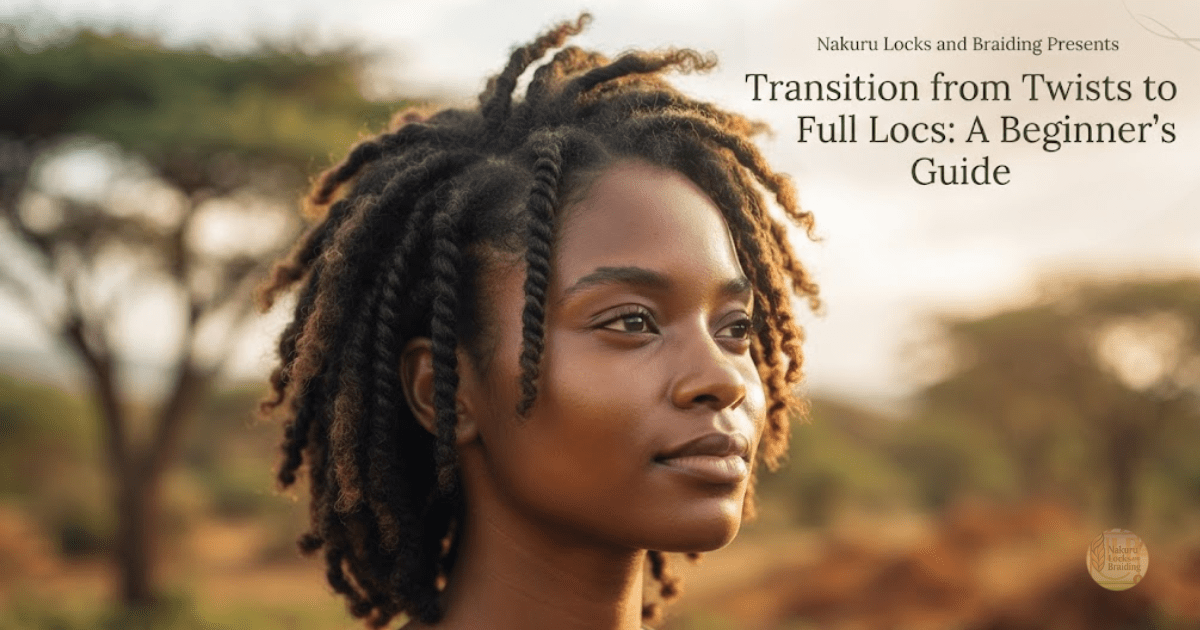
How to Transition from Twists to Full Locs: The Complete Beginner’s Guide
If you’ve been wearing two-strand twists and are wondering, “Can I let my twists turn into locs?”—the short answer is yes.
Two-strand twists are one of the most popular and beginner-friendly methods to start your loc journey.
With patience, the right care, and minimal interference, those twists will gradually swell, matte, and lock into full, mature locs over several months.
This guide walks you through everything you need to know about transitioning from twists to full locs, including timelines, maintenance routines, washing and retwisting schedules, and common mistakes to avoid.
Whether you’re in Nairobi or anywhere else in the world, this step-by-step resource is designed to help you start and sustain healthy, beautiful locs.

Can I Let My Twists Turn Into Locs?
Yes, you absolutely can let your two-strand twists turn into locs. In fact, two-strand twists are a widely recommended starter method for natural hair, especially for those with afro-textured or coily hair types.
When you install two-strand twists and leave them undisturbed, the hair begins to interlock and matte from the inside out, eventually forming traditional locs.
Why Two-Strand Twists Work Well for Starter Locs
- Beginner-friendly: The technique is simple and can be done at home or by a stylist.
- Versatile: Works on a range of hair textures, from 3c to 4c.
- Fuller locs: Compared to comb coils or interlocking, two-strand twists tend to produce thicker, fuller locs as they mature.
- Low manipulation: Once installed, they require minimal daily styling, which supports the locking process.
However, it’s important to note that as your twists begin to loc, they will swell and become thicker than their initial appearance. This is normal and part of the maturation process.

How to Transition from Twists to Full Locs for Beginners
Transitioning from twists to full locs is less about “doing” and more about “allowing.”
The key is to install your twists correctly, then give your hair the time and environment it needs to lock naturally. Here’s how to get started.
Step 1: Start with Clean, Product-Free Hair
Before installing your twists, wash your hair with a gentle, sulfate-free shampoo to remove any product buildup, oils, or dirt.
Heavy creams, waxes, or butters can slow down the locking process and lead to buildup inside the locs later on.
Step 2: Section Your Hair Thoughtfully
The size of your sections will determine the thickness of your final locs. Smaller sections create thinner locs; larger sections result in thicker ones.
Use a rat-tail comb to create neat, consistent partings. Some people prefer grid partings for uniformity, while others opt for organic or circular partings for a more natural look.
Step 3: Install Two-Strand Twists Properly
Take two strands of hair from each section and twist them tightly around each other from root to tip.
Make sure the twists are secure to prevent early unraveling. You can use a lightweight locking gel or just water and natural oils to help hold the twist.
Step 4: Leave Them Alone (Mostly)
Once your twists are in, the most important step is to resist over-manipulation. Avoid combing, brushing, or constantly re-twisting your hair.
Let your hair begin the natural matting and interlocking process. Over-handling can weaken the roots and delay locking.
Step 5: Moisturize Lightly and Protect at Night
Use a lightweight, water-based moisturizing spray 2–3 times per week to keep your hair and scalp hydrated.
Avoid heavy oils or butters that can cause buildup. At night, protect your twists with a satin or silk bonnet or scarf to reduce friction and frizz.

How Long Does It Take for Twists to Turn to Locs?
One of the most common questions is: “How long does it take for twists to turn to locs?”
The timeline varies depending on your hair texture, growth rate, and maintenance routine, but here’s a general breakdown:
Loc Stages and Timeline
1. Starter Phase (0–3 months): Your twists will look like regular two-strand twists. They may unravel slightly at the ends, and your scalp may itch as it adjusts.
2. Budding Phase (3–6 months): This is when the magic happens. Your twists will begin to swell, and you’ll notice small “buds” or hard spots forming along the length of the loc. This is the hair beginning to matte and lock internally.
3. Teen Phase (6–12 months): Your locs will become more defined and less twist-like. They’ll hold their shape better and unravel less.
4. Mature Phase (12+ months): By this point, your locs are fully formed, dense, and resilient. They can be styled in a variety of ways and require less frequent maintenance.
5. For most people, it takes 6 to 12 months for two-strand twists to fully transition into recognizable locs. Coarser hair textures may lock faster (3–6 months), while softer textures may take closer to a year.
How to Start Locs from Twists: A Step-by-Step Breakdown
If you’re asking, “How to start locs from twists?” you’re likely looking for a clear, actionable plan. Here’s a detailed walkthrough:
1. Preparation
- Wash your hair with a clarifying or sulfate-free shampoo.
- Deep condition if needed, but rinse thoroughly to avoid residue.
- Detangle gently and allow your hair to air-dry or blow-dry on low heat.
2. Sectioning
- Use a rat-tail comb to part your hair into your desired loc size.
- Secure each section with a clip or hair tie to keep them organized.
3. Twisting
- Apply a small amount of locking gel or water-based moisturizer to each section.
- Split the section into two equal strands.
- Twist the strands around each other tightly from root to tip.
- Secure the end with a small elastic or by tucking it under.
4. Drying
- Allow your twists to air-dry completely or sit under a hooded dryer for 30–45 minutes.
- Avoid sleeping with wet twists, as this can lead to mildew or odor.
5. Maintenance
- Mist your locs with a water-based spray 2–3 times per week.
- Apply a light scalp oil if your scalp feels itchy or dry.
- Retwist your roots every 3–4 weeks during the starter phase to keep parts neat and encourage locking.
How to Go from Twists to Dreads: What’s the Difference?
The terms “locs” and “dreads” (or “dreadlocks”) are often used interchangeably, though “locs” is the preferred term in many communities due to the negative connotations of the word “dread.”
The process of going from twists to dreads is the same as transitioning to locs—install two-strand twists and allow them to matte and lock over time.
Some people choose to accelerate the process by palm rolling or using a crochet hook to encourage matting, especially in the budding phase.
However, these methods are optional and not necessary for healthy loc formation.
How to Transition from Twists to Full Locs for Beginners Natural
For those embracing a fully natural journey—no extensions, no synthetic hair—the two-strand twist method is ideal. It works with your natural texture and promotes healthy growth from the scalp.
Tips for a Natural Transition
- Avoid heavy products: Stick to lightweight, water-based moisturizers and natural oils like jojoba, argan, or castor oil.
- Wash gently: Use a residue-free shampoo and focus on the scalp, not the length of the locs.
- Protect your edges: Be gentle when twisting around the hairline to prevent thinning.
- Embrace the frizz: Frizz is a normal part of the locking process and indicates that your hair is healthy and moving.
Maintenance Routine: Washing and Retwisting Starter Locs
One of the biggest concerns for beginners is, “When should I wash and retwist my starter locs?” Here’s a simple schedule to follow.
When to Wash Starter Locs
- First wash: Wait at least 1–2 weeks after installation to allow your twists to set.
- Ongoing: Wash every 2–3 weeks, or weekly if you sweat heavily or have an itchy scalp.
- Method: Use a sulfate-free shampoo, focus on the scalp, and rinse thoroughly. You can wear a mesh cap to protect your locs while washing.
When to Retwist Starter Locs
- First retwist: 3–4 weeks after installation.
- Ongoing: Every 4–6 weeks during the starter and budding phases.
- Mature locs: Every 6–8 weeks or as needed.
How to Retwist
1. Dampen your hair slightly with a water-based spray.
2. Apply a small amount of locking gel to the new growth at the root.
3. Use a rat-tail comb to gather the new growth into the existing loc.
4. Twist in the same direction as the original loc to prevent unraveling.
5. Secure with a prong clip or pin and dry under a hooded dryer for 30–45 minutes.
Common Mistakes to Avoid When Transitioning to Locs
To ensure your twists lock properly and your locs stay healthy, avoid these common pitfalls:
- Over-manipulation: Constantly touching, twisting, or re-twisting your hair can weaken the roots and delay locking.
- Using heavy products: Waxes, thick creams, and petroleum-based products can cause buildup, odor, and slow the locking process.
- Washing too soon or too aggressively: Wait at least 1–2 weeks before your first wash, and be gentle to prevent unraveling.
- Comparing your journey to others: Everyone’s hair locks at a different pace. Focus on your own progress.
- Skipping nighttime protection: Always sleep with a satin or silk bonnet to reduce frizz and friction.

FAQ: How to Transition from Twists to Full Locs
Can I let my twists turn into locs without retwisting?
Yes, you can let your twists loc naturally without retwisting (freeform or semi-freeform). However, retwisting every 3–4 weeks helps keep parts neat and encourages a more uniform look.
How often should I wash my starter locs?
Wash your starter locs every 2–3 weeks, or weekly if you have an active lifestyle or itchy scalp. Use a residue-free shampoo and focus on the scalp.
Will my twists unravel when I wash them?
Some unraveling is normal, especially in the first few months. To minimize this, wash gently, avoid rubbing the locs, and retwist after washing if needed.
Can I style my starter locs?
Yes, but keep styles loose and low-manipulation. Avoid tight ponytails or heavy accessories that can stress the roots.
How do I know if my twists are locking?
Look for swelling, budding (hard spots along the loc), and less unraveling. Your locs will also feel denser and hold their shape better over time.
Related Articles from Nakuru Locks and Braiding
For more insights on loc care, styling, and maintenance, explore these related resources from Nakuru Locks and Braiding:
Final Thoughts: Trust the Process
Transitioning from twists to full locs is a journey of patience, consistency, and self-care.
While the early stages may feel uncertain, remember that every twist, every bud, and every bit of frizz is part of your unique loc story.
With the right foundation and gentle maintenance, your twists will blossom into strong, beautiful locs that reflect your natural beauty and personal style.
If you’re ready to start your loc journey or need professional guidance, reach out to Nakuru Locks and Braiding for expert advice and personalized care. Your locs are worth the wait.
Disclaimer: This article is for informational purposes only and is not a substitute for professional loc care advice. Always consult with a certified loctician or stylist for personalized guidance.
References
-
Journal of Clinical and Aesthetic Dermatology
-
International Association of Trichologists (IAT)
-
African Hair Care and Cosmetology Archives

Leave a Reply