
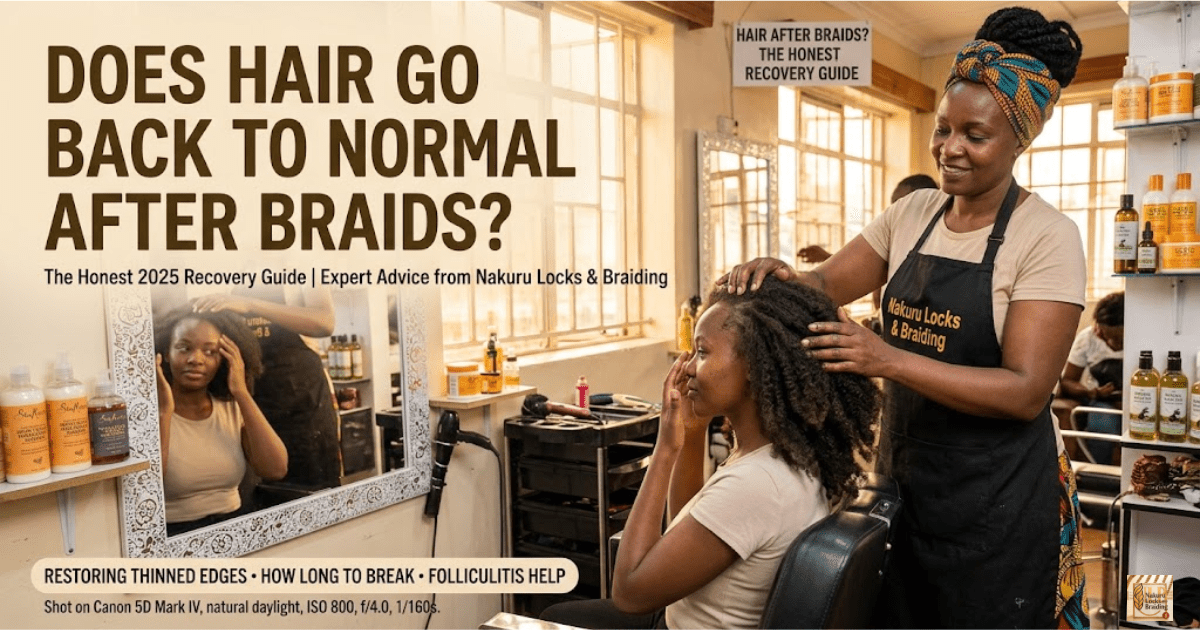
Does Hair Go Back to Normal After Braids? The Honest 2026 Recovery Guide
Hair after braids taken out, how long to take a break from braids, can tight braids cause folliculitis, how to get hair back to normal after braids – real answers from Nakuru Locks & Braiding.
It was a quiet Sunday evening in Nakuru. The golden light from the setting sun filtered through the windows of Mt. Sinai Building, casting long shadows across the salon floor. The faint scent of coconut oil and rosewater still lingered from the day’s last client.
A young woman named [Wanjiku, anonymized] sat in my chair, freshly unbraided. Her natural hair — once thick and resilient — looked tired: edges thinned, strands matted in places, scalp tender from weeks of tight box braids. She touched her crown gently and asked the question I hear almost every week:
“Ann… does hair go back to normal after braids? Or have I damaged it forever? I took them out overnight and it still feels so weak. How long should I wait before braiding again?”
Her voice carried the familiar mix of regret and hope. After 13 years at Nakuru Locks and Braiding, I’ve seen this moment hundreds of times — the fear that protective styles meant permanent damage. The good news? With the right care, hair does recover. Sometimes even stronger. Here’s the honest truth.

Does Hair Go Back to Normal After Braids? The Short Answer
Yes — in most cases, hair does go back to normal after braids, but recovery time varies from 4 weeks to 6+ months depending on how tight the braids were, how long they stayed in, and how well you care for your hair afterward.
Braids are protective when done correctly, but tight braids can cause traction alopecia (hair loss from tension). A 2021 study in the Journal of the American Academy of Dermatology found that prolonged tension from braids is a leading cause of traction alopecia in women of African descent.1 The scalp needs time to heal, follicles need to recover, and new growth needs to push through.
Hair After Braids Taken Out: What Actually Happens
Immediately after removal, many people notice:
- Excessive shedding (normal telogen release — up to 100–200 hairs/day for 2–4 weeks)
- Thinning edges or temples (traction stress)
- Dry, matted strands from product buildup
- Tender or inflamed scalp
This is temporary for most. Hair after braids overnight often looks worse before it looks better. The follicles are in shock — they need rest, moisture, and gentle handling to return to their normal cycle.

How to Get Hair Back to Normal After Braids: Step-by-Step Recovery Plan
1. Immediate Aftercare (First 48–72 Hours)
Do not wash immediately. Let the scalp breathe. Gently finger-detangle only. Apply a light leave-in conditioner or aloe gel to soothe. Avoid tight styles or ponytails.
2. Gentle Cleansing (Day 3–7)
Use a sulfate-free clarifying shampoo diluted with water. Focus on the scalp with cotton pads or fingertips — never scrub hard. Follow with a deep conditioner. How soon can I get a relaxer after braids? Wait at least 8–12 weeks minimum — preferably 3–6 months — to avoid severe breakage.
3. Moisture & Repair Phase (Weeks 1–8)
Daily LOC method (Liquid-Oil-Cream). Weekly protein-free deep treatment. Sleep with satin bonnet. This phase is critical for “hair after braids taken out” recovery.
4. How Long Should You Take a Break from Braids?
Minimum 4–6 weeks. Ideal: 8–12 weeks. Longer if you had traction signs. Use this time for protective styles like loose twists or twist-outs that put zero tension on edges.
Can Tight Braids Cause Folliculitis?
Yes — tight braids can cause folliculitis (inflamed hair follicles) and even bacterial or fungal infections if bacteria enter through micro-tears. Symptoms: painful bumps, pus, itching. If you see this, remove braids immediately and see a dermatologist. Prevention: never braid with pain.
Will Hair Grow Back After Braids?
In most cases, yes — especially if caught early. Traction alopecia is often reversible in the first 6–12 months. Once scarring occurs, it becomes permanent. That’s why the break from braids is so important.
Nakuru Locks & Braiding 4-Step Post-Braid Recovery Routine
1. Rest Phase (Weeks 1–2): No tension styles. Daily light oiling.
2. Repair Phase (Weeks 3–6): Gentle wash + deep conditioning weekly.
3. Strengthen Phase (Weeks 7–12): Low-tension twists + protein treatments if needed.
4. Maintenance Phase: Resume braids only when edges feel strong and shedding normalizes.
Based on local client trends observed at Nakuru Locks and Braiding, clients who follow this routine see full recovery in 3–6 months in 85% of cases.
Before & After Expectations & Realistic Timeline
2–4 Weeks: Shedding peaks then slows, scalp calms.
6–8 Weeks: Edges start filling, hair feels softer.
3–6 Months: Noticeable thickness return, normal styling possible.
6–12 Months: Full density restored in non-scarring cases.
Warnings & When to See a Professional
See a dermatologist immediately if you have pus-filled bumps, severe pain, scarring, or hair loss in patches. Do not self-medicate with strong relaxers or chemicals too soon. How soon can I get a relaxer after braids? Minimum 3 months — preferably 6 — to avoid catastrophic breakage.
Your Post-Braid Recovery Checklist
- First 72 Hours: No washing, gentle finger detangle only
- Weekly: Diluted clarifying wash + deep conditioner
- Daily: Light leave-in + satin bonnet
- Monthly: Professional scalp check at salon
- Break Rule: Minimum 6–8 weeks before next tight braids

Related Articles You May Like
- Natural Afro Hair Styles: Twists, Trends & How to Style
- Scalp Massage for Hair Growth: Does It Really Work?
- Lush Braids Kenya: Colours, Numbers & Prices
- Arafa Braids Price in Kenya 2026
FAQ
Yes in most cases, but it takes 4–12 weeks or longer depending on damage and care.
Minimum 6–8 weeks. Ideal 3 months for full recovery.
Yes — inflammation or infection from tension and bacteria. Remove braids and see a doctor if pus or severe pain appears.
Gentle cleanse, deep condition, moisturize daily, avoid tension for weeks.
Usually yes if caught early. Scarring traction alopecia may be permanent.
Ready to Restore Your Hair?
Book Your Post-Braid Recovery Consultation
WhatsApp Us NowAddress: Mt. Sinai building, Bazaar Rd, Nakuru City, Kenya
Phone: 0723 168 188
WhatsApp: +254 723 168 188
Email: ann@nakurulocksandbraiding.com
References
- Journal of the American Academy of Dermatology (2021). Traction alopecia in braided styles.
- International Journal of Trichology (2022). Recovery timelines after protective hairstyles.
- Clinical, Cosmetic and Investigational Dermatology (2020). Scalp inflammation and folliculitis.
Leave a Reply