
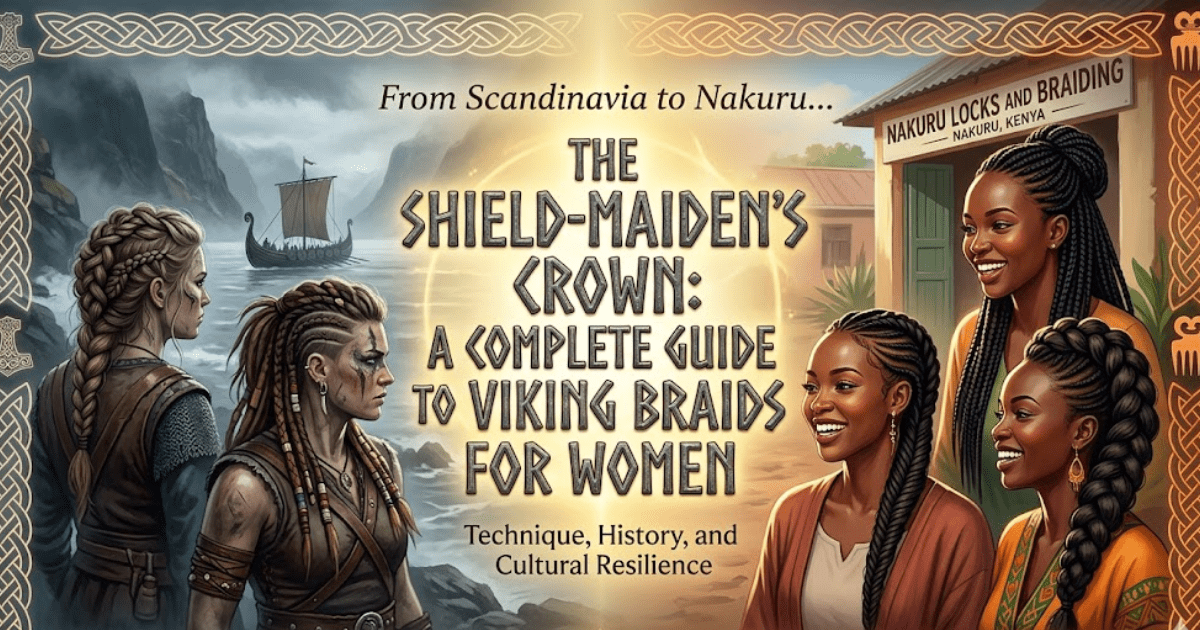
The Shield-Maiden’s Crown: A Complete Guide to Viking Braids for Women
From the mist-shrouded fjords of Scandinavia to the modern-day runways of Paris and the streets of Nakuru, the “Viking braid” has transitioned from a practical warrior necessity to a global symbol of strength, femininity, and artistry.
While television dramas like Vikings and The Last Kingdom have popularized the aesthetic, the true history of female Nordic Viking braids is a rich tapestry of culture, status, and intricate craftsmanship.
At Nakuru Locks and Braiding, we believe every hairstyle tells a story. Whether you are rocking long flowing locks or a chic short cut, Viking braids offer a versatile, edgy, and protective way to express your inner warrior.
The Primacy of the Braid: African Origins and the Dawn of Adornment
The inquiry into which culture pioneered the art of braiding yields a definitive archaeological answer: the roots of this practice are deeply embedded in the African continent, predating the Viking Age by several millennia. While the Viking Era is strictly defined between the 8th and 11th centuries CE, the evidence for African braiding extends back to the prehistoric era.
The earliest representations of what appears to be braided or patterned hair are found in the Upper Paleolithic portable art of Europe and Eurasia, such as the Venus of Willendorf (c. 30,000 BCE) and the Venus of Brassempouy (c. 25,000 BCE), which depict woven patterns capping the head. However, it is in Africa where these techniques evolved into a sophisticated cultural language.
Rock paintings in the Tassili n’Ajjer region of the Sahara, dating to approximately 3500 BCE, clearly depict women with intricate cornrows. These depictions predate any evidence of Scandinavian braiding by over four thousand years, establishing Africa as the primary cradle for the development of complex plaited styles.

Ancient Egypt
In Ancient Egypt, braiding reached a level of high-status artistry during the Early Dynastic Period and the Old Kingdom (c. 3100–2181 BCE). Egyptian hair behavior was a meticulous reflection of social hierarchy; while commoners wore simpler styles for functionality, the elite adorned their braids with gold, beads, and aromatic greases. Archaeological finds of Egyptian mummies have revealed perfectly preserved dreadlocks and braids, some reinforced with additional hair to create volume and length.
The diversity of African braiding is not merely aesthetic but regional and ethnic, with each pattern serving as a repository of communal data. The Nok tribe of modern-day Nigeria left behind clay sculptures dating to 500 BCE that display elaborate cornrow patterns, suggesting that these styles have been a staple of West African identity for over two and a half millennia. Similarly, the Himba people of Namibia have maintained a continuous tradition of using red ochre, butter, and goat hair to create long, thick braids that signal various life stages.
Period or Culture |
Estimated Date | Primary Evidence Type | Key Style Characteristics |
| Upper Paleolithic | 30,000–25,000 BCE | Portable Venus Figurines | Geometric woven head patterns |
| Sahara Region | 3500 BCE | Tassili Rock Art | Vertical cornrows and plaits |
| Ancient Egypt | 3100–1000 BCE | Mummified Remains | Intricate braids, beads, gold |
| Nok Culture (Nigeria) | 500 BCE | Terra Cotta Sculpture | Elaborate scalp-anchored rows |
| Migration Period Europe | 400–550 CE | Gold Bracteates | Ponytails, simple plaits |
| Viking Age Scandinavia | 800–1050 CE | Pendants, Grave Combs | Knots, buns, simple braids |
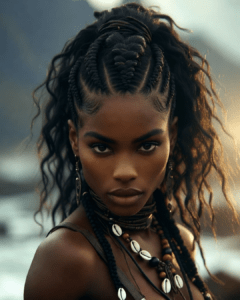
What Did a Real Viking Woman Look Like?
Before diving into the styling chair, it is essential to separate Hollywood fiction from historical reality. Modern media often depicts Viking women with perfectly manicured, complex fishtails and heavy kohl eyeliner. In reality, Viking women prioritized practicality and social signaling.
Archaeological evidence, such as the silver pendants found in Swedish burial sites (like the Hiddensee treasure), suggests that Viking women often wore their hair long. Common styles included:
-
The “Oseberg” Knot: Hair gathered into a ponytail and tied into a sophisticated bulb-like knot at the back of the head.
-
Simple Plaits: Braids were used to keep hair out of the way during labor-intensive tasks like farming, weaving, and—in the case of shield-maidens—combat.
-
Headcoverings: Married women often wore scarves or hoods (like the jorvik cap), with braids peeking out from underneath.
While the “dirty, rugged” look is popular on screen, the Vikings were actually quite fastidious. Excavations frequently uncover ornate bone combs, ear spoons, and tweezers, indicating that hair care was a significant part of Norse daily life.
Who Had Braids First: Vikings or Africans?
A common question in the world of hair styling is the origin of the braid. While many cultures developed braided styles independently, the historical timeline is clear.
African braids are among the oldest recorded hairstyles in human history. The earliest evidence of braiding dates back to the Venus of Willendorf (estimated 25,000–30,000 years ago) and, more definitively, to cave paintings in the Tassili n’Ajjer plateau of the Sahara, which show women with cornrows dating back to 3500 BCE. In Africa, braids were never just “hair”; they were a complex language indicating tribe, marital status, wealth, and religion.
Viking braids, by contrast, appeared much later during the Viking Age (793–1066 CE). While the Norse people undoubtedly used braids for functionality and decoration, the practice of intricate hair weaving was already a millennia-old tradition across the African continent and Egypt long before the first longship touched the shores of Britain.
Viking Braids vs. African Braids: What’s the Difference?
While both styles involve the interlacing of hair strands, the technical execution and cultural purpose differ significantly.
1. Technique and Tension
-
African Braids (e.g., Cornrows, Box Braids): These are typically characterized by high-precision sectioning and “underhand” braiding techniques. On textured hair, these styles are often designed to be “protective,” staying in for weeks at a time to retain moisture and length.
-
Viking Braids: Traditional Norse styles often used an “overhand” or Dutch-style technique. They are generally looser and designed to be worn for shorter periods. In modern styling, “Viking braids” often incorporate “fuzzy” textures and pancaked edges for a voluminous, lived-in look.
2. Materials
Viking styles historically relied on the natural thickness of the hair or wool threads. African styles have a long history of incorporating plant fibers, beads, shells, and, more recently, high-quality synthetic extensions to achieve length and intricate patterns.
3. Aesthetics
Viking braids often feature a “mohawk” silhouette—tightly braided sides with a voluminous, messy top. African braiding often follows the scalp in geometric patterns (cornrows) or hangs freely in uniform sections (box braids).
Top Viking Braid Female Styles for 2026
Whether you have waist-length hair or a tapered cut, there is a Viking-inspired look for you.
1. Viking Braids Female Long Hair: The Triple Goddess
For those with length, the most iconic look is the Triple Dutch Row.
-
How to Style: Section the hair into three vertical columns. Create three tight Dutch braids starting from the hairline and ending at the nape of the neck. Allow the remaining hair to flow into a messy ponytail or a thick, fishtail braid.
-
Pro Tip: Use a sea salt spray to add grit and texture to the loose ends.
2. Viking Braids Female Short Hair: The Side-Shave Illusion
You don’t need long hair to channel Lagertha. Short hair can be transformed using side-accent braids.
-
How to Style: On one or both sides of the head, create two or three very tiny, tight cornrows (or Dutch braids) that follow the curve of the ear. Secure them with clear elastics. This gives the appearance of a “side-shave” or “undercut” without the commitment of a razor.
3. Easy Viking Hairstyles Female: The Half-Up Accent
Perfect for beginners, this style takes less than ten minutes.
-
How to Style: Take two sections of hair from the temples. Braid them back into simple three-strand plaits. Join them at the back of the head with a leather cord or a metallic hair cuff. Leave the rest of your hair in natural waves.
The Technicality: What is the Difference Between Braids and Viking Braids?
Technically, all Viking braids are braids, but not all braids are “Viking.” The distinction lies in the styling architecture.
A standard braid (like a French braid) is often meant to look neat and cohesive. A Viking-style braid usually emphasizes:
-
Exposed Scalp Lines: Creating sharp “lanes” on the side of the head.
-
Volume Contrast: Combining very tight braids with very loose, teased hair.
-
Adornments: The use of rings, beads, and leather ties to give a rugged, “forged” appearance.
How to Maintain Your Viking Braids
To ensure your style stays “warrior-ready” and doesn’t damage your hair, follow these professional tips:
-
Avoid Over-Tension: Especially on the hairline. Viking styles look best when the “messiness” is intentional, not a result of hair breakage.
-
Scalp Health: Use a light oil (like jojoba or rosemary oil) on the exposed parts of your scalp to prevent dryness.
-
Sleep Care: Wrap your hair in a silk or satin scarf at night to prevent the “fuzz” from becoming “frizz.”
Modern Adaptations: The Viking Braid for the 21st Century
The modern resurgence of “Viking braids” for women is heavily influenced by characters like Lagertha from the television series Vikings. These styles often incorporate elements that are not historically Norse but are instead a fusion of various braiding techniques. Modern interpretations often prioritize a “warrior” aesthetic, characterized by high volume and intricate detail.
Braiding the sides of the head very tightly to the scalp (simulating cornrows) creates the appearance of an undercut without the commitment of shaving. To achieve the thick, rugged look seen on screen, stylists use a technique called “pancaking,” where the edges of a braid are gently pulled outward to make it appear wider and more textured. Modern styles often mix three-strand braids with Dutch braids, fishtail braids, and rope twists to create a layered, “shield-maiden” effect.
Viking Braids for Long Hair
Long hair offers the greatest versatility for creating the complex, layered looks associated with the modern Norse aesthetic. The multi-braid “Lagertha” style is designed to keep hair out of the face while maintaining a dramatic profile.
-
Preparation and Texture: Start with dry hair that has been texturized with dry shampoo or sea salt spray for better grip.
-
Strategic Sectioning: Divide the hair into a top section (from forehead to crown) and two side sections.
-
Side Braid Construction: Create two or three small, tight Dutch braids on each side of the head, following the curve of the ear.
-
Central Volumizing: French or Dutch braid the top section, adding volume by “pancaking” the loops once the braid is secured.
-
Final Synthesis: Bring all braids together at the back or leave them hanging for a “half-up” look.
The “Dragon’s Spine” or centrally braided mohawk is a bold, symmetrical style that focuses on a large central braid. This involves braiding a thick section of hair down the center of the head, starting at the hairline and working toward the nape. The sides are kept sleek by either braiding them into micro-braids or pinning them flat against the head. Incorporating leather wraps or metal rings along the length of the central braid provides an authentic texture.
Viking Braids for Short Hair
Short hair, including pixie cuts and bobs, can still embody the spirit of the northern warrior through accent braids and textured styling. For women with very short hair, focus on the temple area to add an edgy detail. This involves sectioning off a small area above the ear and creating one or two tiny, tight braids that run from the temple to the back of the head. The “Undercut Bob” works for chin-length hair and mimics the look of a shaved side by braiding the hair on one side of a deep side part tightly against the scalp and pinning it beneath the loose hair at the back.
| Hair Length | Recommended Viking Style | Key Technical Implementation |
| Pixie Cut | Temple Accent Braids | Dual lace braids with matte pomade |
| Short Bob | Faux Undercut Braid | Tight Dutch braid pinned at the nape |
| Mid-Length | Half-Up Mohawk | Central French braid with crimped sides |
| Long Hair | Multi-Layered Warrior | Triple Dutch braids with pancaking |
| Undercut | Top Knot Braid | Single thick braid into a messy bun |
Technical Mastery: The Anatomy of the Snake Braid
The “snake braid” is a common element in modern Viking-inspired hair design, adding an intricate, non-traditional texture to the style. This technique creates a unique aesthetic that differs from the standard three-strand plait.
-
Fundamental Plaiting: Start by creating a standard three-strand braid, ensuring the tension is loose enough to allow the hair strands to move.
-
Tension Control: Once the desired length is reached, grasp the middle strand firmly in one hand while holding the two outer strands together in the other.
-
The Slide Mechanism: Push the outer strands upward along the middle strand toward the scalp.
-
Structural Formatting: The outer strands will bunch up along the middle strand, creating a winding, snake-like pattern.
-
Final Setting: Gently pull the bunched sections downward to space out the “snake” segments evenly, then secure the terminal end with a clear elastic.
Hair Health and Maintenance
When engaging in frequent braiding, particularly styles that require high tension or heavy manipulation, it is vital to prioritize hair health to prevent long-term damage. Traction alopecia is a significant concern when attempting to replicate “Viking” styles on fine hair using techniques originally designed for coarser textures.
Preventing Mechanical Damage
Traction alopecia is hair loss caused by repeated tension on the hair follicles. This is a risk when applying heavy tension to the fine, straight hair typical of Northern European descent. Professional practitioners recommend avoiding over-tightening at the hairline; if the wearer experiences pain or notices small white bumps at the follicle base, the braid is excessively tight. It is essential to rotate styles frequently, avoiding keeping the same braided configuration for more than a few days to allow the scalp to recover.
Professional Preparation Protocols
The “dirty hair” myth—the idea that braids hold better on unwashed hair—is often cited, but professional standards favor starting with clean hair that has been texturized with professional-grade products. Clays, pomades, and texturizing sprays provide the necessary “grip” without the buildup of natural oils that can lead to scalp irritation.
Thorough detangling before sectioning is mandatory to prevent breakage during the braiding process. At night, protecting the hair with a silk or satin bonnet reduces friction and prevents the braids from becoming “fuzzy” or damaged during sleep.
Historical Mystery: The Suebian Knot and Iron Age Precursors
Before the Viking Age, Germanic tribes practiced a form of hair binding known as the “Suebian knot.” Described by the Roman historian Tacitus in 98 CE, this style involved combing the hair to the side and tying it into a distinctive knot on the temple or crown. Tacitus noted that this fashion distinguished the freeman from the slave and was worn even by old men as a status symbol.
While primarily a male style intended to make warriors appear taller and more formidable on the battlefield, the Suebian knot illustrates the long-standing tradition of hair as a social and mystical statement in Northern Europe. Bog bodies like the Osterby Man (c. 70–220 CE) have been found with perfectly preserved Suebian knots, providing a rare direct link to the braiding and knotting traditions of the pre-Viking era. The technical skill required to maintain such a knot on long, fine hair—even in the absence of modern styling products—demonstrates the high level of grooming expertise present in ancient Germanic societies.
The Sociopolitical Legacy of African Braids in the Diaspora
To understand African braiding is to understand a legacy of resilience. During the centuries of enslavement in the Americas, braids became a vital tool for the preservation of culture and the pursuit of freedom. Cornrow patterns were used to “draw” maps of plantations and escape routes, which could be easily hidden from overseers. Braids were also used to hide gold and seeds, such as rice or okra, to be planted once freedom was achieved, ensuring that the liberated could sustain themselves in new lands.
In the 20th and 21st centuries, the reclamation of natural hair and traditional braiding styles became a symbol of pride and a rejection of Eurocentric beauty standards. The CROWN Act, signed into law in several US states starting with California in 2019, prohibits discrimination based on hair texture and protective hairstyles like braids, locs, and twists, highlighting the ongoing political significance of these styles.
Frequently Asked Questions regarding Viking and African Braiding
What is the difference between a French braid and a Viking braid?
A “Viking braid” is not a single technique but a stylistic category popularized by modern media. Technically, most “Viking” looks use Dutch braids (an underhand technique where the braid sits on top of the hair) rather than French braids (an overhand technique where the braid is woven into the hair) to create more visible texture and volume.
Did Viking women actually have shaved sides?
There is very little archaeological evidence to suggest that Viking women shaved their heads. Representational art, such as Valkyrie pendants and carvings on the Oseberg ship, consistently shows women with long hair tied in elaborate buns or knots. Shaved styles for women are largely a modern cinematic invention used to signal a “warrior” persona.
Can I do Viking braids on short hair?
Yes. Short hair can be styled with “accent braids” at the temples or along the part line. For pixie cuts, micro-braids or twists can add a Norse-inspired edge without requiring long hair.
Are Viking braids a form of cultural appropriation?
The term “Viking braids” is controversial when used to describe traditional African styles like cornrows. While braiding is a universal human practice, the specific on-scalp techniques of cornrowing have a distinct African history and deep cultural meaning. It is respectful to use correct technical terminology (e.g., Dutch braids, rope twists) and acknowledge the diverse origins of the styles.
How do I make my Viking braids look thick?
Use the “pancaking” technique: once the braid is secured, gently pull on the outer loops of each section to flatten and widen the braid. Crimping the hair before braiding or using texturizing powder can also add significant volume and a “rugged” finish.
Synthesis and Conclusion: The Interwoven Future of Braiding
The enduring appeal of the braid—whether in the refined knots of a Viking matron or the symbolic cornrows of a West African queen—lies in its ability to transform the ephemeral growth of the human body into a structured expression of identity. While the “Viking braid” of today is a hybrid of history and Hollywood, it serves as a testament to our fascination with the “warrior” spirit and the aesthetic power of woven hair.
By understanding the chronological primacy of African braiding and the meticulous grooming habits of the Norse people, we can approach modern styling with greater technical skill and cultural respect. Whether used for protective maintenance, social signaling, or purely aesthetic pleasure, the art of the braid remains a vital thread in the tapestry of human culture. As we continue to innovate and blend these traditions, we honor the millions of hands that have, over thirty thousand years, rhythmic and steady, interlaced the strands of our shared history.
Read more articles from Nakuru Locks and Braiding:
-
The Science of Scalp Health: Preventing Tension and Breakage in Braided Styles
-
Ancient African Braiding: A Regional Guide to Tribal Identity and Patterns
-
Modern Protective Styling: Navigating the Transition from Tradition to Trend
Sources
-
The Vikings by Else Roesdahl (Penguin Books)
-
Hair: A Human History by Kurt Stenn
-
Textiles and Costume of the Viking Age by Gale Owen-Crocker
Leave a Reply