
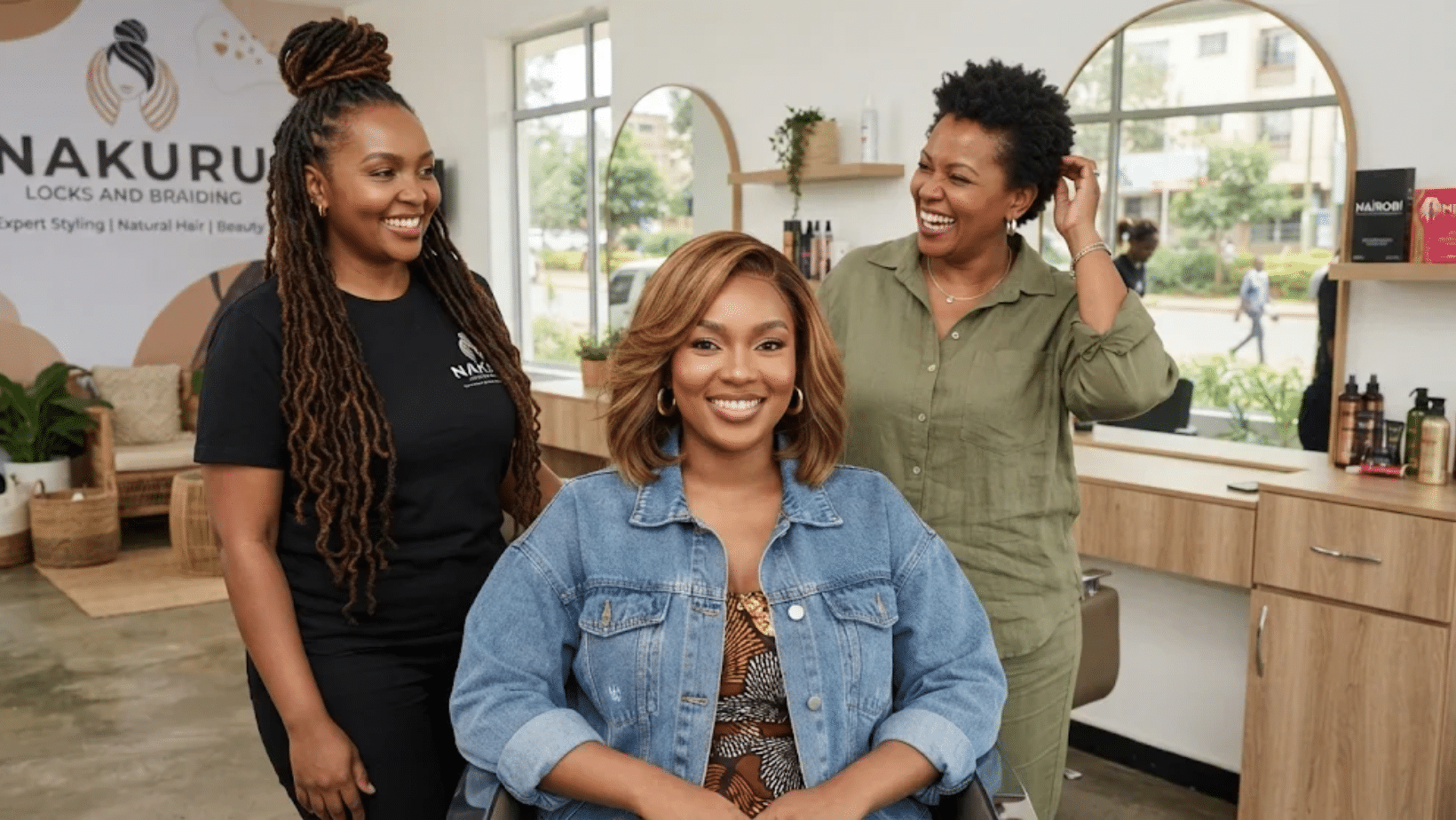
Plus Size Hairstyles: Flattering, Easy, and Confidence-Boosting Styles for Every Face and Hair Type
The best hairstyle is not the one that “hides” your body—it is the one that frames your face beautifully, suits your hair texture, fits your lifestyle, and makes you feel like yourself.
For plus-size women, the most flattering looks often use balance, face-framing layers, strategic volume, and comfortable protective styling rather than rigid beauty rules.
At Nakuru Locks and Braiding, we help clients choose styles that respect their features, hair health, and personal style.
This guide explains plus-size hairstyles for double chins, thin hair, straight hair, women over 50, and Black women—while answering common questions such as whether short or long hair looks better on a plus-size figure.

What “Plus Size” Really Means
“Plus size” is a clothing and body-size category, not a limitation on what hairstyles you can wear.
Medically, the NHS describes a BMI of 25–29.9 as overweight and 30 or above as obese for most adults; however, BMI does not define your worth, beauty, or ability to wear a particular hairstyle.
A hairstyle should never be chosen to “correct” a body. Instead, choose it to complement your face shape, neck length, hair density, texture, maintenance routine, and the occasion.
That approach produces a more natural, confident result than following outdated rules about what plus-size women “should” wear.
What Hairstyle Suits a Plus-Size Woman?
The most useful answer is: the one that balances your proportions and suits your hair type, lifestyle and comfort. Stylists commonly work with four ideas:
- Balance volume. A style with some lift at the crown or soft width at the jaw level tends to look proportionate with a fuller body. Very flat, very close-cut styles can feel less balanced for some people, while extremely big styles can overwhelm. Moderate volume is the safe middle.
- Frame the face. Face-framing pieces, soft fringes, long side-swept layers or braids that start above the ear draw the eye to your eyes and cheekbones.
- Choose movement over blunt lines. Soft layers, waves and curls add shape. A heavy, blunt line can sit exactly where you do not want attention.
- Match the style to your maintenance reality. A beautiful style that fights your hair every morning will not look beautiful for long.
These are starting points, not rules. If you love a style and feel confident in it, that matters more than any chart.

Plus Size Hairstyles for a Double Chin
A double chin is a normal feature that affects people of every body size, and plenty of slim people have one as well. If you would like to soften attention around the jaw and neck, these approaches work well:
- Chin-to-collarbone lengths. Hair that ends well below the chin, around the collarbone, lengthens the line of the face and neck. A cut that stops exactly at the jaw can emphasise the area.
- Height at the crown. Lift at the top, through a root-lifting cut, a soft pompadour or a high braided style, creates a vertical line that draws the eye upward.
- Side parts. A deep side part is more flattering to most faces than a centre part because it breaks symmetry and adds asymmetrical interest.
- Long layers and side-swept fringe. Pieces that fall diagonally across the face create angles that soften roundness.
- Updos with volume on top. A loose bun or twist placed high, with a few face-framing strands left out, shows off your neck and cheekbones.
What to approach carefully: a blunt bob that ends precisely at the chin, and very tight slicked-back styles that leave the whole jawline exposed with no softness around it.
Plus Size Hairstyles for a Double Chin With Layers
Layers are one of the best tools for this concern, when they are placed with intention:
- Long layers starting at the cheekbone. Layers that begin around the cheekbone add movement exactly where the eye travels. They create a gentle “V” shape that points downward, lengthening the face.
- Curtain fringe. Parted in the middle and swept to each side, a curtain fringe frames the cheeks and softens the lower face.
- Layered lob (long bob). A lob that skims the collarbone, with soft layers throughout, gives shape without sitting at the chin.
- Waves rather than a stiff blowout. Loose waves add width that is soft, not heavy.
- Layered curls and coils. For natural textures, a shaped curly cut with layers distributes volume evenly, which keeps curls from forming a “triangle.” Ask your stylist to cut curls dry or while curls are in their natural pattern.
Tip for the salon: Show your stylist photos from the front and the side. Say where you want the longest layer to fall, for example “around my collarbone,” so that it does not end up at the jaw.
Plus Size Hairstyles for Thin Hair
Thin hair needs the opposite of heaviness. The aim is to create the look of fullness without causing damage.
- Blunt ends with soft interior layers. A one-length cut at the ends makes thin hair look denser. Add only a few subtle layers on top for movement.
- Shoulder-length cuts. Very long thin hair can look stringy. A length between the chin and the collarbone often reads fuller.
- A short, textured pixie or cropped cut. Short cuts remove thin, fragile ends and can look striking when the haircut is shaped well.
- Soft curls or waves. Heat-free methods such as flexi-rods or braid-outs add body without high heat. Take care with hot tools.
- Colour for depth. Subtle highlights or lowlights create the illusion of thickness. Discuss the health of your hair first.
- Avoid extra tension. If your hair is thin, it is more important not to add heavy extensions or very tight braids. Tension on fragile hair can contribute to hair loss. See the safety section below.
If you are noticing a receding hairline, widening parting or new shedding, see a doctor or dermatologist. Hair thinning has many causes, including hormonal, nutritional and medical ones, and a hairstyle cannot treat them.
Plus Size Hairstyles for Women Over 50 and Overweight
After 50, hair often changes in texture, density and colour. Hormonal changes can make hair finer or drier. A good haircut should be low effort, kind to the scalp and flattering to the face.
- The soft layered bob or lob. It is elegant, easy to maintain and adds polish.
- Face-framing layers with a side-swept fringe. These soften the forehead and jawline.
- A short, tapered, textured crop. Perfect for fine or thinning hair. It stays light, and a little styling cream gives lift.
- Embracing silver or grey. Grey hair can look luminous when the cut is crisp and the hair is kept hydrated and glossy. A gloss treatment helps with shine.
- Gentle protective styles. Loose twists or larger, lightweight braids are comfortable options for those with afro-textured hair. Avoid pulling at the hairline.
- Avoid: hairstyles that need hours of heat styling, and extremely dark, flat colour that can look harsh against softer skin tones.
Comfort matters too. If you spend long periods seated, choose styles that do not press against the neck or the back of the head.
Hairstyles for Plus Size Black Women
Black women have some of the richest hairstyling traditions in the world, from braids and twists to locs, Afros and silk presses. Many of the styles below suit a fuller figure beautifully, because they bring height, texture and presence.
Styles that work well
- Medium or large box braids. These are lightweight compared with very small braids, and they can be worn in a bob length, waist length or tied up in a high bun for height.
- Knotless braids. Many clients and stylists find the feathered start gentler at the root, though they must still be installed without tension.
- Twist-outs and braid-outs. They create natural volume and a soft shape around the face.
- A tapered natural cut (TWA). Bold and low maintenance. It highlights the cheekbones and neck.
- Locs. Styled in a high bun, a halo or soft loops, locs offer both shape and variety.
- Updos with height. Braided crowns, top-knots and sculpted buns add elegant lift.
- Fulani braids and cornrow designs with an accent bun. These look dramatic. Keep them lightly installed.
Scalp and hair safety: what the dermatology evidence says
This is the part many salons skip, and it is essential. Traction alopecia is gradual hair loss caused by repeated or prolonged pulling on the hair roots.
The American Academy of Dermatology (AAD) lists cornrows, locs, tight braids, tightly pulled ponytails and buns, and extensions or weaves among the styles that can cause it when too tight.
It also notes that the shape of hair follicles in people of African descent can make hair more vulnerable to damage from tight or rough styling.
Researchers at Johns Hopkins reviewed 19 studies and found a “strong association” between scalp-pulling hairstyles and traction alopecia, and estimated that around one third of African-American women are affected.
Dermatologists interviewed by Dermatology Times add that the condition can progress to scarring hair loss if the tension continues, and that individuals of any ethnicity can develop it.
The AAD’s practical advice is clear, and we follow it at our salon:
- If a style feels painful, it is too tight. The AAD says to remove it.
- Loosen braids, especially around the hairline.
- Choose thicker braids or locs, and keep them shorter, because longer hair is heavier and pulls more.
- Keep braids in for no more than 6-8 weeks (some dermatology reviews say up to two to three months at the outside), and give your hair a rest between sets.
- Prefer sewn-in weaves to those using bonding glue.
- Check monthly for early signs such as broken hairs at the forehead or a receding hairline.
For plus size clients who are also thinking about weight and comfort, remember that a lightweight style is a kinder style. Ask us for medium-sized, shorter or half-up braided looks that stay comfortable on the scalp.
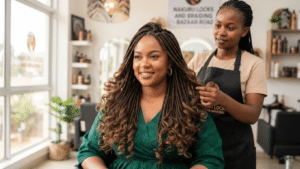
Short Hairstyles for Plus Size Women
Short hair can look fantastic on a fuller figure, as long as it has shape.
- The textured pixie with volume on top. It lengthens the face and shows off cheekbones.
- An asymmetrical bob. It is longer at the front, shorter at the back, which creates diagonal lines.
- A tapered cut for natural hair. Clean edges and defined shape are very striking.
- The soft crop. A little length through the top, tapered sides and a side-swept fringe.
- The short wavy bob. It has movement and is easy to wash and go.
Does Short Hair Look Good on Plus Size Women?
Yes, it can. Short hair works best when it has volume or texture at the crown and soft detail around the face.
The cuts that tend to be less flattering are those that are very flat, very rounded and end exactly at the widest part of the face.
A cut that is chosen for your face shape and hair texture will look good whatever your body size. Short hair also shows off the neck and collarbones, which many women love.
Is Short or Long Hair Better for Overweight Women?
Neither is better by default. Here is a simple comparison:
| Factor | Short hair | Long hair |
|---|---|---|
| Face shape | Can lengthen and lift the face when styled upward | Frames the face and draws the eye downward in a lengthening line |
| Neck | Shows off neck and shoulders | Covers the neck, so it may feel more comfortable for some |
| Upkeep | Needs regular trims (every 4-6 weeks) | Needs less frequent trims but more detangling |
| Scalp health | No weight on the scalp | Heavy lengths and extensions add tension |
| Best for | Fine, thinning or heat-damaged hair; low-maintenance days | Those who love versatility and updos |
Our most common recommendation is the middle path: collarbone to mid-length hair with soft layers. It gives you the benefits of both options.
Hairstyles for Plus Size Women With Straight Hair
Straight hair shows every line of a cut, which is an advantage when you want precision:
- Long layers with a side part. Layers begin at the cheekbone and add movement.
- A collarbone lob. Slightly angled toward the face.
- A soft, curtain fringe. It frames the face and is easy to grow out.
- Textured ends. Ask for “point cutting” so the ends do not look heavy.
- Volume at the root. Straight hair often falls flat. Use a root-lifting spray and blow-dry the roots upward.
- Beach waves. A wand or a heat-free braid wave adds shape.
If your straight hair is also thin, keep the length around the collarbone and add only light layers.
Simple and Easy Plus Size Hairstyles
You do not need an hour in front of the mirror. These are quick styles that look polished:
- The high bun or top-knot. It adds height, takes two minutes and shows off the neck. Use a soft scrunchie, not a tight elastic.
- The half-up style. Gather the top section for crown height and leave the rest down.
- A side braid or loose plait. Drape it over one shoulder for an asymmetrical line.
- A headband or silk scarf. Instant polish on a wash day. Tie it loosely.
- Twist-outs or wash-and-go curls. Define curls with a leave-in conditioner and a gel and let them dry.
- Large, low-tension box braids. They last for weeks and need little styling.
- A sleek low ponytail with face-framing pieces. Keep it loose to avoid pulling at the temples.
The AAD notes that wearing a tightly pulled ponytail or bun is fine once in a while, but should not be the everyday habit.
How to Choose Your Style: A Quick Checklist
- Hair type: straight, wavy, curly or coily?
- Density: thin, medium or thick?
- Lifestyle: how many minutes can you give each morning?
- Scalp health: any soreness, thinning or flakiness?
- Comfort: does the style press on your neck, ears or scalp?
- Confidence: do you feel like yourself?
Bring your answers and photos to your consultation. At Nakuru Locks and Braiding we will talk through what is realistic for your hair before we start, and we will tell you if a style is too heavy or tight for your scalp.

Frequently Asked Questions
What hairstyle suits a plus-size woman?
A style that balances proportion, offers moderate volume and frames the face: soft layers, a collarbone lob, a textured crop, loose braids, or an updo with height. The best choice also suits your hair texture and routine.
What are the best plus size hairstyles for a double chin?
Hair that falls below the chin to the collarbone, height at the crown, a side part, a side-swept fringe and long face-framing layers. Avoid a blunt cut that ends exactly at the jaw.
Which layered cuts are best for a double chin?
Long layers beginning at the cheekbone, a curtain fringe, a layered lob and loose waves. Ask for the longest layer to fall around the collarbone.
What are good plus size hairstyles for thin hair?
Blunt ends with light layers, shoulder-length cuts, a textured pixie, soft waves and subtle colour. Avoid heavy extensions and tight braids, which can stress fragile hair.
What hairstyles suit plus size women over 50?
A soft layered bob or lob, face-framing layers, a tapered crop and glossy natural grey. Choose low-maintenance, gentle styles.
Which braided styles are safe for plus size Black women?
Medium or large, lightweight braids installed without tension at the hairline. The AAD recommends loosening braids, choosing thicker ones, keeping them shorter and removing them if they hurt.
How long can I keep braids in?
The AAD suggests no longer than 6-8 weeks, and some dermatology guidance allows up to two to three months at most. Rest your hair between styles.
Does short hair look good on plus size women?
Yes, when it has volume at the crown and a soft shape. Avoid flat, rounded cuts that end at the widest point of the face.
Is short or long hair better for overweight women?
Neither. Collarbone to mid-length hair with soft layers is a reliable middle option.
What are easy hairstyles for plus size women?
A high bun, half-up style, side braid, twist-out, wash-and-go curls or large box braids. Keep ties loose.
Do straight hair and plus size hairstyles work together?
Absolutely. Long layers, a collarbone lob, a curtain fringe and root volume work especially well on straight hair.
Authoritative References
- American Academy of Dermatology Association. Hairstyles that pull can lead to hair loss.
- Johns Hopkins University Hub. Risky hairstyles and traction alopecia (2016).
- Haskin A, Aguh C. “All hairstyles are not created equal: What the dermatologist needs to know about black hairstyling practices and the risk of traction alopecia.”
- Practical Dermatology. Tight Ponytails, Braids Linked to Traction Alopecia.
- Dermatology Times. Helping patients with traction alopecia: basics, treatment and prevention.
- Billero V, Miteva M. “Traction alopecia: the root of the problem.” Clinical, Cosmetic and Investigational Dermatology, 2018; 11: 149-159.
Styling suggestions in this article reflect professional salon experience and are not medical advice. If you have hair loss, scalp pain or sudden thinning, consult a doctor or board-certified dermatologist.
Leave a Reply