
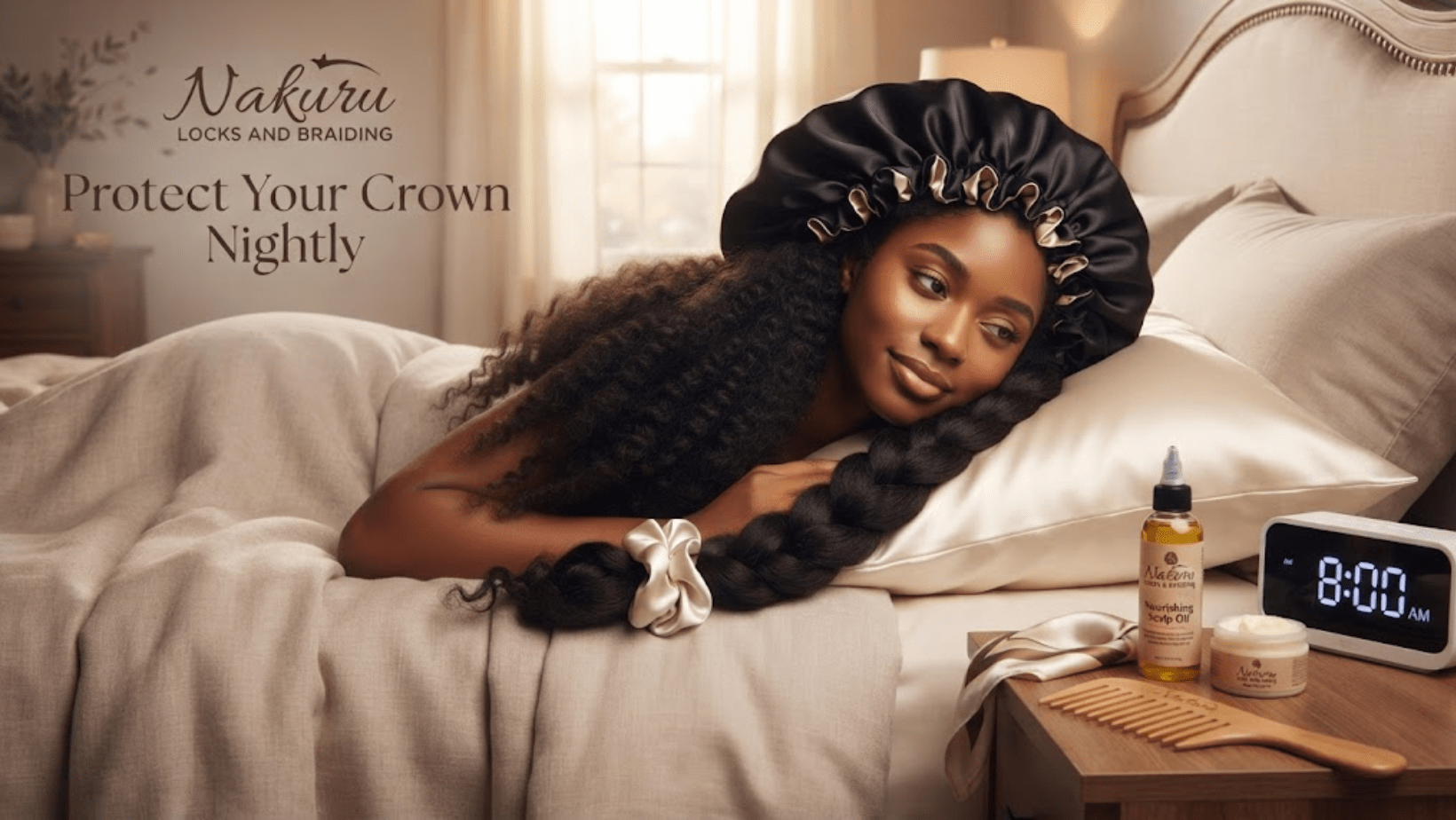
Protective Hairstyles for Sleeping: The Complete Global Guide to Waking Up with Healthier Hair
There’s a moment nearly everyone recognizes, no matter which continent they call home.
You climb into bed with hair that looks good — freshly braided, blown out, or twisted into loose curls — and eight hours later you wake up to a tangled, frizzy version of the same head.
Somewhere between the pillow and the alarm clock, the night undid what the morning had built.
At Nakuru Locks and Braiding, clients ask us some version of this question almost every single day, whether they’re sitting in our chair in Kenya or messaging us from London, Toronto, or Atlanta: what is the best hairstyle to sleep in?
The honest answer is that it depends on your hair type, your goals, and how much tension your scalp can tolerate — but the underlying science is universal.
This guide walks through every angle of that question, from short hair to long hair, from straight strands to tight coils, from breakage prevention to hair growth, all backed by dermatologists and published research.
Why What You Do at Night Matters as Much as What You Do in the Morning
It’s tempting to think hair damage only comes from bleach, flat irons, or chemical relaxers. In reality, a huge amount of everyday wear happens while you’re unconscious.
Using the right sleeping hairstyle is considered an essential part of a healthy haircare routine, since the wrong approach can leave hair prone to breakage, frizz, and tangling, according to L’Oréal Paris beauty experts.
The mechanism is straightforward: through the night, hair rubs repeatedly against the pillowcase, and that friction is what drives tangling, breakage, and frizz — while tight hairstyles add tension at the roots that compounds the damage, as haircare researchers at Yuaia note.
This is why “protective hairstyles for sleeping” has become one of the most searched hair-care topics worldwide — it isn’t a trend, it’s a genuine gap in most people’s nightly routine.
The Golden Rule: Loose, Not Tight
Before getting into specific styles, it’s worth settling the single biggest myth about nighttime hair care: tighter is not better.
The key to any good sleep hairstyle is keeping it loose enough on the scalp to prevent pulling and breakage, never pulled so tight that it creates tension at the roots.
Dermatologists back this up directly — board-certified aesthetic dermatologist Dr. Sam Elmais specifically advises against going to bed with hair pulled into a tight style.
This matters more than most people realize. According to the American Academy of Dermatology (AAD), a sleek ponytail, cornrows, a tightly pulled updo, or a head covering can look and feel great, but styles like these constantly pull at and damage the hair, and over time that pulling can cause a form of hair loss called traction alopecia.
A landmark review of 19 studies by Johns Hopkins dermatologists, published in the Journal of the American Academy of Dermatology, found that constant pulling in one direction, tight-locking patterns, and added weight from certain styles can cause significant breakage and eventually traction alopecia — a condition affecting an estimated one-third of African-American women, making it the most common form of hair loss in that group.
The same review offered reassuring news for anyone who loves braids and twists: natural, unprocessed hair styled with moisturizing, conditioning products carries a much lower risk of traction alopecia than chemically processed hair styled the same way.
In other words, the goal isn’t to avoid braids or updos altogether — it’s to keep every style loose enough that you never feel pulling at your hairline.
The AAD also lists practical warning signs to watch for: broken hairs around the hairline, a receding hairline, and thinning patches where the hair is pulled tight are all early signals that a style is too tight and should be loosened or changed.
If a hairstyle ever hurts, that’s your scalp telling you to redo it — pain is never part of a healthy protective style.
Best Hairstyle to Sleep In, by Hair Type
Protective Hairstyles for Sleeping: Short Hair
Short hair has less length to tangle, but it still rubs directly against the pillow all night.
For short hair, low buns and simple updos work particularly well because they reduce friction and help maintain volume overnight, per haircare researchers at Yuaia.
If a bun feels like too much for very short lengths, a silk or satin bonnet accomplishes the same goal without needing enough hair to gather.
Sleep Hairstyles for Long Hair
Long hair has the most surface area exposed to friction, so containment is essential.
A single loose braid reduces friction on long hair, keeps it tangle-free through the night, and unravels into a soft, wavy texture by morning, making it one of the most reliable protective sleep hairstyles for longer lengths, according to Sitting Pretty.
A looped “sock bun” or a low, loose ponytail secured with a soft scrunchie works nearly as well and takes seconds to create.
Best Hairstyle to Sleep in for Straight Hair
Straight hair tends to fall flat and tangle at the ends rather than at the root, so the priority is keeping strands from crossing and rubbing each other.
GK Hair’s stylists recommend a loose braid or bun for straight or long hair specifically because these styles reduce the friction that causes a messy morning.
A loose Dutch or three-strand braid also gives straight hair gentle, heat-free waves by morning — a bonus if you like a bit of texture without heat styling.
Protective Hairstyles for Sleeping: Curly Hair
Curly and coily textures need a different strategy, because the goal is preserving curl definition rather than just avoiding tangles.
The “pineapple” — gathering curls loosely at the very top of the head with a soft scrunchie — remains the most popular and effective protective sleep style for curly hair.
As GK Hair summarizes it: reach for a loose braid or bun if your hair is straight or long, a silk wrap if it’s short, and a pineapple if it’s curly or coily.
For very tight coils, sectioning hair into two or more smaller “pineapples,” or using bantu knots before bed, can prevent flattening on one side while you sleep.
Protective Hairstyles for Sleeping: Braids
If you already wear braids, cornrows, or twists — a staple service at Nakuru Locks and Braiding — the nightly routine is about protecting the style itself, not creating a new one.
Wrapping braids loosely in a satin or silk scarf, or sleeping in a satin-lined bonnet, keeps the ends from frizzing against cotton fibers and extends how long the style stays looking fresh.
This is also where the tension rule matters most: dermatologists recommend that braided hairstyles stay in place no longer than two to three months, and that extensions or weaves be removed for a period of time after six to eight weeks, giving the scalp a chance to recover between styles.
Overnight Braids for Waves and Texture
Braiding hair before bed isn’t only about protection — it’s also a heatless styling trick.
Overnight braids can create loose waves on wavier hair types and can stretch tighter coily textures, which is why so many people braid damp hair specifically to wake up with texture instead of reaching for a curling iron.
Is It Better to Wear Hair Up or Down When Sleeping?
This is one of the most common questions we get, and the honest answer is: it depends on tightness, not direction.
Leaving hair completely loose overnight can cause tangles and knots that are difficult to manage by morning, while an overly tight ponytail or bun pulls on the roots and stresses the scalp over time.
The winning middle ground is a loose up-style — braided, twisted, or bunned, but never pulled taut.
If you tend to sleep on your back, hair is more exposed to continuous friction against the pillow, so gathering it to the side in a loose ponytail keeps it away from that high-friction zone, according to hairstyle guides at HairstyleCamp.
Side or stomach sleepers benefit from styles that pin the front hairline back loosely, since sleeping with your face flat against the pillow puts front strands at the highest risk of rubbing and frizzing.
Best Hairstyle to Sleep In for Hair Growth
There’s no single hairstyle that grows hair on its own — length comes from healthy follicles and consistent care — but the styles that prevent breakage are the same ones that protect the length you’re already growing.
Because dermatologists emphasize that early intervention can stop or even reverse traction-related hair loss, choosing low-tension buns, braids, or wraps every night is one of the simplest habits for protecting hair growth over months and years.
Pair a loose protective style with a healthy scalp routine — gentle cleansing, regular trims to remove split ends, and giving the scalp breaks between tight protective styles — for the best long-term results.
Silk and Satin: The Fabric That Makes Every Style Work Better
No protective hairstyle performs at its best on a rough cotton pillowcase. Board-certified dermatologist Dr. Dendy Engelman explains that pillowcases can’t reverse skin or hair damage, but they can support healthy hair and slow down overnight wear — and the difference comes down to fabric, specifically how absorbent it is and how much friction it creates.
Silk is a smooth, low-friction material that doesn’t strain hair the way coarser fabrics do, and unlike cotton, it doesn’t draw moisture out of hair or trap it against the fabric.
Dermatologist Dr. Brendan Camp adds that silk pillowcases keep skin cooler, hold onto hydration better than cotton, and are gentle for anyone whose skin or scalp reacts to rougher fabrics.
For hair specifically, the reduced friction of silk means strands glide instead of catching and roughening against the fabric the way they do on cotton.
Whether you choose a full pillowcase, a bonnet, or a simple scarf wrap, the fabric you sleep on can matter almost as much as the style you choose.
The One Thing to Avoid Regardless of Hairstyle: Sleeping With Wet Hair
Even the best protective style can’t undo the damage of going to bed with soaking-wet hair.
Dermatologists interviewed by Fox News Digital warn that sleeping with wet hair can lead to breakage and shedding over time, and that a damp scalp trapped against a pillow overnight creates a warm, humid environment that encourages fungal growth and bacterial buildup, which can trigger scalp irritation or dandruff.
Board-certified dermatologist Dr. Noah Gratch confirms this is a habit he consistently advises patients against.
Before styling hair for bed, let it air-dry as much as possible, or use a low, cool dryer setting if you’re pressed for time.
A Simple Nightly Routine to Follow
1. Detangle first. Brush hair from root to tip with a gentle brush, working out every knot while hair is dry, so you’re not sealing tangles in overnight.
2. Make sure hair is fully dry, not damp, before you tie it up.
3. Choose your style based on hair type and length — a pineapple for curls, a loose braid for long or straight hair, or a low bun or silk wrap for short hair.
4. Keep the tension loose. If you feel pulling at your hairline, redo it.
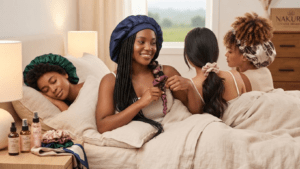
5. Finish with silk or satin — a pillowcase, bonnet, or scarf — to lock in the benefits of whichever style you chose.
FAQ: Protective Hairstyles for Sleeping
What is the most protective hairstyle to sleep in?
There isn’t one universal answer — the most protective style is whichever loose, low-tension style suits your hair type: a pineapple for curls, a loose braid or bun for long and straight hair, and a silk wrap for short hair. The common thread across all of them is that they minimize friction and avoid pulling at the roots.
Is it better to wear hair up or down when sleeping?
Loosely up generally beats fully down, since loose hair left completely down is more prone to tangling and friction against the pillow. The exception is if “up” means tightly pulled — a tight style causes more harm than wearing hair loose. Aim for gathered but relaxed.
Which hairstyle is best while sleeping?
For most people, a loose three-strand or Dutch braid offers the best all-around balance of tangle prevention, breakage reduction, and next-morning texture, regardless of hair length.
What’s the healthiest way to wear your hair at night?
The healthiest approach combines three things: hair that’s completely dry before bed, a loose (never tight) style suited to your texture, and a silk or satin pillowcase, bonnet, or scarf to reduce friction.
How should I wear my hair when I go to sleep?
Detangle it fully while dry, choose a loose style appropriate for your texture (pineapple, braid, bun, or wrap), and sleep on silk or satin rather than cotton whenever possible.
Can a sleep hairstyle actually help with hair growth?
Indirectly, yes. Length you’ve already grown is easiest to lose through breakage and traction, so a consistently loose, low-friction nightly style protects the length you have while your natural growth cycle continues.
Related Articles from Nakuru Locks and Braiding
Nakuru Locks and Braiding specializes in protective styling for every hair type and texture. If you’re due for a fresh set of braids, locs, or twists, our stylists can also walk you through the nighttime care routine that will help your new style last as long as possible.
References
- American Academy of Dermatology, Hairstyles That Pull Can Lead to Hair Loss
- Journal of the American Academy of Dermatology, review of 19 studies on traction alopecia risk categories (Johns Hopkins), reported via Johns Hopkins University Hub and ScienceDaily
- Fox News Digital, dermatologist commentary on sleeping with wet hair
- NBC Select and Bustle, board-certified dermatologist commentary on silk pillowcase benefits
- L’Oréal Paris USA Beauty Magazine, guidance on protective sleep hairstyles by hair type
- GK Hair USA and Sitting Pretty, protective hairstyle breakdowns by hair texture
Leave a Reply