
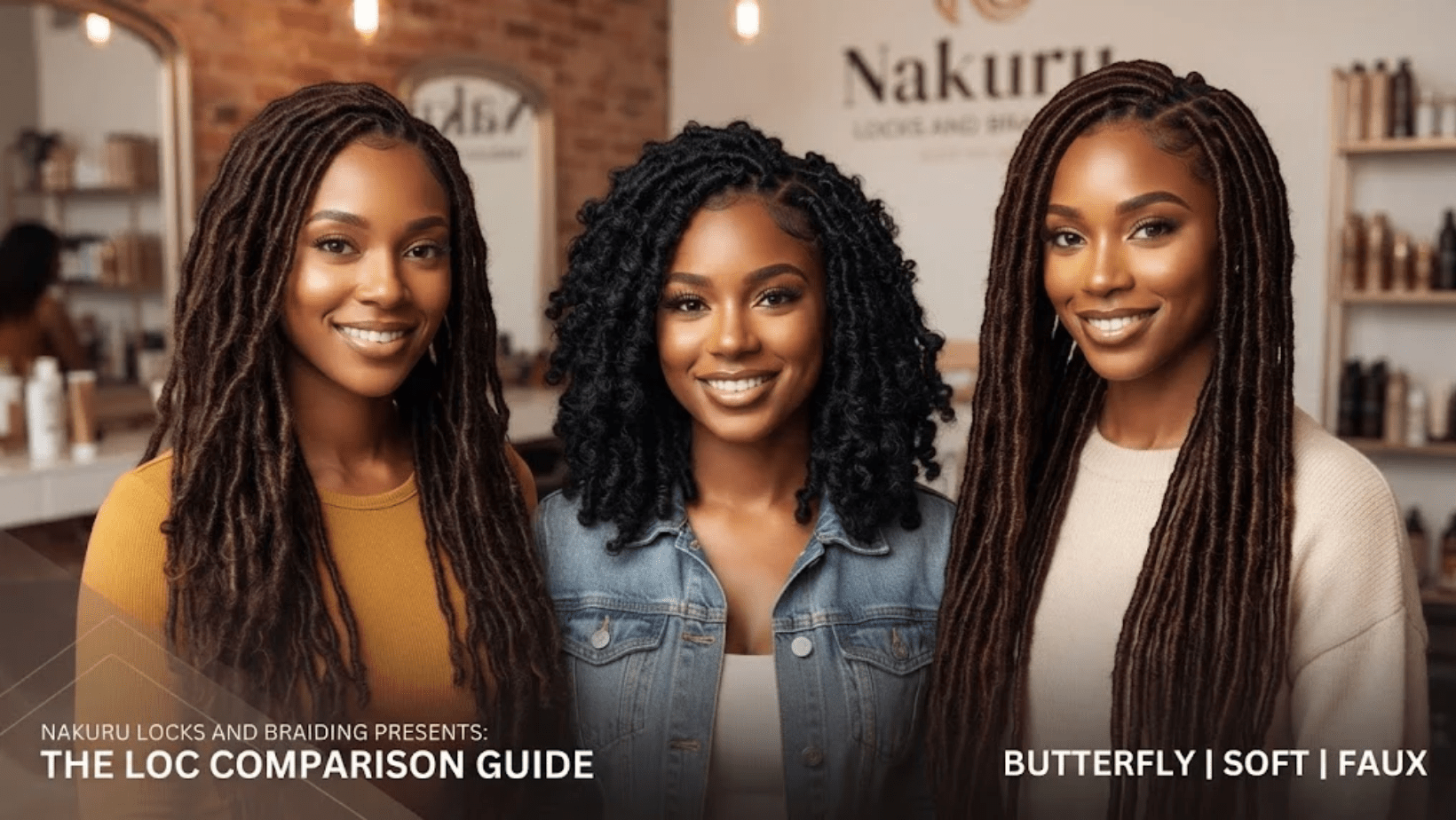
Butterfly Locs vs Soft Locs vs Faux Locs: Which One Is Actually Right for You?
A client once walked into our Nakuru chair with three phone screenshots open at once: one of soft, feathery curls she’d seen on a bride in Lagos, one of a chunky, distressed style from a TikTok video filmed in London, and one of a neat, uniform loc set from a salon in Nairobi.
“I want this,” she said, pointing at all three. She wasn’t wrong to be confused — she was looking at butterfly locs, soft locs, and traditional faux locs, three styles that get lumped together online but behave completely differently in the chair, on the wallet, and on the hair underneath them.
That confusion is the most common reason people arrive at our salon undecided, and it’s also the most searched question in this category worldwide.
So this guide answers it properly: what each style actually is, how butterfly locs differ from soft locs, where crochet locs fit into the picture, what happens when you try any of these on straight or relaxed hair, and what you should realistically expect to pay.
First, the umbrella term: what are “faux locs”?
Every style in this article is technically a faux loc. Faux locs are hair extensions that are wrapped, braided, or crocheted to imitate the look of grown, matured dreadlocks — without your own hair ever being locked.
A stylist braids your natural hair into a base (usually small box braids or cornrows), then attaches synthetic or human hair over that base using one of two techniques: the braid-and-wrap method, where loose hair is wound around each braid by hand, or the crochet method, where pre-looped locs are pulled through the base with a latch hook.
Both attachment methods can produce a finished loc; what changes is the texture, the time in the chair, and the price.
Soft locs and butterfly locs are not a separate category from faux locs — they are both types of faux locs.
Think of “faux locs” as the family name, and “soft locs,” “butterfly locs,” “goddess locs,” and “distressed locs” as the individual members, each defined by the hair texture used and the wrapping technique applied over the base braid.
Butterfly locs vs soft locs: what is the actual difference?
This is where most of the online confusion starts, because soft locs and butterfly locs are built the same way — hair wrapped loosely around a braid rather than tightly locked — and are sometimes even marketed under each other’s name.
The real difference sits in the hair texture used for the wrap and the finished silhouette.
Soft locs are made with smoother, straighter wrapping hair (often marketed as pre-looped or water-wave soft loc hair) wound tightly enough to leave a clean, uniform, glossy finish.
They’re lighter and less rigid than a traditional faux loc, which is why stylists describe them as easier on the scalp and more forgiving to style into buns, ponytails, or half-up looks straight after installation.
Butterfly locs use a wavier, curlier hair type wrapped more loosely around the same kind of braid base, so curled pieces of hair are deliberately left peeking out along the length of the loc.
That’s the “butterfly” in the name — the loose curls flutter and catch movement the way soft locs don’t. The result is a bulkier, more textured, deliberately undone look, sometimes described as messier or more voluminous, next to the neater, thinner finish of soft locs.
|
Soft Locs |
Butterfly Locs | |
|---|---|---|
|
Hair used |
Water-wave or pre-looped soft loc hair | Wavy hair such as water wave or freetress-style curls |
| Finish | Neat, thin, glossy, straight-hanging | Bulkier, curl-flecked, deliberately “lived-in” |
| Weight on scalp | Lighter, less tension | Slightly heavier due to added curl volume |
| Styling flexibility | Very easy to bun, tie, and reshape | Good, though bulk can limit tight updos |
| Typical lifespan | 4–6 weeks | 4–8 weeks with careful maintenance |
| Best suited to | Longer lengths, sleek looks, first-timers wanting comfort | Shorter-to-mid lengths, bold or festival-ready looks |
So, is one “better” than the other? Not objectively. Stylists generally agree that soft locs suit anyone prioritising comfort, low scalp tension, and a longer wear window, while butterfly locs suit anyone who wants a more voluminous, textured statement and doesn’t mind a slightly shorter maintenance runway.
If your scalp is sensitive or this is your first protective style, soft locs are usually the gentler starting point.
Butterfly locs vs soft locs vs faux locs vs crochet locs
Adding “crochet locs” to the comparison confuses people because crochet isn’t a style — it’s an installation method that can be used to create soft locs, butterfly locs, or traditional faux locs.
The confusion is understandable, since “crochet locs” is often sold in packs as its own product. Here’s how all four terms actually relate to each other.
|
Style |
What it is | Chair time | Finished look |
|---|---|---|---|
|
Traditional faux locs (braid-and-wrap) |
Marley or kanekalon hair hand-wrapped around a braid, strand by strand | 4–8+ hours | Most realistic, mimics mature dreadlocks closely |
| Pre-looped locs pulled through cornrows with a latch hook | 2–5 hours | Slightly less seamless at the root, but far faster | |
|
Soft locs |
A texture/finish (usually installed via crochet) using smoother wrap hair | 3–6 hours | Neat, light, glossy |
| A texture/finish (crochet or wrap) using curlier hair left loose at intervals | 4–7 hours | Voluminous, textured, curl-flecked |
In short: “crochet” describes how the loc got onto your head, while “soft” and “butterfly” describe what it looks like once it’s there.
A stylist can crochet a soft loc or crochet a butterfly loc — the technique and the texture are two separate decisions you make with your loctician, and worth naming separately when you book so nobody is guessing at the chair.
Can you get butterfly locs, soft locs, or faux locs on straight hair?
Yes — and this is one of the more reassuring facts about this style family.
Because the loc itself is made almost entirely from extension hair, your natural texture underneath matters far less than it does for styles like natural locs, twist-outs, or cornrows.
What actually determines success on straight or relaxed hair is the base.
Stylists typically prep straight or fine natural hair with small two-strand twists or tight box braids before attaching any faux loc hair.
This base-braiding step gives the extension hair something textured to grip, which stops it slipping — the single biggest risk when faux locs are installed directly onto slick, straight strands.
If you’re relaxed, freshly blow-dried, or simply have a straight natural texture, tell your loctician before your appointment; they’ll usually recommend the crochet method over hand-wrapping, since a crocheted loc locks into the cornrow itself rather than relying on friction along a smooth braid.
One caution specific to straight and chemically relaxed hair: because there’s less natural grip, over-wearing the style raises the risk of the locs slipping and pulling at the root, which can stress the hairline.
Most stylists recommend straight-haired clients err toward the shorter end of any lifespan estimate and come in for a check at the three-to-four-week mark.
Booking tip:
Cost breakdown: butterfly locs vs soft locs vs faux locs
Cost is the question that varies most by where you’re booking, so treat the figures below as a general international benchmark rather than a fixed price — and always ask your salon for a quote based on your hair length, density, and the hair brand you want used.
Cost varies significantly depending on your geographic location, salon reputation, hair length, and whether the installation is done via individual wrapping or crochet methods.
- Traditional Faux Locs: Generally the most labor-intensive if wrapped individually from scratch, often ranging from $150 to $300+ USD globally, or approximately KES 6,000 to KES 12,000+ in professional East African salons like Nakuru Locks and Braiding.
- Soft Locs: Usually moderately to highly priced ($160 to $280 USD / KES 7,000 to KES 13,000) depending on whether pre-made locs are crocheted or individual wrapping is requested.
- Butterfly Locs: Tend to be on par with soft locs or slightly higher due to the specialized wrapping technique required to achieve the signature loops ($170 to $300 USD / KES 7,500 to KES 14,000).
Three things move the price more than the style name does:
- Installation method. Crochet installs are generally cheaper and faster than full hand-wrapping, because the crochet technique can cut chair time by roughly two-thirds compared with wrapping every strand by hand.
- Hair type. Synthetic kanekalon or marley hair is dramatically cheaper than human hair extensions of the same length — often by a factor of five or six.
- Length and density. Waist-length, thick sets cost meaningfully more than shoulder-length, medium-density sets, regardless of which of the three styles you choose.
At Nakuru Locks and Braiding, we quote per style, length, and hair brand at consultation, so you know the exact cost before any hair touches your head — book a free consultation rather than relying on averages from a different market.
(Note: Prices vary based on hair length, density, and whether hair extensions are provided by the client or the salon).
How long each style lasts, and what maintenance looks like
All three styles are protective styles, meaning their real job is shielding your natural hair from daily manipulation and heat while it grows underneath, undisturbed.
General guidance across the industry puts faux locs and soft locs at a four-to-six-week wear window, with well-maintained butterfly locs sometimes stretching to six or eight weeks.
Whichever style you choose, three habits protect both the style and your hairline:
1. Wash at the scalp, not the length. Let shampoo suds rinse down through the locs instead of scrubbing the strands directly — scrubbing causes frizz and can loosen the wrap.
2. Cover at night. A satin bonnet or scarf reduces friction against cotton pillowcases, which is one of the fastest ways locs unravel prematurely.
3. Retire the style on time. Once locs start slipping, feel heavy at the root, or the base braid becomes visibly loose, it’s time to take them down — wearing any protective style past its window is the leading cause of tension and breakage, not the style itself.
So, which should you actually book?

Frequently asked questions
Are butterfly locs and soft locs the same thing?
No, though they’re closely related and sometimes confused online. Both are wrapped rather than tightly locked, but soft locs use smoother, straighter hair for a neat, glossy finish, while butterfly locs use wavier, curlier hair left loose at intervals for a bulkier, textured look.
Which lasts longer, butterfly locs or soft locs?
Soft locs and traditional faux locs both typically last four to six weeks. Butterfly locs can sometimes stretch to six or eight weeks with careful maintenance, though this varies by hair density, aftercare, and how quickly your natural hair grows.
Can I get faux locs if I have straight or relaxed hair?
Yes. The extension hair does most of the visual work, so your natural texture matters less than the base underneath it. Stylists usually prep straight hair with small two-strand twists or box braids first, then use the crochet method to attach the loc hair securely.
Which is cheaper: butterfly locs, soft locs, or traditional faux locs?
Soft locs and butterfly locs are usually similarly priced, and both can be slightly cheaper than a fully hand-wrapped traditional faux loc set, mainly because the crochet installation method typically used for soft and butterfly locs is faster than hand-wrapping every strand.
What’s the difference between crochet locs and faux locs?
They’re not competing styles — crochet is an installation method, and faux locs is the style family. You can crochet soft locs, butterfly locs, or traditional-looking locs; the word “crochet” just tells you how the hair was attached, not what texture it is.
Do faux locs damage natural hair?
Properly installed and properly timed, faux locs are considered a protective style and shouldn’t damage your natural hair. Damage risk rises when a set is left in too long, installed too tightly at the root, or removed carelessly — all reasons to have your set installed and taken down by a trained loctician.
Leave a Reply