
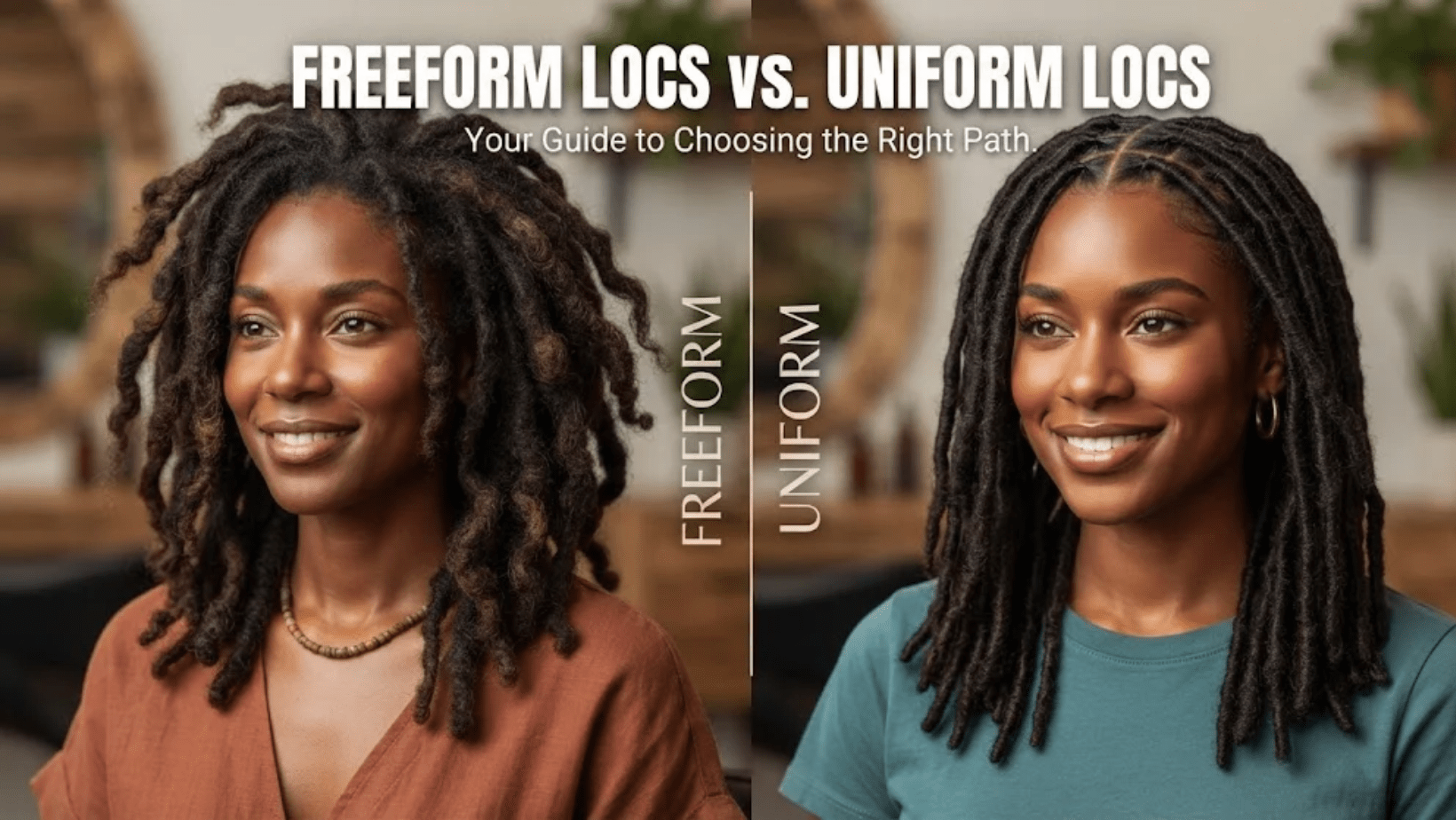
Freeform Locs vs. Uniform Locs: Understanding the Difference
A client walked into our salon not long ago, ran her fingers through eighteen months of hard-won locs, and asked the question we hear almost every week, in one form or another: “Should I let my hair do its own thing, or should I keep it neat?”
She had watched a friend in Nairobi grow bold, uneven, sculptural freeform locs, and she had watched an aunt in London keep hers razor-parted and retwisted like clockwork for a decade. Both women looked stunning. Both women loved their hair.
And both were living proof that “locs” is not one hairstyle — it is a spectrum, with freeform locs on one end and uniform locs on the other.
This guide breaks that spectrum down in full: what freeform locs are, what uniform locs are, how freeform locs vs. uniform locs compare for women specifically, and the honest pros and cons of each path.
We draw on salon experience with hundreds of loc journeys in Nakuru and Nairobi, current hair-care research, and the realities our clients across Kenya, the UK, and the US actually live with day to day.

What “Locs” Actually Means
Before comparing styles, it helps to define the category. Locs (also called dreadlocks) are sections of hair that have been intentionally matted, twisted, coiled, or interlocked into permanent, rope-like strands, or that have been left alone until the hair mats and locks on its own.
The methods used to start locs — comb coils, two-strand twists, interlocking, or simply leaving the hair alone — set the trajectory for how the loc will look and behave for years afterward.
Where locs diverge sharply is in how much control the wearer keeps over that process going forward.
That single decision — control versus surrender — is the real difference between freeform locs and uniform locs.
What Are Freeform Locs?
Freeform locs are locs that form with little to no manipulation. There is no regular parting, no scheduled retwisting, and no attempt to force the hair into a uniform pattern.
Instead, the hair is washed to keep the scalp and strands clean, and then left alone to knot, tangle, and mat naturally over time. The hair decides its own shape rather than being shaped into someone else’s plan for it.
Because there is so little intervention, freeform locs typically vary in thickness, length, and shape across the head.
Some sections may be thin and wiry; others thick and full. Two locs sitting side by side may look nothing alike, and that unevenness is not a flaw — it is the entire point of the style. As one hair-care guide puts it, if regular locs are “guided,” freeform locs are “allowed.”
Key features of freeform locs:
- Minimal to zero manipulation. No regular parting, twisting, or palm-rolling.
- Organic, individualized shape. No two heads of freeform locs look identical, and no two locs on the same head look identical either.
- A visible early stage. Freeform locs pass through a budding and matting phase that can look loose or messy before it resolves into recognizable locs — a normal, expected part of the process, not a sign anything has gone wrong.
- Lower salon frequency. Because there is no retwist schedule to maintain, freeform wearers spend far less time in the chair after the initial start.
- Cleanliness still matters. Freeform does not mean unwashed. Regular washing with a residue-free shampoo actually helps hair lock rather than delaying it, since product buildup and heavy conditioners can slow the process down.
There is also a middle ground worth knowing: semi-freeform locs. These start with some structure — parting or starter twists — and then the wearer gradually steps back from regular retwisting, letting the locs mature more naturally while keeping a little more control over size and section than true freeform allows.

What Are Uniform Locs?
Uniform locs (sometimes called traditional or maintained locs) are the mirror image of freeform.
The hair is sectioned into a deliberate grid, started using a structured method such as two-strand twists, comb coils, or interlocking, and then maintained on a consistent schedule — typically retwisted or interlocked every four to eight weeks depending on the loc’s stage and the client’s hair texture.
That ongoing maintenance is what keeps uniform locs looking neat, symmetrical, and consistent in size from root to tip, month after month, year after year.
The retwist schedule is not just cosmetic — it also manages new growth at the root before it can loosen or merge with a neighboring loc.
Key features of uniform locs:
- Structured sectioning. Hair is parted into an intentional grid pattern from day one.
- Regular retwisting or interlocking. Typically every 4–8 weeks for starter and budding locs, stretching to every 6–12 weeks once locs mature.
- Consistent size and shape. Every loc is meant to match its neighbors in thickness and spacing.
- Higher, predictable salon commitment. The neat look depends on keeping appointments, which is part of the trade-off clients should plan for financially and in terms of time.
- More styling versatility for symmetrical looks. Ponytails, updos, and parted styles read cleaner on uniform locs because the sections are already even.

Freeform Locs vs. Uniform Locs: The Core Differences
|
Factor |
Freeform Locs | Uniform Locs |
|---|---|---|
|
Starting method |
Little or no structured start; hair mats on its own | Structured: two-strand twists, coils, or interlocking |
|
Ongoing maintenance |
Rarely or never retwisted | Retwisted/interlocked every 4–8+ weeks |
|
Appearance |
Uneven, organic, varied loc sizes | Neat, symmetrical, consistent loc sizes |
|
Salon time & cost |
Lower over the long run | Higher and ongoing |
|
Styling control |
Wearer gives up size/shape control | Wearer keeps control over parting and shape |
|
Best for |
Clients who want a natural, low-intervention look and fewer appointments | Clients who want a polished, predictable look for work, events, or personal preference |
Freeform Locs vs. Uniform Locs for Women: What Actually Changes
The mechanics of freeform versus uniform locs don’t change by gender, but the decision-making context often does, and it’s worth naming honestly rather than glossing over.
Hair length and growth patterns.
Many women grow their hair for years before locking it, which means starter sections are often longer and heavier than a typical short male starter loc.
Longer starter hair can mat into freeform locs faster in some cases, but it can also merge into unwanted “congo” locs (two locs fusing at the root) more easily if left completely unattended, so freeform-leaning women often still separate merging roots by hand even while skipping formal retwists.
Styling frequency for work and social settings.
Women navigating professional dress codes, especially across different cultural contexts in Kenya, the UK, and the US, sometimes choose uniform locs specifically because the neat, parted look reads as more “styled” in conservative workplaces, while others choose freeform specifically to push back against those same narrow beauty standards and wear their hair exactly as it grows.
Updos and protective styling.
Uniform locs generally give a woman more predictable results when pulling hair into buns, ponytails, or wedding-day updos, because the even sections lie flatter and more symmetrically.
Freeform locs, with their varied thickness, tend to create fuller, more textured, sculptural updos — a different aesthetic rather than a worse one.
Postpartum and life-stage timing.
Several clients start or transition their loc journey around major life changes — a new baby, a new job, a move abroad — and freeform’s lower maintenance schedule is often chosen simply because it fits a season of less available salon time, with a plan to add more structure later.
None of this means one path is “more feminine” or “more professional” than the other.
It means the same technical choice — manipulate or don’t manipulate — plays out against different personal and cultural pressures for different women, which is exactly why this decision deserves an honest consultation rather than a one-size-fits-all answer.

Freeform Locs vs. Uniform Locs: Pros and Cons
Freeform Locs — Pros
- Significantly lower long-term maintenance cost and salon time
- A genuinely one-of-a-kind, organic look that cannot be replicated on anyone else’s head
- Less mechanical tension on the scalp from repeated twisting, which can be gentler for sensitive or thinning hairlines
- Full styling freedom — no pressure to maintain a “neat” standard
Freeform Locs — Cons
- The early budding stage looks messy and unpredictable, which some clients find hard to sit through emotionally
- Loc sizes vary unpredictably; you cannot request a specific uniform look later without cutting and restarting
- Locs can merge into congos if roots aren’t occasionally separated
- Less symmetrical for tightly parted updos or styles that rely on even sectioning
Uniform Locs — Pros
- Neat, symmetrical, “finished” look from a very early stage
- Predictable sizing makes advanced styling (ponytails, wedding updos, parted looks) far easier
- Easier to track loc health and root growth on a fixed schedule with a stylist
- A familiar, widely recognized look for workplaces and formal occasions
Uniform Locs — Cons
- Ongoing cost and time commitment for retwists every 4–8 weeks
- Repeated twisting and tension at the root, especially if done too tightly, is associated with a higher risk of traction alopecia — a form of hair loss caused by sustained pulling on the follicle, according to the American Academy of Dermatology.
- Less “natural” in the sense that the look depends on continual intervention rather than the hair’s own growth pattern
- Missed retwist appointments can leave new growth looking uneven until the next visit
A Note on Scalp Health, Whichever Path You Choose
However you loc your hair, tension management matters. The American Academy of Dermatology identifies traction alopecia — gradual, tension-related hair loss most often affecting the hairline and temples — as a real risk with tightly maintained protective styles, including dreadlocks, when retwisting or parting pulls too hard on the follicle over time.
The condition is reversible if caught early, which is why we recommend that uniform-loc clients tell their stylist immediately if a retwist feels painful rather than just tight, and why we build rest and gentle handling into every maintenance visit at Nakuru Locks and Braiding.
Freeform wearers are not immune either: occasional root separation, done gently, prevents the kind of forced congo-merging that can also stress the scalp.
Whichever direction you choose, clean hair locks and holds better than product-coated hair, so a residue-free wash routine benefits both freeform and uniform journeys equally.
So, Which Should You Choose?
There is no universally “better” option — only the better fit for your hair, your calendar, your budget, and the look you actually want to see in the mirror. Ask yourself:
1. How much salon time and cost can I realistically commit to for years, not months? If the honest answer is “not much,” freeform or semi-freeform will serve you better.
2. Do I need my hair to look symmetrical for work, performance, or events? If yes, uniform locs will get you there more reliably.
3. Am I comfortable with an unpredictable, evolving appearance for the first year? Freeform’s budding stage tests patience more than any other part of the journey.
4. Do I want full creative surrender, or do I want to stay in the driver’s seat? This is really the heart of the decision.
If you are still unsure, semi-freeform is a legitimate, popular middle path — start structured, then ease off the schedule once your foundation locs are solid.
Why Trust This Guide
Nakuru Locks and Braiding has guided well over a thousand clients through starter locs, freeform transitions, and long-term uniform maintenance from our salon in Nakuru City, Kenya, working with textures across the 3A–4C spectrum for men, women, and children.
Our certified stylists — including Sisterlocks™-trained consultants — combine East African hair-care traditions with modern, chemical-free techniques like interlocking, crocheting, and palm-rolling, and we stay current with dermatological guidance on scalp health so that style choices never come at the expense of long-term hair health.
Frequently Asked Questions
Can I switch from freeform locs to uniform locs later?
Yes, though it usually requires a stylist to comb through and re-section the existing locs, which can shorten length or require cutting depending on how matted they’ve become. It’s easier to move from uniform to a looser, semi-freeform routine than the reverse.
Do freeform locs take longer to fully lock than uniform locs?
Not necessarily — coily, tightly curled hair often locks faster with freeform than expected, since there’s no combing or detangling working against the matting process. Looser curl patterns generally take longer to lock under either method.
Are freeform locs considered less professional than uniform locs?
Perception varies by region, industry, and personal workplace culture rather than by any technical rule. Many professionals worldwide wear freeform locs successfully; others prefer uniform locs specifically for a more parted, polished look in conservative settings.
Is it true that freeform locs are dirty or unwashed?
No — this is one of the most persistent myths in loc culture. Clean, residue-free hair actually locks better than product-buildup-heavy hair. Freeform simply means no combing or forced sectioning, not infrequent washing.
Which style is gentler on the scalp long-term?
Freeform generally involves less repeated tension at the root, since there is no regular retwisting. Uniform locs can be equally gentle if retwisted correctly and never pulled tight enough to cause pain — the American Academy of Dermatology’s guidance on traction alopecia applies mainly to styles maintained with excessive tension, not to loc maintenance done carefully.
Can semi-freeform locs be converted fully to freeform?
Yes. Many clients transition from semi-freeform to full freeform after the first year once the foundation is mature, simply by stopping retwists altogether and separating roots only occasionally.
How often should uniform locs be retwisted?
As a general guide: starter locs every 4–6 weeks, budding locs every 4–8 weeks, and mature locs every 6–12 weeks, adjusted for hair texture, lifestyle, and how the scalp responds.
Related Articles from Nakuru Locks and Braiding
Authoritative References
- American Academy of Dermatology Association. “How to Prevent Hair Loss from Hairstyles.”
- Billero, V., Miteva, M. “Traction alopecia: the root of the problem.” Clinical, Cosmetic and Investigational Dermatology, 2018;11:149–159.
- Asbeck, S., Riley-Prescott, C., Glaser, E., Tosti, A. “Afro-Ethnic Hairstyling Trends, Risks, and Recommendations.” Cosmetics, 2022;9(1):17.
Ready to start your loc journey — freeform, uniform, or somewhere in between? Book a consultation with Nakuru Locks and Braiding and let our stylists help you choose the path that fits your hair and your life.
Leave a Reply