
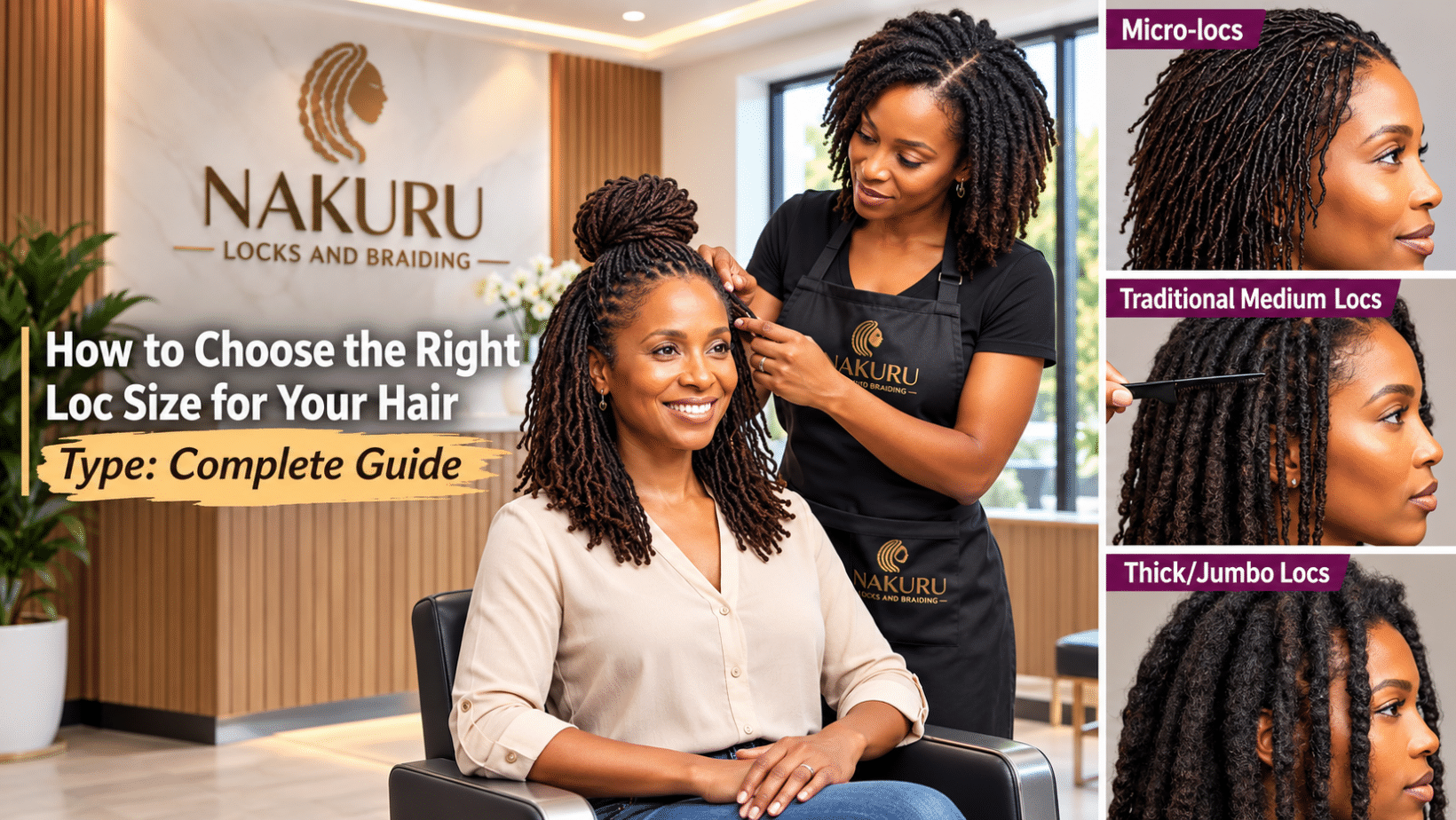
How to Choose the Right Loc Size for Your Hair Type
Imagine sitting in a salon chair in Nakuru, Nairobi, London, New York or Johannesburg, ready to begin your loc journey. You have saved photos of stylish men’s locs, elegant women’s microlocs and bold freeform wicks—but one important question remains: What loc size is right for your hair type?
The best loc size depends on more than personal taste. Hair density, strand thickness, curl pattern, length, lifestyle, maintenance budget and your preferred appearance all influence the final result.
This guide from Nakuru Locks and Braiding explains how to choose the right loc size for your hair type, how to measure loc size, how many locs you may need and how to use a loc size calculator or quiz before installation.
Quick answer: Fine or low-density hair often benefits from small to medium locs for better fullness. Thick, dense hair can support small, medium or large locs, but too many small locs may become heavy and time-consuming to maintain. Always discuss your desired size with an experienced loctician before starting.
What Determines Loc Size?
Loc size is influenced by the width of each section at the root and the amount of hair placed into that section. Two people can request “medium locs” but receive different results because their hair density, strand thickness and curl pattern are not identical.
The main factors include:
-
Hair density: how much hair grows across the scalp.
-
Strand thickness: whether individual strands are fine, medium or coarse.
-
Curl pattern: how tightly or loosely the hair curls.
-
Hair length: longer hair can create more weight as locs mature.
-
Desired loc count: fewer sections usually produce thicker locs.
-
Maintenance preferences: smaller locs usually require more time.
-
Styling goals: some sizes offer more flexibility for updos, braids and accessories.
-
Scalp and root strength: fragile or thinning areas may need larger, lighter sections.
Nakuru Locks and Braiding uses a personalised consultation because the final loc size is affected by hair length, thickness, product use, installation method and stylist expertise. The salon is located at Mt. Sinai Building, Bazaar Road, Nakuru City, and offers consultations for natural locs, microlocs, interlocking and related services.
Loc Size Chart
The following chart gives practical starting ranges. These are not rigid medical or technical measurements because locs swell, mature and change shape over time.
These ranges are useful for planning, but they should not replace an in-person assessment. Curl Centric notes that loc counts are only estimates because density and strand thickness can make the same number of sections look different on different heads.
Traditional locs are commonly described as small, medium or thick. Small locs may resemble chopsticks, medium locs may resemble pencils and thicker locs may resemble Sharpie markers. Sisterlocks use very small, structured sections, while microlocs generally sit between Sisterlocks and traditional locs.probeautycentral.
Important measurement note
Loc size is usually measured by the diameter or width of the mature loc, not simply the size of the original part. A loc may look narrow at the beginning but swell during budding and maturation. For this reason, your loctician should plan for the expected mature size rather than only the starter appearance.
How Hair Type Affects Loc Size
Fine or thin strands
Fine strands can be delicate and may not create much bulk inside each loc. If you choose very large sections, the finished locs may look sparse or show more scalp than you expect.
Small or medium locs often create better visual coverage because the hair is distributed across more sections. However, extremely tiny locs can place stress on weak roots if the hair is fragile or frequently styled.
A good starting approach for fine hair may be:
-
Small traditional locs for a defined appearance.
-
Medium locs if you want simpler maintenance.
-
Microlocs only when your hair density and root strength can support them.
-
Avoiding excessive weight from extensions or heavy accessories.
Low-density hair does not automatically require microlocs. The most important goal is balanced scalp coverage without creating fragile, overly thin sections.
Thick or coarse strands
Thick strands and dense hair can support a broad range of loc sizes. Small locs may produce a full, detailed appearance, while medium or large locs can create a bold shape with fewer sections.
Very thick hair with too many small locs may become time-consuming to retwist, interlock or style. It can also create considerable weight after the locs mature.
For dense hair, consider:
-
Medium locs for versatility.
-
Large locs for a fuller, lower-maintenance look.
-
Small locs if you want many styling options and can commit to upkeep.
-
Strategic sectioning around the hairline to avoid excess tension.
Tightly coiled hair
Tightly coiled hair, commonly associated with type 4 textures, often holds starter styles well and can lock with less manipulation than looser textures. Coils may shrink significantly at first and later expand as the locs bud.
Small, medium and large locs can all work, depending on density and preference. Two-strand twists, comb coils, braids and interlocking are commonly considered during installation, but the ideal method depends on length and texture.
Tightly coiled hair can still experience breakage if the roots are repeatedly twisted too tightly. A strong curl pattern does not make the hair immune to tension.
Looser curls or wavy hair
Looser curls and wavy textures may take longer to lock and can unravel more easily during the starter stage. Larger sections or a method that provides additional hold may be helpful.
The locs may also appear less compact initially. This is normal, but installation and maintenance should be adapted to the hair’s behaviour. Your loctician may recommend:
-
Larger starter sections.
-
Two-strand twists or braids.
-
Interlocking for selected areas.
-
Extra patience during the budding stage.
-
Less frequent manipulation to prevent unnecessary tension.
Hair type should guide the plan, but it should not restrict your style choices. A skilled loctician can create locs across many textures.
Right Loc Size for Your Hair Type: Male
Men can wear every loc size, from tiny microlocs to large freeform wicks. The right choice depends on desired fullness, styling habits, hairline condition and maintenance preferences—not gender alone.
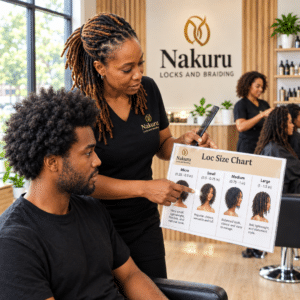
Best loc sizes for men with thin hair
Small or medium locs may provide better scalp coverage than large locs because the hair is divided into more sections. Large locs can leave visible spaces between sections when density is low.
Men with thinning edges or a receding hairline should avoid heavy locs and tight styling around the perimeter. A professional should assess whether the hairline can safely support the desired size.
Best loc sizes for men with thick hair
Medium and large locs are popular choices for thick, dense hair because they create a substantial appearance without requiring hundreds of sections. Men who want a classic, versatile look often choose medium locs.
Large locs may be suitable for:
-
Low-maintenance routines.
-
Bold, rounded silhouettes.
-
Freeform or semi-freeform journeys.
-
Fewer, thicker sections.
-
Men who do not want lengthy retwisting sessions.
However, large locs can become heavy as they grow. Regularly inspect the roots, especially around the front and temples.
Men’s loc size and lifestyle
Choose smaller locs if you want:
-
Intricate styling.
-
Braided loc designs.
-
More locs for ponytails and updos.
-
A detailed, uniform appearance.
Cho0se medium locs if you want:
-
A balanced, classic look.
-
Reasonable maintenance time.
-
Flexibility for professional and casual styles.
-
Easier separation and retwisting.
Choose large locs if you want:
-
A bold appearance.
-
Fewer locs.
-
Lower maintenance frequency.
-
Freeform or semi-freeform styling.
Current men’s starter-loc guidance commonly describes micro locs as pencil-thin, medium locs as marker-sized and large locs as finger-width, while also emphasising that density should influence the final distribution.
Right Loc Size for Your Hair Type: Female
Women can also wear every loc size. The best option depends on preferred volume, face-framing, parting pattern, styling goals and the condition of the hairline.
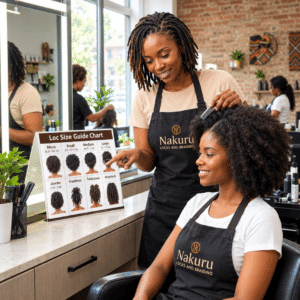
Small locs for women
Small locs can create a neat, detailed appearance and offer many styling possibilities. They may work well for clients who want:
-
Defined parts.
-
High styling versatility.
-
Loc ponytails, buns and braided styles.
-
A lighter, more detailed look.
-
The appearance of microlocs without choosing the smallest possible size.
Small locs require more individual sections, so appointments may take longer. They may also require more frequent and precise maintenance.
Medium locs for women
Medium locs are often a practical middle ground. They provide visible fullness while remaining flexible enough for many hairstyles.
They may suit women who want:
-
A balanced loc count.
-
Moderate maintenance.
-
A classic loc appearance.
-
Room for beads, cuffs and wraps.
-
Enough thickness for updos without excessive bulk.
Medium locs can also be adapted around the hairline and crown to flatter different face shapes.
Large locs for women
Large locs can create a striking, sculptural appearance. They may be suitable for dense hair or anyone who prefers bold, low-manipulation styling.
Consider the weight before choosing large locs. If the hair is fine, chemically processed or fragile, very thick locs may place too much stress on the roots. Large locs are also less adjustable once installed because locs that are combined later are difficult or impossible to separate cleanly.
For this reason, choosing a slightly smaller size can provide more flexibility. Locs can sometimes be combined later, but locs that are started too thick cannot easily be divided.
How to Measure Loc Size for Your Hair Type
If you want to know how to measure loc size for your hair type, focus on both the section width and the expected mature diameter.
Method 1: Measure the part
Use a soft measuring tape or ruler to estimate the width of a square, diamond or organic section at the root. Common planning ranges include:
-
Sisterlock-sized parts: approximately ⅛–⅜ inch.
-
Microloc parts: generally under ½ inch.
-
Small traditional locs: approximately ½–¾ inch.
-
Medium locs: approximately ¾–1½ inches.
-
Thick traditional locs: approximately 1½–1¾ inches.
-
Jumbo sections: approximately 1¾–2 inches or more.
These are planning ranges rather than guarantees. The final loc may expand depending on curl pattern, density and installation technique. Curl Centric gives similar sectioning guidance for microlocs, pencil-sized locs, medium locs, thick locs and jumbo locs.
Method 2: Use an object comparison
Object comparisons can make loc sizes easier to visualise:
-
Microlocs: fine yarn or shoelace.
-
Small locs: chopstick or thin pencil.
-
Medium locs: pencil or marker.
-
Large locs: Sharpie or finger width.
-
Wicks: larger than a finger, often formed by combining locs.
Object comparisons are helpful for consultation photographs, but they are not exact measurements. A mature loc may swell, flatten or vary slightly along its length.
Method 3: Estimate loc count
Loc count can help you estimate the final appearance:
-
20–50 locs: thick or large traditional locs.
-
51–100 locs: medium traditional locs.
-
101–150 locs: small traditional locs.
-
150–400 locs: microlocs.
-
400 or more: Sisterlock-sized or extremely small locs.
For example, a client with dense hair who wants medium locs may be comfortable with a higher number of sections than a client with fine hair. The same loc count can produce different results on each person.
Loc Size Calculator
A loc size calculator can help you narrow down your options, but it cannot replace a professional consultation. Use the following planning formula:
Estimated loc count = total scalp area ÷ desired section area
In practice, you usually do not need to calculate scalp area manually. Instead, answer these questions:
-
Is your hair low, medium or high density?
-
Are your strands fine, medium or coarse?
-
How many locs do you want?
-
Do you prefer a neat or organic appearance?
-
How much time can you spend on maintenance?
-
Do you want frequent updos and intricate styles?
-
Are your edges and roots strong enough to support the chosen weight?
-
Do you plan to retwist, interlock, palm roll or freeform?
Simple loc size calculator guide
This calculator should be treated as a consultation tool. Hair history matters too. Previous chemical processing, heat damage, shedding, scalp conditions and breakage can change the safest choice.
Loc Size Quiz
Use this loc size quiz to identify your most suitable starting category.
1. How dense is your hair?
-
A. Low density or visible scalp in some areas.
-
B. Medium density.
-
C. Very thick or dense.
2. What is your strand thickness?
-
A. Fine.
-
B. Medium.
-
C. Coarse or thick.
3. How much maintenance do you prefer?
-
A. I enjoy detailed maintenance and regular salon appointments.
-
B. I want a balanced routine.
-
C. I prefer fewer and shorter appointments.
4. What look do you prefer?
-
A. Tiny, detailed locs.
-
B. Classic and versatile locs.
-
C. Bold, chunky or organic locs.
5. How important is intricate styling?
-
A. Very important.
-
B. Somewhat important.
-
C. Not a priority.
Results
Mostly A: Consider microlocs or small locs, provided your hair density and root strength are suitable. These sizes can create visual fullness and detailed styling but require more maintenance.
Mostly B: Medium locs are likely to provide the best balance of appearance, flexibility and upkeep.
Mostly C: Large traditional locs or semi-freeform locs may suit your lifestyle. Ask a loctician to assess the weight and protect the hairline.
If your answers are mixed, medium locs are often a sensible starting point. A consultation can then refine the parting pattern and distribution.
Maintenance by Loc Size
Loc size affects more than appearance. It affects the time, cost and techniques required for maintenance.
Microlocs and Sisterlocks
Small locs involve many individual sections. Retightening or interlocking can take significantly longer than maintaining traditional locs. They also require precise parting and careful root management.
Small and medium locs
These sizes generally offer a balance between styling flexibility and manageable appointment times. Maintenance may involve retwisting, palm rolling, interlocking or crocheting, depending on the installation and your loctician’s method.
Large locs and wicks
Large locs usually require fewer sections, but they should be dried thoroughly because their interiors can retain moisture. Very thick locs may also become heavy, especially when long or decorated with accessories.
Nakuru Locks and Braiding explains that traditional loc maintenance often occurs every four to eight weeks, depending on growth rate, hair texture and the desired level of neatness.
A separate Nakuru maintenance guide identifies four to six weeks as a common benchmark while noting that mature locs may go six to twelve weeks between sessions.
Regardless of size:
-
Cleanse with a residue-free shampoo.
-
Dry locs thoroughly after washing.
-
Avoid excessive gel and heavy buildup.
-
Protect locs at night with satin or silk.
-
Monitor thinning around the hairline.
-
Separate roots when you want to preserve individual locs.
-
Avoid retwisting too tightly or too frequently.
Locs should be low-maintenance, not neglected. Cleanliness, drying and scalp health remain essential for every size.
Common Mistakes to Avoid
Choosing based only on a photograph
A loc size may look different because of the wearer’s density, length, styling and camera angle. Use photographs for inspiration, not as an exact template.
Ignoring hair density
The same number of locs can look full on one person and sparse on another. Density should be assessed before parting begins.
Choosing the smallest possible locs
Tiny locs may look attractive but require substantial time and maintenance. They may also be unsuitable for weak or fragile hair.
Choosing large locs for low-density hair
Large sections can expose more scalp and may not provide the fullness you expect.
Overlooking future weight
Locs become heavier as they grow. Extensions, beads and long lengths increase the load on the roots.
Retwisting too frequently
Repeated tension can contribute to thinning and breakage. Maintenance should preserve root health rather than create an overly tight appearance.
Starting without a consultation
A consultation is especially important when you have colour-treated hair, previous damage, thinning edges, scalp concerns or a strong preference for a specific loc count.

Frequently Asked Questions
What is the most popular loc size?
Small (pencil) to medium (Sharpie) traditional sizes work for the widest range of hair types and lifestyles.
Can I change size later?
You can combine (marry) smaller locs into larger ones. Separating thick locs is difficult and risky. When in doubt, start smaller or consult a professional.
How many locs should I have?
It depends on the target diameter and your density. Use the chart ranges as guides and adjust with professional input.
Do men and women need different sizes?
No—hair type and lifestyle matter more than gender. Preferences often differ, but the science is the same.
Should I start with the exact size I want long-term?
Many locticians recommend starting one size larger to account for maturation shrinkage.
Is there a loc size calculator that is 100% accurate?
No. Density, growth patterns, and individual hair behavior vary. Charts and quizzes are excellent starting points; a skilled loctician’s assessment is the gold standard.
Final Advice from Nakuru Locks and Braiding
The right loc size is the one that matches your hair’s density, your root strength, your lifestyle and the appearance you want to maintain over time. Fine or low-density hair may benefit from smaller sections for fullness, while dense hair can support medium or large locs without looking sparse.
If you are undecided, bring reference photos and complete the loc size quiz before booking. Then ask a professional to examine your hair in person, create a sample section if appropriate and explain how the locs may look after swelling and maturation.
Nakuru Locks and Braiding offers personalised loc consultations and services in Nakuru City at Mt. Sinai Building, Bazaar Road. You can call or WhatsApp +254 723 168 188 to discuss your hair type, preferred loc count and maintenance goals.
Related Articles from Nakuru Locks and Braiding
Continue learning with these related guides:
-
Loc Retwisting vs Freeforming for choosing between structured maintenance and organic growth.
-
Dreadlock Care for Beginners for cleansing, moisturising and starter-loc routines.
-
How Often Should You Retwist Locs? for building a maintenance schedule.
-
Palm Roll Locs Guide to understand palm rolling and loc formation.
-
How to Care for Locs and Braids Year-Round for year-round scalp and hair care.
-
Artificial Dreadlocks and Locs for testing a loc-inspired appearance before committing to natural locs.
References
-
Curl Centric, “Dreadlock Size Chart: Small, Yarn, Pencil and Sharpie Dreads.”
-
Curl Centric, “Starting Locs With Two-Strand Twists.”
-
Professional Beauty Central, “Understanding 7 Loc Styles to Embrace Natural Hair Journeys.”
Leave a Reply