
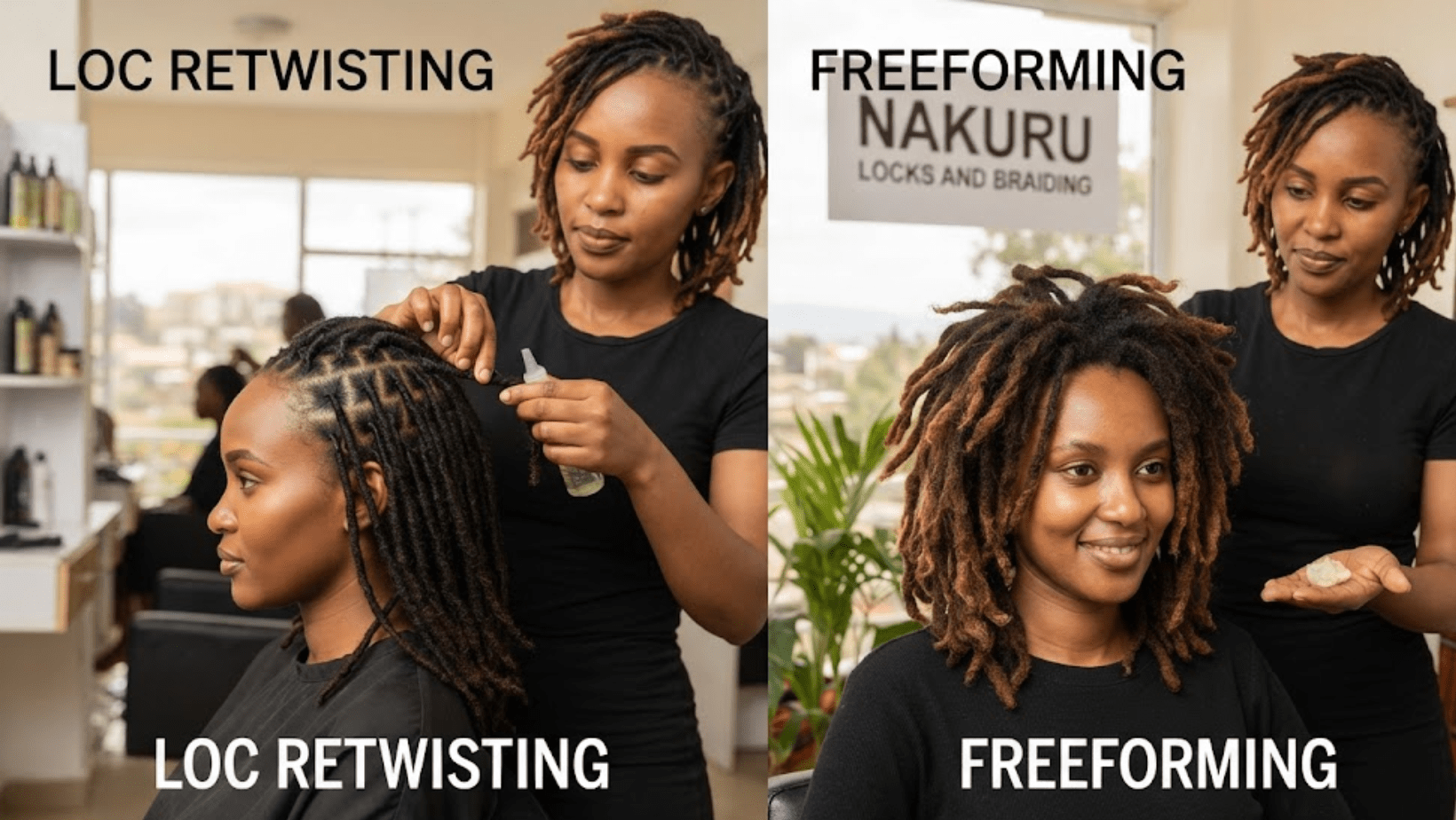
Loc Retwisting vs Freeforming: Which Is Better for You?
Imagine sitting in a salon chair in Nairobi, London, New York or Johannesburg with two very different goals: one person wants clean, defined parts and a polished retwist, while another wants their locs to grow organically, merge naturally and reflect their personality.
Neither choice is automatically better. The right option depends on your preferred appearance, maintenance routine, scalp health, lifestyle and willingness to let your hair develop with less control.
At Nakuru Locks and Braiding, we view loc maintenance as a personal journey rather than a competition between “neat” and “natural.” Loc retwisting offers structure and a groomed finish, while freeforming allows the hair to lock with minimal manipulation. Semi-freeforming sits between the two.
This guide explains loc retwisting vs freeforming, whether freeforms are the same as dreads, what people say in loc retwisting vs freeforming Reddit discussions, how the choice applies to women, and whether you should get a retwist with freeforms.
Understanding the Terms: Loc Retwisting, Freeforming, and Dreads
Loc retwisting (also called palm-rolling or root twisting) is the process of taking new growth at the scalp and twisting or rolling it into the existing loc using fingers, a comb, or gel.
The goal is to keep roots neat, parts clean, and individual locs separate and uniform. Most traditional or “maintained” locs rely on retwisting every 4–8 weeks depending on growth rate, hair texture, and desired neatness.
Freeforming (or freeform locs / organic locs) means allowing the hair to lock and mature with minimal or no regular twisting, interlocking, or forced sectioning. You wash, dry thoroughly, moisturise the scalp as needed, and separate only when necessary to prevent unwanted merging. The locs form their own organic shapes—sometimes uneven, thicker in places, highly individual. True freeform typically involves little to no retwisting from the start or after a deliberate decision to stop.
Dreads or dreadlocks is the broader umbrella term. “Locs” is often preferred in many African and diaspora communities for its cultural resonance. Both freeform and retwisted styles fall under locs/dreads; the difference lies in maintenance philosophy. Semi-freeform sits in the middle: occasional separation or infrequent light maintenance (for example every 3–6 months or a few times a year) while still allowing a more natural silhouette.
These distinctions matter because the phrases “loc retwisting vs freeforming,” “loc retwisting vs freeforming vs dreads,” and “should I get a retwist with freeforms” all circle the same core decision: how much control versus how much natural development you want.

Loc Retwisting vs Freeforming: The Core Comparison
Retwisting produces a polished, uniform look. Roots stay defined, parts remain visible longer, and the overall style can appear more “professional” or controlled in certain workplaces or social settings.
It works well for people who enjoy regular salon visits, prefer a neat aesthetic, or have hair that benefits from guided locking (especially in earlier stages).
Drawbacks include time and cost of frequent appointments, cumulative tension that can contribute to thinning or traction issues at the roots over years, and the risk of product buildup if gels are overused.
Freeforming emphasises low manipulation and individuality. Maintenance focuses on cleansing, thorough drying, scalp care, and gentle separation rather than reshaping.
Many wearers report thicker-feeling roots over time (because tension is reduced), less breakage from handling, lower long-term cost, and a deeply personal aesthetic that evolves uniquely.
Challenges include the “in-between” phase where roots look softer and less defined, potential for congos (merged locs) if separation is neglected, and the need for patience—full maturity can take 1–2 years or longer depending on texture.
A clear side-by-side view:
- Manipulation: Retwisting = regular; Freeform = minimal to none.
- Shape: Retwisting = more uniform and controlled; Freeform = organic, unique, often uneven in a deliberate way.
- Maintenance frequency: Retwisting typically every 4–8 weeks; Freeform mainly washing and occasional separation.
- Scalp impact: Frequent retwisting can place repeated tension on the same points; freeforming reduces that mechanical stress.
- Aesthetic outcome: Polished vs raw/expressive.
- Lifestyle fit: Structured schedule vs freedom from frequent appointments.
Semi-freeform offers a practical bridge for many—extending time between services while still preventing excessive merging.
Experts caution against abrupt changes, especially with interlocked locs or very young sets, and recommend testing longer intervals gradually while monitoring root health.
What Reddit and Real Journeys Reveal
Searches for “loc retwisting vs freeforming reddit” surface lived experience more than textbook advice. Common themes include:
- People who stopped retwisting after noticing root thinning and felt relief once tension decreased.
- Wearers debating whether to “break the freeform code” with a one-time retwist for a fresh look or special event.
- Discussions of congos, volume, and the emotional adjustment to a less controlled silhouette.
- Advice that freeforming is not neglect—cleanliness and drying remain non-negotiable.
- Stories of transitioning from traditional to freeform (or semi) and the temporary “ugly” or in-between stage that eventually settles into something unique.
Reddit is peer experience, not professional diagnosis. Patterns that appear repeatedly—concern about thinning from over-twisting, love for organic volume, questions about washing frequency—align with what experienced locticians observe in salons.
Treat community threads as useful pulse checks and pair them with professional assessment of your specific hair density, texture, and scalp condition.
Considerations for Women: Loc Retwisting vs Freeforming Female Perspectives
Women often navigate additional layers: workplace expectations, styling versatility for formal events, edge protection, and how the silhouette frames the face.
Freeform locs on women can look powerfully expressive—think thicker organic sections, creative colour, updos that showcase texture, or soft fringe areas left slightly freer.
Many appreciate the reduced time commitment and the cultural/spiritual resonance of allowing hair to form without constant intervention.
Retwisting remains popular among women who prefer defined parts for neat upstyles, braided accents, or a consistently polished appearance.
Some practice semi-freeform: maintaining front sections or the hairline more carefully while allowing the crown and back to develop more freely.
Edge care, moisture balance, and gentle handling matter regardless of method—overly tight retwists near the hairline can contribute to traction concerns over time for anyone, including women.
Ultimately the choice is personal. A woman in a corporate environment may lean toward controlled roots for certain seasons and freer growth at others.
Another may fully embrace freeform as an extension of natural-hair confidence.
At Nakuru Locks and Braiding we help clients explore both aesthetics through consultation, ensuring the method supports healthy growth rather than fighting the hair’s natural behaviour.

Should I Get a Retwist with Freeforms?
This is one of the most frequent questions. Strict freeform philosophy holds that if you are regularly retwisting, the style is no longer pure freeform.
Occasional maintenance, however, is common in real life and often called semi-freeform.
Reasons people still get an occasional retwist or professional tidy while freeforming include:
- A special event where they want a temporarily cleaner root appearance.
- Managing excessive merging or very uneven budding that bothers them aesthetically.
- Addressing specific problem areas without returning to a strict 4–6 week cycle.
- Simply testing whether they prefer the defined look again.
If you do retwist freeform or semi-freeform locs, communicate clearly with your loctician: light tension, focus mainly on separation and any stubborn new growth, avoid heavy gels that create buildup, and do not force every loc back into a rigid previous pattern.
Many who try a one-off retwist return to freer growth afterward because they prefer the volume and reduced maintenance.
Others discover they enjoy a hybrid rhythm. The key is intentionality—retwisting should serve the hair and the wearer, not become automatic.
Practical Care Regardless of Path
Healthy locs—retwisted, freeform, or semi—share fundamentals:
- Residue-free cleansing on a schedule that matches your lifestyle and activity level (often weekly or bi-weekly).
- Thorough drying; damp locs left wet too long invite issues.
- Scalp care: gentle massage, appropriate oils or moisturisers without overloading.
- Night protection (satin or silk) to reduce friction and lint.
- Separation of budding roots when you want to preserve individual loc size.
- Patience during stages—starter, budding/teen, mature—especially with freeform.
Hair texture influences everything. Coily and kinky patterns often lock more readily with less intervention; looser textures may need more time or light guidance early on. Density, length at starting, and previous chemical history also play roles.
Which Is Better for You?
There is no universal winner. Choose retwisting (or frequent traditional maintenance) if you love a neat, uniform look, enjoy regular salon rituals, need predictable definition for styling or professional contexts, or are still in the early locking stages where structure helps.
Choose freeforming if you prioritise low manipulation, want an organic and highly personal aesthetic, seek to minimise tension and cost, or feel drawn to the freedom of letting the hair lead. Many land on semi-freeform as the sustainable middle ground.
Ask yourself:
- How much time and money am I willing to invest in appointments?
- Do I prefer controlled uniformity or natural variation?
- How is my scalp and root health responding to current practices?
- What aesthetic makes me feel most like myself?
- Am I prepared for the transitional look if I change methods?
A professional consultation can assess your specific hair and help map a path—whether that means starting freeform, transitioning existing locs, refining a retwist technique, or designing a hybrid schedule.
FAQ
What is the main difference between loc retwisting and freeforming?
Retwisting regularly guides new growth into a defined pattern for a neater look. Freeforming allows natural locking and shape with minimal root manipulation.
Can I switch from traditional retwisted locs to freeform?
Yes. Many do successfully. Expect an adjustment period at the roots and monitor for unwanted merging. Gradual lengthening of intervals often works better than abrupt stop, especially if interlocking was used previously.
Do freeform locs require any maintenance?
Yes—cleaning, drying, scalp care, and selective separation. They are low-manipulation, not zero-care.
Will freeforming make my locs thicker?
Many people experience fuller-looking roots and more volume because tension is reduced. Results vary by texture and how consistently you separate (or allow) congos.
Is freeforming suitable for women who need versatile styles?
Absolutely. Freeform and semi-freeform locs can be styled in updos, half-up looks, with accessories, or left natural. Definition level is a personal preference.
Should I get a retwist if I have freeforms?
Only if you want temporary neatness or specific correction. Pure freeform avoids regular retwisting; occasional light work is common in semi-freeform practice.
How often should traditional locs be retwisted?
Commonly every 4–8 weeks, adjusted for growth rate, climate, and preference. Over-twisting can stress roots.
Where can I get expert guidance in Nakuru?
Nakuru Locks and Braiding specialises in natural locks, artificial options, maintenance, and education tailored to individual hair and lifestyle.
Related articles from Nakuru Locks and Braiding
These pieces expand on stages, practical routines, and styling ideas that complement the retwisting-versus-freeforming decision.
Final Thoughts from Nakuru Locks and Braiding
Your locs are a living expression of your journey. Whether you choose the refined structure of regular retwisting, the organic freedom of freeforming, or a thoughtful hybrid, the best choice is the one that keeps your scalp comfortable, your hair healthy, and you feeling confident.
In Nakuru and for clients everywhere, we are here to support that decision with skill, eco-conscious products, and honest conversation.
Book a consultation at Nakuru Locks and Braiding (Mt. Sinai Building, Bazaar Rd, Nakuru; WhatsApp/call 0723 168 188).
Bring your questions about loc retwisting vs freeforming, show us where you are in your journey, and leave with a clear plan that respects both your hair and your life.
Your next chapter—neat, free, or somewhere beautifully in between—starts with understanding the options. Choose the path that lets your locs, and you, thrive.
Reference
Experienced locticians consistently emphasise that healthy roots and a happy wearer matter more than any single method.
Over-manipulation is a frequent cause of long-term issues; thoughtful under-manipulation with good hygiene supports longevity.
Community platforms and educational sites reinforce the same principles: clean hair locks better, tension should be managed, and personal preference is valid.
Leave a Reply