
Do Locs Get Thicker or Thinner Over Time? The Truth Behind the Ups and Downs
Picture this: you started your loc journey with neat, pencil-thin coils. Eighteen months later, you catch your reflection and do a double take — some locs look like they’ve doubled in girth, while a few near your hairline seem to have shrunk to threads. Is something wrong? Are you losing your hair? Or is this just… normal?
If you’ve searched “do locs get thicker or thinner over time,” scrolled through Reddit threads at 2am, or asked a loctician in Nakuru whether your roots are supposed to look this thin — you’re part of a very large, very confused club.
The good news is that loc thickness isn’t random. It follows a predictable biological pattern, and once you understand it, the mystery (and the anxiety) mostly disappears.
At Nakuru Locks and Braiding, we see this question almost daily, from first-time starter-loc clients to people nursing eight-year-old locs back to health.
This guide walks through the science, the stages, the warning signs, and what you can actually do about it — backed by dermatological research, not just salon folklore.

So, Do Locs Get Thicker or Thinner Over Time?
The honest, unglamorous answer: both, at different times, for different reasons.
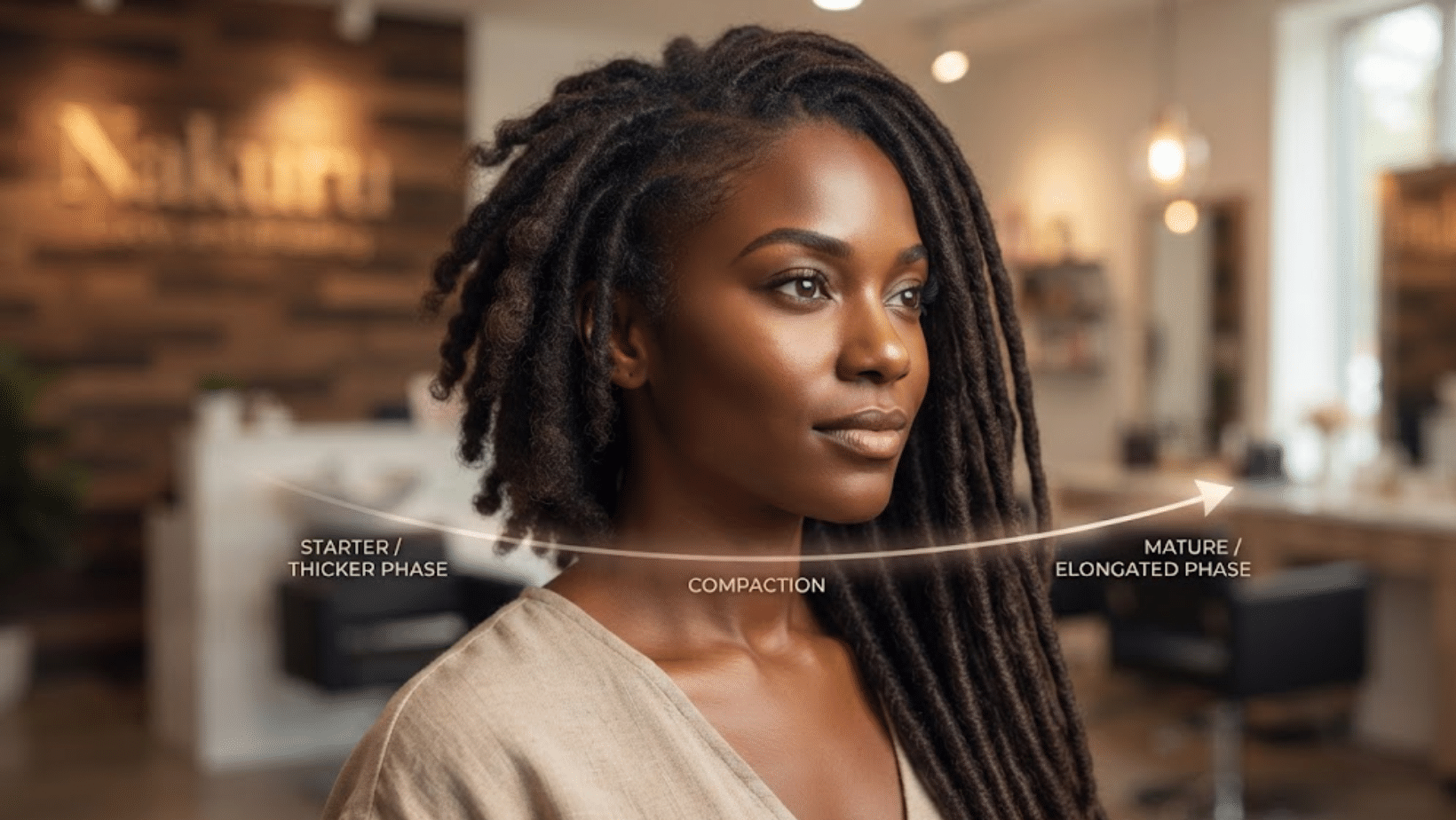
Loc thickness isn’t a straight line. It’s more like a wave. Locs can get thicker or thinner over time depending on hair type, parting size, maintenance routine, and overall hair health, and the thickness and length of dreadlocks fluctuate a lot during the first year or two simply because the hair is still adjusting and becoming matted.
Once your locs reach maturity, most healthy locs settle into a size that’s a little larger than what you started with, but the road there is rarely smooth.
Trichologists and loc specialists generally describe two separate phenomena that people lump together under “thickening” or “thinning”:
1. Natural maturation cycles — swelling, compacting, and settling as the internal structure locks up. This is normal and expected.
2. Structural thinning — root weakening, breakage, or hair loss caused by tension, neglect, or an underlying scalp condition. This is not normal and needs attention.
Knowing which one you’re dealing with is the entire game.

Why Locs Swell, Shrink, and Swell Again: The Stages Explained
To understand why your locs seem to change shape every few months, it helps to walk through the loc life cycle.
Stage 1 — Starter Locs.
In the early months, locs may appear fuzzy, uneven, or loose in some areas as the hair begins to knot and frizz reaches its peak. At this point they typically look their thinnest and most uniform, since the strands haven’t fully tangled into a cohesive rope yet.
Stage 2 — Budding.
This is where most of the “why is my loc suddenly fat in the middle?” panic comes from. A budding loc can look smooth from the root to the mid-shaft while the end of the loc appears fuller, thicker, and frizzier, and this budding phase can begin within the first three to six months and last anywhere from six months to a year. New growth constantly emerges loose at the root and has to be worked back into the strand, which is part of why roots often look thinner than the rest of the loc during this phase.
Stage 3 — Teen/Adult Locs.
By roughly a year and a half in, locs thicken, become more defined, and settle into their structure — though they may still shrink, expand, bunch, or lump unpredictably along the way.
Stage 4 — Mature (Rooted) Locs.
Several years in, locs become firm, fully locked, and uniform, with frizz decreasing, shrinkage slowing down, and length retention becoming noticeable.
So if you’re asking “do locs get thicker after starter locs” — generally, yes, once they move past the budding chaos and into the teen stage.
And if you’re asking “do locs get thinner as they get longer” — also yes, sometimes, because longer locs carry more weight, and weight is one of the biggest drivers of thinning we’ll cover next.

Do Locs Get Skinnier as They Get Longer?
This is one of the most common versions of the question, and it deserves a direct answer: length itself doesn’t shrink a healthy loc, but the weight that comes with length can.
As locs grow past shoulder length, gravity pulls on every root. Roots can only support so much weight, and the longer locs get, the heavier they become — which is exactly why many people notice their longest locs are also their thinnest at the base. This isn’t a sign your hair is dying; it’s mechanical stress.
It’s also why experienced locticians recommend lighter partings, fewer heavy accessories, and looser styles as locs get longer, rather than tighter retwists that add even more tension to an already-strained root.

Does Washing Your Dreads Make Them Thicker?
Washing itself doesn’t add thickness — hair strands don’t expand from water the way a sponge does — but washing reveals thickness that product buildup was hiding.
Wax, heavy butters, and gels can flatten and coat the hair, making locs look sleeker and sometimes deceptively slimmer.
Once you wash that residue out, the individual strands separate and puff up again, especially in the budding and teen stages, which is why so many people say “my locs look so much thicker right after I wash them, then thinner after a fresh retwist.”
Both observations are true — you’re just seeing two different things: natural fullness after washing versus the compacting effect of a tight retwist.

Locs Thinning at the Root: When It’s a Warning Sign
Here’s where the conversation needs to shift from “normal maturation” to “please pay attention.” Thinning at the root, specifically, is the most common complaint we hear at the salon, and it has several possible causes.
1. Traction alopecia.
This is by far the most frequent culprit. Locs are one of the hairstyles that can cause traction alopecia when worn too tightly, and traction alopecia is a scarring form of hair loss caused by repeated or excessive pulling and weight on the hair strands, where stress on the follicle when hair is repeatedly pulled from the root damages it over time.
Twisting locs too tightly, wearing them in high buns, and constant pulling are common triggers, and the strain causes inflammation, soreness, and itching before hair eventually begins falling out at the hairline and sides.
The American Academy of Dermatology notes that the constant rubbing of hats, headscarves, or other coverings can also contribute, especially when hair is pulled back tightly underneath them, and that people of African descent may be more prone to this kind of damage due to natural hair follicle shape.
2. Over-retwisting.
Excessive or overly forceful retwisting manipulates the new growth at the scalp, and aggressive handling can weaken the connection between the loc and the scalp, sometimes leading to breakage right where new growth meets the established loc.
3. Neglected roots.
Ironically, the opposite problem also causes thinning. If new growth isn’t regularly joined into its respective loc, the loc can weaken and eventually become thinner over time.
4. Nutritional deficiencies.
Your scalp needs raw materials to build strong hair. Zinc supports scalp tissue repair, selenium guards against fungal growth that can worsen dandruff, vitamin D helps create new hair follicles, and iron aids scalp circulation — and a deficiency in any of these can reduce new growth or increase shedding, both of which show up as thinning at the roots.
5. Central Centrifugal Cicatricial Alopecia (CCCA).
This is a more serious, scarring form of hair loss that starts at the crown and spreads outward in a circular pattern, and it’s particularly common in Black women but can affect men and other groups as well. Because it’s progressive and scarring, it needs a dermatologist’s diagnosis rather than salon-based fixes.

What Do Unhealthy Locs Actually Look Like?
Not every change in thickness is cause for alarm, but certain signs mean it’s time to see a professional loctician or a dermatologist:
- Locs that thin specifically at the hairline, temples, or nape while the rest of the head looks normal — a classic traction alopecia pattern.
- Broken, snapped hairs sticking out near the root rather than smooth new growth.
- Itching, redness, scaling, or small bumps and pustules along the scalp — signs of follicle inflammation, not just dryness.
- Locs that fall out completely at the root, rather than simply looking slimmer.
- A widening, circular bald patch starting at the crown — a possible sign of CCCA that requires medical attention.
- Persistent tenderness when locs are touched or styled, which often means the follicle is already under strain.
Healthy locs, by contrast, can look uneven, lumpy, swollen in places, and slim in others — especially in year one or two — without any of the above symptoms. Fluctuation alone is not a red flag; pain, breakage, and patterned hairline loss are.

Will Thinning Locs Grow Back?
It depends entirely on the cause and how early it’s caught.
- Traction alopecia caught early is often reversible once tension is removed. If the symptoms and signs are caught in the early stages, traction alopecia can be reversed, though for many people the damage is more severe and requires medical intervention such as steroids, antibiotics, or minoxidil to help regrow the hair.
- Thinning from over-manipulation or neglect generally responds well to a gentler maintenance routine, looser partings, and giving the scalp a rest.
- Nutritional-deficiency thinning usually improves once the underlying deficiency is corrected — though this should be confirmed with bloodwork rather than guesswork.
- CCCA and long-standing scarring alopecia are harder to reverse, since scar tissue can permanently replace the follicle. Early diagnosis dramatically improves the odds of preserving remaining hair.
The takeaway: the earlier you address thinning, the better your chances. Waiting months or years to “see if it fixes itself” is the single biggest mistake we see.
How to Repair Locs That Are Thin at the Root
If you’ve noticed thinning and want to actively repair it, here’s a practical approach:
1. Stop the tension immediately. Switch out of tight ponytails, buns, and heavy hanging styles. Give the root a break from any pulling.
2. Space out retwists. Retwisting too often re-traumatizes the same spot on the scalp. Many locticians recommend stretching retwists to every 6–8 weeks, especially on thinning sections.
3. Reduce weight where possible. For long, heavy locs, consider trimming length, thinning out overly bulky sections, or avoiding heavy loc jewelry near thinning areas.
4. Nourish the scalp, not just the hair shaft. Look for zinc, iron, biotin, and vitamin D in your diet or supplements (after checking with a doctor), and use lightweight, non-greasy scalp oils rather than heavy waxes that clog follicles.
5. Join new growth gently and consistently so roots don’t go neglected, but avoid aggressive re-twisting motions.
6. See a professional. A loctician can assess whether the thinning is mechanical (fixable with technique changes) or medical (needs a dermatologist). At Nakuru Locks and Braiding, root health checks are part of every retwist appointment specifically to catch this early.
7. Get a dermatology consult for anything beyond mild thinning — especially bumps, scaling, or a spreading bald patch, which are outside what any salon treatment can fix.
The Reddit Consensus (And Why It Matches the Science)
If you’ve read “do locs get thicker or thinner over time reddit” threads, you’ll notice the community answer lines up closely with dermatological findings: most commenters report their locs got noticeably thicker after the first year, several mention thinner roots after tight styles or long stretches between retwists, and a recurring theme is that washing “reveals” thickness that wax and buildup were hiding.
In other words, the lived experience of thousands of loc-wearers matches what trichologists describe clinically — it’s just rarely explained in one place, which is exactly why this confusion is so common.

Frequently Asked Questions
Do locs get thicker over time?
Generally yes, once they move past the early budding stage. Healthy dreadlocks are typically a little thicker once mature than when they started, with the final thickness depending mostly on hair density, texture, and the size of the parting.
Do locs get thinner as they grow longer?
Not from length alone, but the added weight of longer locs increases root strain, which can cause thinning at the base if not managed with looser styling and proper maintenance.
Does washing your dreads make them thicker?
Washing doesn’t add hair mass, but it removes product buildup that was compressing the strands, so locs often look and feel fuller right after a wash.
How do I know if my locs are thinning in a bad way?
Watch for thinning concentrated at the hairline or nape, breakage, itching or scalp bumps, and any bald patch that’s spreading — these point to traction alopecia or a scarring condition rather than normal maturation.
Will thinning locs grow back?
Often, yes, if caught early and the cause is mechanical (tension, over-retwisting, neglect). Scarring conditions like CCCA are harder to reverse, which is why early professional evaluation matters.
What causes locs to be thin at the root specifically?
The leading causes are traction alopecia from tight styling, over-retwisting, neglected new growth, nutritional deficiencies, and in some cases CCCA — each with a different fix.
Related Articles from Nakuru Locks and Braiding
For deeper practical guidance, explore these resources on our site:
- How to Maintain & Style Dreadlocks: Step-by-Step Guide for Beginners – Healthy vs. unhealthy signs and care routines.
- Freeform Locs: What They Are, Stages, How to Start & Care – Lower-manipulation approaches that can support natural fullness.
- How to Detox Your Locs at Home – Removing buildup that stresses roots.
- Dreadlock Retwist Guide – Frequency, techniques, and tension tips.
- Starter Locs Hairstyles: Best Methods, Types & Care Guide – Setting the foundation for desired thickness.
Loc thickness is less a straight path and more a conversation your hair is having with itself — swelling, settling, tightening, loosening — over years, not weeks.
Most of it is completely normal. But when thinning shows up at the root, the hairline, or in a spreading patch, it’s your hair asking for help, not just going through a phase.
Catching that difference early is what separates a passing budding stage from a preventable loss.
References
- American Academy of Dermatology — Hairstyles That Pull Can Cause Hair Loss
- DermNet NZ — Traction Alopecia
- Hair.com, in consultation with licensed trichologist Kari Williams — Understanding Traction Alopecia
Leave a Reply