
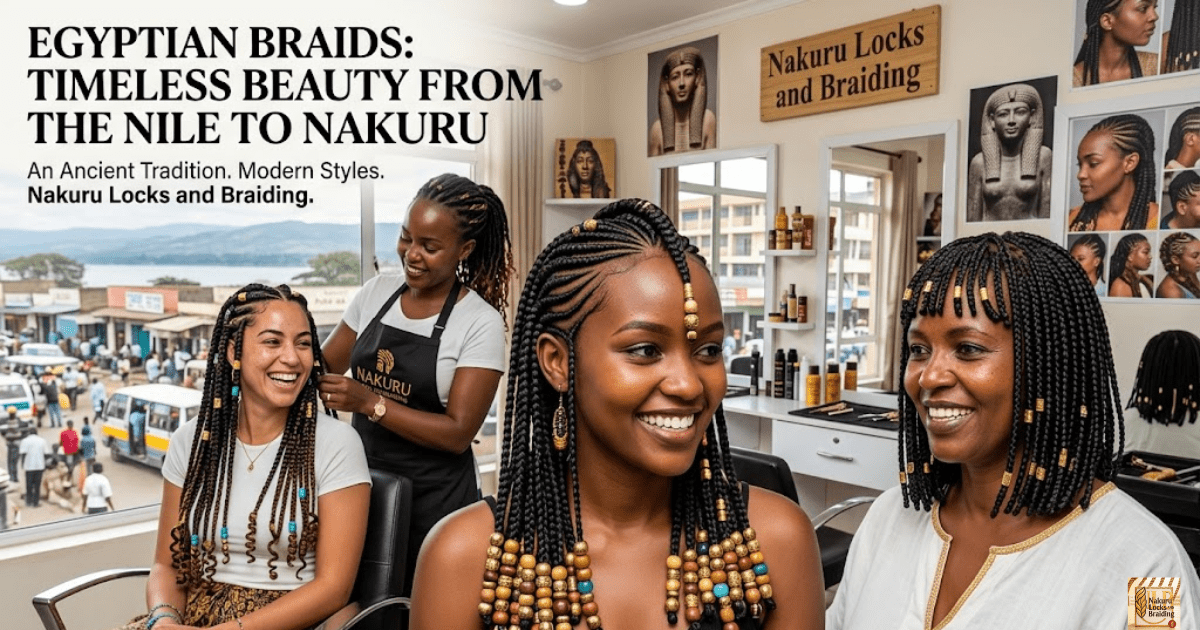
Egyptian Braids: Timeless Ancient Egyptian Braided Hairstyles, Traditional Twists, Egyptian Fulani Tribal Braids, and Modern Styles with Beads at Nakuru Locks and Braiding
From the golden sands of the Nile to the vibrant streets of Nakuru, Kenya, Egyptian braids have captivated hearts for over 5,000 years. Picture this: a global traveler lands in Nairobi, craving a hairstyle that whispers ancient royalty while turning heads in 2026.
She walks into Nakuru Locks and Braiding, our expert salon, and emerges with Egyptian hair braids that blend pharaonic elegance with contemporary African flair. Whether you’re in London, New York, or right here in the Rift Valley, these styles connect you to a shared African heritage that transcends borders.
At Nakuru Locks and Braiding, we specialize in Egyptian braided hairstyles that honor history while delivering the protection, versatility, and beauty modern women demand.
In this comprehensive guide, we explore egyptian braids, egyptian hair braids, ancient egyptian braids, traditional egyptian braids, egyptian fulani tribal braids, egyptian braids with beads, and answer the burning question: are box braids egyptian?
Backed by archaeological evidence, Egyptological research, and our decade-plus experience braiding across East Africa, this article equips you with everything you need to choose, maintain, and love your next look.
The Genesis of Style: Ancient Egyptian Braids
In ancient Kemet (the indigenous name for Egypt), hair was a primary indicator of age, gender, and social status. Ancient Egyptian braids were not merely functional; they were symbolic.
Royal Weaves and Divine Symbolism
Archaeological findings, such as those from the workers’ village at Deir el-Medina, reveal that both men and women utilized braids to manage hair in the heat. However, for the elite, braids were often adorned with gold tubes, lotus flowers, and heavy oils.
-
The Sidelock of Youth: Children often wore a single braid on the right side of their head, symbolizing their status as minors.
-
Wigs and Extensions: Contrary to popular belief, many “braids” seen on statues were actually high-quality wigs made of human hair or sheep’s wool, intricately braided and set with beeswax.
Expert Insight: “Braiding in ancient Egypt served as a form of social communication. The complexity of a woman’s braids often indicated her wealth and the number of servants she employed to maintain them.” — Historical Archives of Nakuru Locks and Braiding.
Deciphering the Styles: Egyptian Braided Hairstyles Today
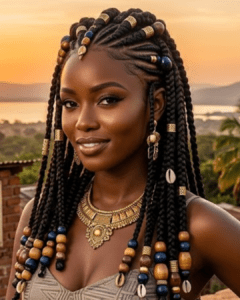
When we discuss Egyptian braided hairstyles in a modern salon context, we are looking at a fusion of North African geometry and Sub-Saharan texture.
Egyptian Braids with Beads
Perhaps the most recognizable aesthetic is the use of heavy ornamentation. Egyptian braids with beads serve a dual purpose:
-
Weight and Tension: They help the braids hang straight and provide a rhythmic movement.
-
Spiritual Protection: Historically, beads made of carnelian, turquoise, or lapis lazuli were believed to ward off the “evil eye.”
At Nakuru Locks and Braiding, we recommend using wooden or metallic beads to capture that authentic Nile Valley aesthetic while protecting the hair shaft from breakage.
Egyptian Fulani Tribal Braids: A Cultural Crossroads
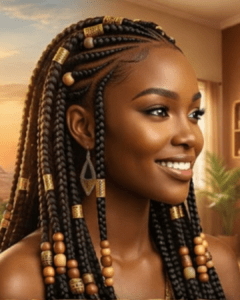
One of the most requested styles is the Egyptian Fulani tribal braid mix. While the Fulani people are traditionally from West Africa (the Sahel region), there is a significant historical overlap in braiding patterns between the East and West.
-
The Signature Pattern: These typically feature a central cornrow braided from front to back, with side braids directed toward the face or tucked behind the ears.
-
The Fusion: Modern “Egyptian” Fulani styles often incorporate the “Goddess” aesthetic—long, flowing braids with curled ends, reminiscent of the depictions of the Goddess Isis.
Are Box Braids Egyptian? A Historical Correction
A common question we receive at the salon is: Are box braids Egyptian?
The short answer is: Yes and No.
While the term “box braids” is a modern Western descriptor for braids with square-shaped parts, the technique itself—attaching extensions to natural hair using a three-strand weave—has deep roots in ancient Egypt. Mummies dating back to 3000 BCE have been discovered with synthetic or human hair extensions braided into their natural locks using methods nearly identical to today’s “box” sections.
However, the specific “box” parting system as we know it today was refined across various African cultures, including the Himba of Namibia and the Nile Valley civilizations. Egypt was undeniably a pioneer in the use of added fiber to create length and volume.
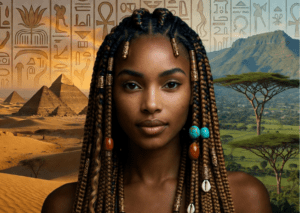
Traditional Egyptian Braids vs. Modern Interpretations
Understanding traditional Egyptian braids requires looking at the “Chin-Length Bob” braids often seen in 18th-dynasty artistry.
| Feature | Traditional (Ancient) | Modern Egyptian Style |
| Material | Human hair, sheep wool, beeswax | Synthetic kanekalon, human hair blends |
| Ornaments | Gold, lapis lazuli, ivory | Acrylic beads, gold cuffs, shells |
| Longevity | Weeks (due to heavy wax) | 6 to 8 weeks |
| Parting | Organic, often hidden by wigs | Precise, geometric (Diamond/Box) |
Maintenance and Care for Egyptian Styles
Maintaining the integrity of Egyptian hair braids requires a balance of moisture and scalp health. Because these styles often involve intricate parting and weight from beads, follow these expert tips:
-
Scalp Hydration: Use a light oil (like Jojoba or Grapeseed) to keep the “valleys” between braids hydrated.
-
Night Care: Always wrap your braids in a silk or satin scarf. This prevents the “Egyptian frizz” that can occur from friction against cotton pillows.
-
Bead Security: If you have Egyptian braids with beads, check the tension weekly. If the beads feel too heavy on your edges, have your stylist reposition them.
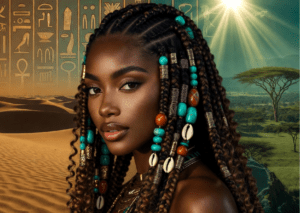
Why Choose Nakuru Locks and Braiding?
Our team of certified braiders—trained in traditional African techniques and modern protective styles—has served thousands from Nakuru to Nairobi and beyond. We use only premium, tangle-free hair, sterile tools, and gentle products to ensure scalp health. Egyptian braids offer:
- Protection: Shields natural hair from UV, pollution, and manipulation.
- Versatility: Style as updos, ponytails, or buns in minutes.
- Longevity: 6–12 weeks with proper care.
- Cultural Pride: Celebrate Africa’s first braided civilization.
Book your consultation today and let us craft a look that honors the pharaohs while fitting your lifestyle.
Frequently Asked Questions (FAQ)
1. How long do Egyptian braids typically take to install?
Depending on the complexity and the addition of beads, expect to spend 4 to 7 hours in the chair. Intricate tribal patterns require precision that shouldn’t be rushed.
2. Can I get Egyptian braids on short hair?
Yes. With the modern “feed-in” technique used at Nakuru Locks and Braiding, we can anchor extensions to hair as short as 2 inches.
3. Are these styles “protective”?
Absolutely. When installed with the correct tension, Egyptian and Fulani styles protect your natural ends from environmental stress and manipulation, promoting hair growth.
4. What is the difference between Egyptian braids and regular cornrows?
Egyptian-style braids often focus on symmetry and accessories. While standard cornrows are functional, Egyptian styles typically feature specific parting patterns meant to mimic crown-like structures or royal headdresses.
Related Articles from Nakuru Locks and Braiding
References
-
Fletcher, J. (2002). “Ancient Egyptian Hair and Wigs.” The Journal of Egyptian Archaeology.
-
Cox, C. (2015). “African Hairstyles: A History of Social Signaling.” University of Heritage Press.
-
Smith, T.K. (2020). “The Geometry of the Nile: Braiding Patterns in Kemet.” International Journal of African Styling.
Leave a Reply