
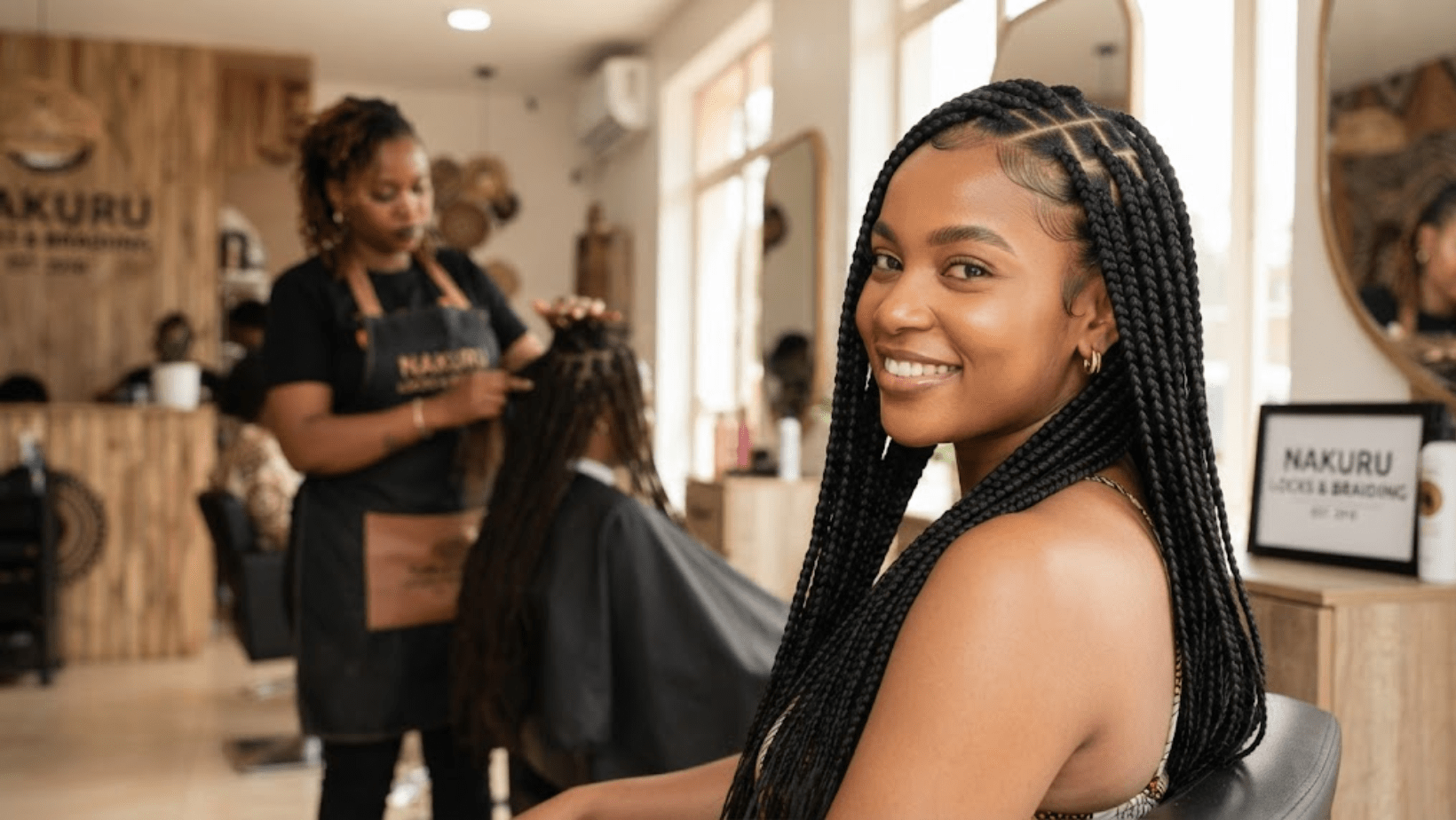
How to Make Braids Last Longer Between Salon Visits: A Complete Guide for Natural Hair, Cornrows, Dutch Braids, French Braids & More
It’s 2 a.m. and you’re wrapped in a silk bonnet, gently smoothing down a flyaway with your fingertip, silently negotiating with your braids: just three more weeks, please.
If you’ve ever tried to stretch a fresh set of box braids, cornrows, or knotless braids past their prime — or tried to keep a French braid looking crisp through a long workday — you already know the quiet, universal ritual of braid maintenance.
It doesn’t matter whether you’re in Nakuru, Nairobi, London, or Lagos: braids are an investment of time, money, and patience, and everyone wants to protect that investment for as long as possible.
At Nakuru Locks and Braiding, we install braids nearly every day, and the most common question our clients ask isn’t “how do I get braids” — it’s “how do I make them last?”
This guide brings together everything we tell clients in the chair, backed by dermatologist research and hairstylist expertise, so you can keep your style fresh, healthy, and salon-worthy for weeks at a time — whether you’re rocking cornrows, knotless braids, Dutch braids, or a simple French plait.
How to Make Braids Last Longer Between Salon Visits (Natural Hair)
For natural, textured hair, braid longevity comes down to three things: moisture balance, low tension, and protecting the style while you sleep.
Braided hairstyles are considered a “protective style,” meaning they shield your natural hair from daily manipulation — but only if you maintain them correctly, because poorly maintained braids can do more harm than good.
Keep your scalp clean and hydrated.
A build-up of sweat, dead skin, and product residue is one of the fastest ways braids start looking (and feeling) tired.
Stylists recommend a light, sulfate-free shampoo or a diluted root rinse every one to two weeks to keep the scalp comfortable without soaking or loosening the braids themselves.
Using a sulfate-free shampoo along with lightweight scalp oils helps prevent buildup and irritation.
Between washes, a tea tree or lavender-infused scalp spray can help control bacteria and dandruff while keeping your roots calm.
A mixture of tea tree oil, lavender, and water sprayed onto the scalp daily helps keep the base cool and prevents the natural hair underneath from drying out and breaking.
Moisturize the braids themselves, not just the scalp.
Spraying with a water-based leave-in conditioner and sealing with a natural oil like jojoba or argan keeps braids hydrated without weighing them down.
The goal is balance — under-moisturized braids turn dry and frizzy, while over-moisturized ones attract dust and product buildup.
Protect your edges from tension.
Traction alopecia — hair loss caused by consistent pulling — is a real risk with any braided style, and it’s the single biggest reason braids should never be installed too tight.
Experts agree that you shouldn’t feel pulling or tugging once braids are in, and tight braiding around the hairline can cause excessive breakage and pull the hair right out of the follicle.
A 2016 review of 19 studies by Johns Hopkins researchers, published in the Journal of the American Academy of Dermatology, found a strong association between tension-heavy styles like tight braids, ponytails, and buns and the development of traction alopecia, with braids, locs, weaves, and extensions ranking among the highest-risk styles when applied too tightly or left in for extended periods.
The same research team’s guidance for dermatologists recommends that braided hairstyles stay in no longer than two to three months, with weaves and extensions removed periodically after six to eight weeks to give the scalp time to recover.

How to Make Braids Last Longer at Home (Natural, No-Salon Methods)
You don’t need a stylist’s chair to extend the life of your braids between appointments. A few home habits make an enormous difference:
- Sleep with protection, every single night. Wrapping braids with a satin or silk scarf or bonnet — or swapping a cotton pillowcase for a silk one — prevents the friction that causes frizz and moisture loss overnight. This is arguably the single highest-impact habit for braid longevity, because cotton fibers pull moisture from hair and rough up the braid’s surface every time you turn over in your sleep.
- Trim flyaways carefully. Keeping loose ends and fuzzy strands in check with small hair scissors prevents them from unraveling further, but always braid-track where your real hair ends to avoid an accidental haircut.
- Handle your hair gently. Favor fingers over combs or brushes for styling, and use fabric-covered hair ties rather than rubber bands, which snag and stress the hair shaft.
- Do a scalp refresh instead of a full wash. Dry shampoo, a diluted apple cider vinegar rinse, or a warm damp cloth wiped along the parts can lift oil and buildup between full washes without loosening your braids early.
- Touch up instead of redoing the whole head. When your roots grow out and your parts start looking uneven, most stylists recommend refreshing just the front hairline or the most visible sections rather than removing the entire style — a “partial takedown” that saves both time and money.
How to Make Braids Last Longer on White Hair (Fine or Straight-Textured Hair)
Braiding fine, straight, or silver/white hair comes with its own challenges — mainly slippage, because the hair shaft is often smoother and less able to “grip” itself the way coarser, textured hair does. A few adjustments help:
- Prep with texture, not just moisture. A light sea-salt spray or texturizing mist before braiding gives slick strands something to grip, which helps braids hold their shape longer.
- Choose Dutch over standard braids for extra hold. The Dutch braiding technique creates a raised ridge along the part that keeps strands from lying flat and sliding out, and building the braid with slightly larger sections as you go makes the finished look fuller and more secure.
- Anchor the ends properly. Fine hair braids and extensions on white or silver hair benefit from a light hold gel or edge cream at the root and a secure, non-slip elastic at the tip, since finer hair is more prone to unraveling from the bottom up.
- Avoid heavy oils. On fine hair especially, heavy oils weigh the braid down and accelerate slippage; a light, non-greasy serum applied sparingly is a better choice for maintaining shine without collapsing the style.

How to Make Braids Last Longer on Natural Hair (Extension Styles)
If your braids are done with added hair — box braids, knotless braids, Senegalese twists — the maintenance principles above apply, with a bit more emphasis on scalp health since these styles typically stay in for four to eight weeks.
Smaller braids generally last longer because there’s less tension pulling on the scalp, which means less breakage and frizz, but every style — regardless of size — should be removed on time to protect your natural hair underneath.
As a general rule, braids should be taken out within four to six weeks, and dermatology researchers note the outer limit sits around two to three months for braids and six to eight weeks for heavier extensions and weaves before the scalp needs a break.
If a style ever causes real pain, tingling, or bumps, don’t wait it out — take it down early. Persistent, undiagnosed traction alopecia can become permanent, so the American Academy of Dermatology’s core guidance is simple: if your hairstyle feels painful, the style is too tight, and dermatologists recommend switching to looser braids and cutting back on heat and heavy products if you notice hair loss.
Between installs, a light leave-in and oil-seal routine two to three times a week keeps both the extension hair and your natural hair underneath from drying out — dry braids are brittle braids, and brittle braids frizz and unravel faster.
How to Make Cornrows Last Longer
Cornrows sit closer to the scalp than most other braid styles, which makes scalp care even more important — but it also means they tend to loosen at the roots faster as your hair grows out.
- Wash less, refresh more. Because cornrows are so close to the scalp, a full wash can loosen the pattern quickly. Use a diluted shampoo applied directly along the parts with an applicator bottle, or a foam/dry shampoo between full washes.
- Moisturize the scalp specifically, not just the braids. Since cornrows expose more scalp than bulkier styles, they’re more prone to dryness and flaking. A lightweight scalp oil massaged in every few days keeps skin comfortable and prevents itching that tempts you to scratch (and loosen) your braids.
- Expect a shorter lifespan than bulkier styles. Cornrows typically last one to three weeks, while knotless braids and box braids can often be worn longer with proper care. Planning your refresh schedule around this — rather than expecting cornrows to last as long as box braids — will save you frustration.
- Retouch the edges first. Cornrows tend to show new growth fastest along the hairline. A hairline-only touch-up can buy another one to two weeks before a full redo is needed.
How to Make Dutch Braids Last Longer
Dutch braids (the “underbraid” or reverse French braid) are especially popular because their raised, rope-like texture holds up well to movement — but they still need help to survive a full day or several days of wear.
- Start with the right texture. Applying gel evenly through dry hair before braiding — including the ends — creates the grip needed for a Dutch braid to hold its shape.
- Braid tighter than feels natural at first. Keeping the braid nice and tight while you work — you can always loosen it slightly afterward — is a simple way to help a Dutch braid last longer through the day.
- Secure with the right elastic. A soft, fabric-covered elastic at both the base and the tip prevents the reverse-woven structure from working itself loose, which is the most common way Dutch braids unravel.
- Refresh overnight for a second-day style. Many people intentionally braid Dutch braids the night before, sleep in them, and loosen slightly in the morning — the slept-in texture actually helps the braid look more “lived-in” and secure on day two.

How to Make French Braids Last Longer
French braids — where each strand crosses over the center rather than under — are a daily styling staple, and small technique choices make a big difference in how long they hold.
- Prep dirty (not squeaky-clean) hair. Freshly washed, ultra-smooth hair is notoriously slippery. French braids hold best on fresh, clean hair, few-days-old hair, or hair that’s been given texture through the right prep. If your hair is freshly washed, a light texturizing spray or dry shampoo gives the braid something to grip.
- Keep tension even. Alternating the crossing of the left and right strands evenly over the center strand, while incorporating small, consistent sections of new hair from the sides, keeps the braid from becoming lopsided or loosening unevenly.
- Finish smart. A light hairspray along the surface of a finished French braid tames flyaways without stiffening the whole braid, helping it look fresh for longer through a busy day.
- Adjust for tangles as you go. If you hit a tangle mid-braid, stop and work it out gently before continuing rather than braiding over it, since a hidden knot will work its way loose later and unravel the section around it.
How to Refresh Braids Without Taking Them Out
This is the question we get asked more than any other in the salon: can I make my braids look new again without a full redo? In most cases, yes.
1. Do a scalp cleanse. Mixing equal parts water and apple cider vinegar with a few drops of tea tree or peppermint oil, then spraying it directly onto the scalp and massaging it in, breaks down product buildup and leaves the scalp feeling refreshed without fully wetting or loosening the braids.
2. Revive the shine and texture. A light spray of water mixed with a small amount of alcohol-free mousse, worked through the mid-lengths and ends and gently scrunched, can restore texture and shine to tired-looking braids.
3. Rebraid just the edges or the front section. Rather than redoing your entire head, most stylists suggest reinstalling braids only along the hairline where new growth is most visible — a partial take-down and rebraid of the perimeter, done in the same visit, refreshes the whole look without a full reinstall.
4. Tighten loose roots. Spraying a lightweight, alcohol-free braid spray directly onto loose or frizzy roots, then smoothing with a small amount of edge control and creating clean parts with a rattail comb, tightens the look of the braids without a full redo. A brief warm-water rinse at the roots (not boiling) followed by a cool rinse can also help braids contract slightly and feel more secure.
5. Know when it’s genuinely time for a redo. If your parts are no longer visible, your scalp feels irritated or tender, or the braids have started matting at the roots, refreshing them further will only add stress to your scalp — it’s time to book a reinstall.

FAQ: Making Braids Last Longer
How long should braids realistically last?
Most braided protective styles last four to eight weeks depending on the style and braid size, though cornrows are typically shorter (one to three weeks) because they sit closer to the scalp.
Dermatology researchers advise against keeping any braided style in longer than two to three months regardless of how it looks, to give your scalp and follicles time to recover.
Is it bad to wash braids?
No — in fact, skipping washes entirely is one of the fastest ways to shorten a braid’s lifespan, since product and sweat buildup causes itching, odor, and premature frizz.
The key is washing gently and infrequently (roughly every one to two weeks) with a diluted, sulfate-free shampoo rather than scrubbing the way you would with loose hair.
Why do my braids frizz so quickly?
Frizz is almost always caused by friction — usually from a cotton pillowcase, weather, or handling the braids too much during the day.
Switching to a silk or satin scarf or pillowcase at night is the single most effective fix.
Can tight braids cause permanent hair loss?
Yes, if left unaddressed. Traction alopecia — hair loss from sustained pulling at the follicle — can become permanent the longer it goes untreated, which is why any braid that causes pain or tingling should be loosened or removed rather than “toughed out.”
Do braid sprays and oils actually help?
Light, water-based leave-in sprays and non-greasy sealing oils (jojoba, argan) genuinely help by keeping both the extension hair and your natural hair hydrated.
Heavy oils and butters, however, can cause buildup and should be used sparingly, especially near the roots.
Related Articles from Nakuru Locks and Braiding
References
- American Academy of Dermatology — Hair Loss: Causes, Hairstyles (aad.org)
- Journal of the American Academy of Dermatology, via Johns Hopkins Medicine — Risky Hairstyles and Traction Alopecia (hub.jhu.edu)
- Practical Dermatology — Tight Ponytails, Braids Linked to Traction Alopecia
- StyleSeat Pro Beauty Blog — 5 Simple Ways to Make Your Braids Last Longer
- TODAY — How to Care for and Maintain Braids, According to Hairstylists
At Nakuru Locks and Braiding, healthy hair is always the goal behind every style. Book a consultation with our team to find a braid size, tension, and maintenance routine that fits your hair type and lifestyle.
Leave a Reply