
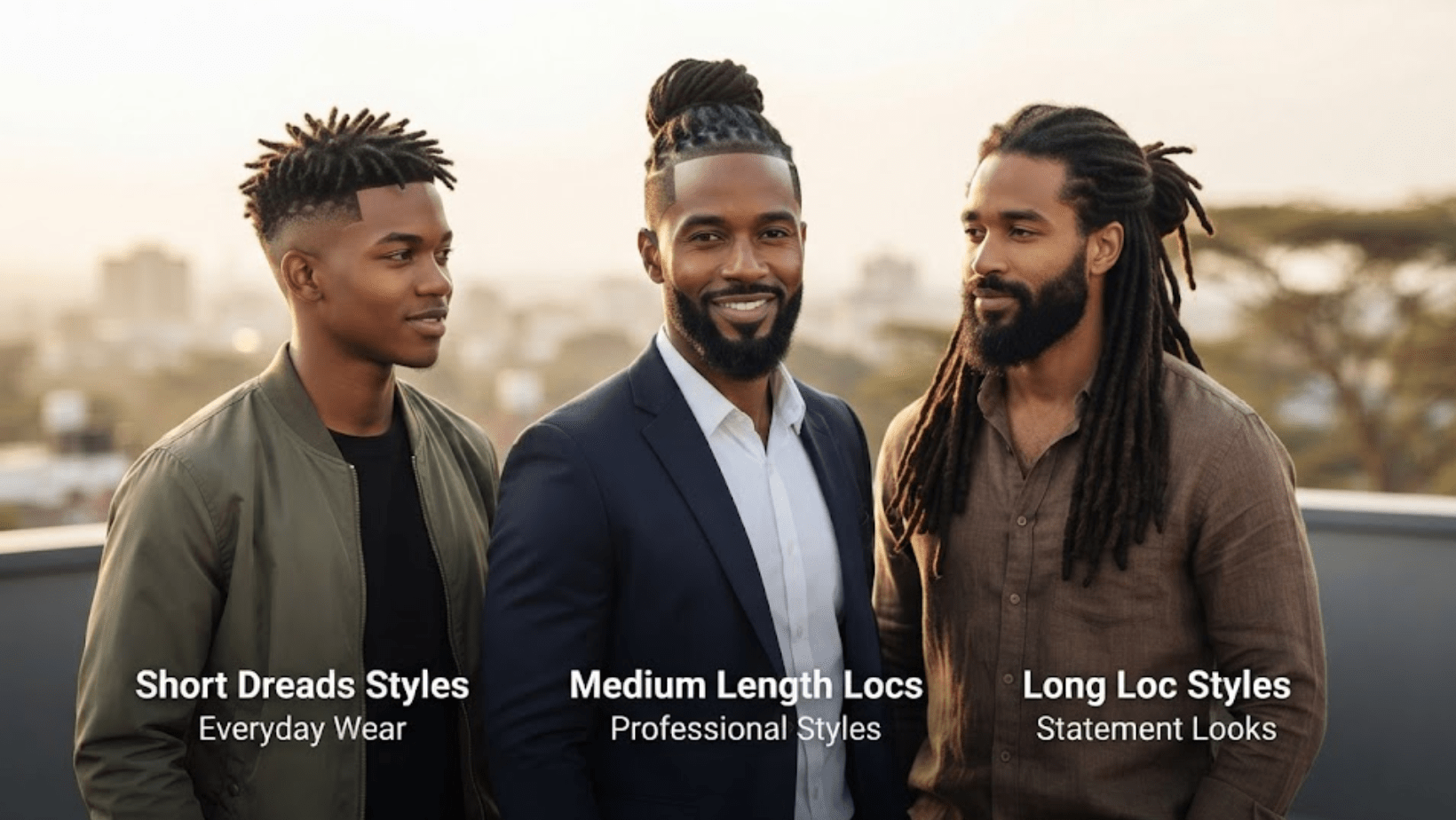
Male Loc Styles: Short, Medium-Length, Long and Professional Looks for Men
A man walks into a salon in Nakuru with one question: “Can I wear locs to work without losing my personal style?”
Another wants short dreads that require little daily styling, while someone else is ready to let long locs fall over his shoulders at a wedding, concert or family celebration.
The answer is yes—male loc styles can be shaped around your hair length, profession, personality and maintenance routine.
From clean high-top fades and short starter locs to medium-length barrel styles and long loc buns, men’s loc hairstyles offer remarkable versatility.
At Nakuru Locks and Braiding, we help clients choose styles that complement their face shape, hair density and lifestyle while keeping scalp health and low-tension care in mind.
The salon specialises in locks, artificial dreadlocks, sisterlocks, thread twists, extensions and scalp treatments in Nakuru City.
Choosing Male Loc Styles
Before choosing among short, medium or long loc styles for men, consider four practical factors:
-
Your current loc length and shrinkage.
-
The thickness and number of your locs.
-
Your workplace or dress code.
-
How often you can wash, retwist and style your hair.
The terms “dreads,” “dreadlocks” and “locs” are often used interchangeably in online searches.
In this article, “locs” refers to hair that has been intentionally cultivated or formed into matted strands, while “artificial locs” or “faux locs” describe temporary extensions installed over or alongside natural hair.
Traditional locs develop over time; artificial locs can be installed in one appointment and removed later when handled correctly.
Locs also change as they mature. Starter locs may appear shorter because textured hair shrinks, while mature locs usually hang more visibly.
A style photographed on waist-length locs may not look the same on chin-length locs. For the best result, show your loctician a reference photo featuring a similar length and thickness to yours.

Short, Medium and Long Locs
There is no universal measurement for these categories because curl pattern, shrinkage and loc thickness vary. As a helpful styling guide:
The best loc style for men is not necessarily the most elaborate one. A simple style that protects the hairline, suits your schedule and makes you feel confident will usually be more practical than a high-tension design that looks impressive for only a few days.
Short Loc Styles for Men
Short locs are ideal for men who want visible texture without the weight or daily styling demands of long hair.
They are also popular among people beginning a loc journey, although starter locs should be handled gently while the sections settle and mature.
1. Short locs with a taper fade
A taper fade keeps the sideburns, temples and neckline gradually shorter while the locs remain on top.
This is one of the most adaptable men’s loc hairstyles for short hair because it creates a clean outline without removing the entire side section.
Ask your barber or loctician for:
-
A low, mid or high taper.
-
Locs kept natural on top.
-
A sharp but not overly aggressive hairline.
-
A neckline that matches your face shape.
A low taper works well for professional settings, while a high taper creates stronger contrast and a more fashion-forward finish.
2. High-top locs
High-top locs grow from the crown and top of the head, with the sides and back faded or clipped short.
This style is particularly useful for men who prefer a structured haircut while keeping the character of locs.
High-top locs can be:
-
Retwisted into neat individual strands.
-
Left slightly freeform for a softer appearance.
-
Decorated with subtle cuffs or beads.
-
Swept forward, upward or to one side.
The key is maintaining the boundary between the locs and the faded areas. Regular barber visits can keep the cut crisp, while retwists should not be so frequent or tight that they strain the roots.
3. Short freeform locs
Freeform locs are cultivated with minimal manipulation. Instead of creating perfectly uniform sections, the hair is allowed to lock according to its natural growth pattern. The result is organic, individual and often fuller-looking.
Short freeform locs suit men who want:
-
A low-intervention hair journey.
-
A less symmetrical appearance.
-
Natural volume and texture.
-
A style that reflects personal expression.
Freeform does not mean neglecting the scalp. Cleansing, thorough drying and checking for excessive buildup remain essential.
If the hair begins joining into larger sections unintentionally, discuss separation or semi-freeform maintenance with a professional.
4. Short two-strand twist locs
For short natural hair or starter locs, two-strand twists can create a neat temporary style while the hair continues developing. Mature locs may also be twisted in pairs for a textured, chunky appearance.
This look is especially useful when you want a change without adding extensions. However, avoid keeping paired locs under tension for too long, particularly around the hairline.
5. Short locs with a line-up
A clean line-up can make even very short locs look polished. The locs may be worn naturally, twisted at the ends or combined with a taper.
This is an excellent option for men who prefer simple short dreads styles for guys that look intentional and easy to maintain.
A line-up should complement your natural hairline rather than repeatedly pushing it backward.
If you experience pain, stinging, bumps or visible thinning after a cut or retwist, the style or service may be too aggressive.
6. Short locs with a mohawk or burst fade
A burst fade leaves a central strip of locs while the sides curve downward around the ears. The locs can be short and upright, loosely twisted or styled into a small ponytail once they gain length.
This is one of the bolder male loc styles for short hair. It works well for creative professionals, performers and men who want their haircut to be a noticeable part of their identity.
Medium-Length Loc Styles for Men
Medium-length locs offer the greatest balance between manageability and styling freedom. They are long enough for ponytails, buns and loc braids but generally lighter and easier to control than very long locs.
1. Medium locs worn loose
The simplest medium-length loc style is to wear the locs down. A professional retwist, clean parting and healthy-looking ends can make this style suitable for everyday wear, casual events and some workplaces.
For a refined finish:
-
Keep the scalp clean and free from visible residue.
-
Ask for natural-looking parting rather than excessive root tension.
-
Use lightweight products sparingly.
-
Trim or repair weak ends when necessary.
Medium locs can also be side-swept across the forehead or directed behind the ears. This small change gives the style a different shape without requiring a full updo.
2. Half-up, half-down locs
Gather the upper section into a small bun, ponytail or knot while allowing the lower locs to remain loose. This style keeps hair away from the face but preserves movement and length.
It works particularly well for:
-
Medium locs that are too short for a full bun.
-
Men transitioning between short and long loc styles.
-
Weddings, dinners and smart-casual occasions.
-
Men who want a relaxed but deliberate appearance.
Use a soft, snag-free band and avoid pulling the front locs tightly toward the crown.
3. Medium locs in a low ponytail
A low ponytail at the nape is understated and practical. It is among the most professional loc styles for men because it keeps the hair controlled without creating a dramatic silhouette.
For office or client-facing work, pair a neat low ponytail with:
-
A clean retwist or naturally tidy roots.
-
A simple black, brown or matching hair tie.
-
A well-maintained beard or clean shave.
-
Minimal accessories.
The ponytail should feel secure but never painful. Repeated tight pulling can place stress on the follicles.
4. Barrel twists
Barrel twists involve wrapping or twisting several locs around one another to create a rope-like or woven effect. They can be arranged straight back, diagonally, in a ponytail or into a compact updo.
Barrel styles are popular among men because they look detailed without requiring loose strands to be individually styled.
They are also a strong choice for special events. Because the technique can create tension, ask your stylist to keep the front and temple sections comfortable.
5. Medium loc braids
Loc braids are created by braiding mature locs together. They can be made into two, three or more larger braids, depending on the number and thickness of the locs.
Nakuru Locks and Braiding describes braided locs as a styling technique for managing the volume of established dreadlocks.
This style is suitable for:
-
Travel.
-
Sports and active routines.
-
A dramatic but controlled appearance.
-
Men who want to temporarily reduce the width of their locs.
Loc braids should not be confused with installing new extensions. They are formed from existing mature locs.
Your loctician should assess whether the locs are strong enough to be braided together, especially if the ends are thin or fragile.
6. Medium locs with accessories
Small cuffs, wooden beads, shells or discreet metallic accessories can personalise medium locs.
For a professional appearance, limit accessories to a few carefully chosen pieces.
For festivals, cultural celebrations or weddings, you may choose more visible embellishments.
Accessories should be smooth and lightweight. Rough metal, sharp edges or heavy beads can catch on neighbouring locs and contribute to breakage.
7. Medium locs with colour
Colour can be added to the ends, a few accent locs or the entire set. Natural-looking brown, honey, copper and auburn shades create a subtle change, while red, platinum or blue offer a more expressive result.
Chemical colouring can affect hair strength, particularly when locs are already dry or weak.
Discuss strand condition, previous colour treatments and aftercare with a professional before making a major colour change.
Long Loc Styles for Men
Long locs create the most visual impact and offer multiple updo options. They also carry more weight, so length, thickness and styling tension matter.
The American Academy of Dermatology advises keeping locs shorter or choosing thicker locs when possible because longer, heavier styles can pull on the hair; pain, stinging, crusting or a receding hairline are warning signs that a style may be causing damage.
1. Long locs worn down
Long locs worn loose create a strong, flowing silhouette. They can be centre-parted, side-swept or allowed to fall naturally. This is one of the best loc styles for men who want their length to be the main feature.
To keep long locs comfortable:
-
Avoid sleeping with wet locs.
-
Use a satin or silk covering at night.
-
Keep the scalp clean.
-
Avoid repeatedly pulling all the locs into one tight position.
-
Check the roots and hairline for thinning.
Long locs may take longer to dry after washing. The NHS guidance on afro-textured hair notes that locs should be dried thoroughly after cleansing because prolonged dampness can contribute to mould and mildew buildup.
2. Long locs in a man bun
A loc bun can be worn high, low or at the back of the head. A low bun is generally more understated and may suit professional environments, while a high bun creates a stronger fashion statement.
For a safer bun:
-
Use a wide, soft band.
-
Do not wrap the hair excessively tightly.
-
Change the bun’s position regularly.
-
Leave the hair loose after long periods of wear.
-
Avoid styling immediately after a tight retwist.
3. Long loc ponytail
A ponytail is quick, practical and ideal for work, exercise or travel. It may be positioned at the crown, middle of the head or nape. A low ponytail is usually the most conservative version.
If the locs are thick or heavy, a ponytail can place considerable tension on the hairline. A looser hold or partial ponytail may be better for daily wear.
4. Long loc braids
Long locs can be divided into large braids or combined into barrel-style patterns. This reduces loose movement and creates a sculptural look for weddings, photoshoots and cultural events.
Ask your stylist to inspect the locs first. Weak, thinning or newly repaired locs may need a simpler style until they regain strength.
5. Viking or barrel locs
Viking-inspired loc styles typically use thick, structured sections, braids or barrel arrangements. They create a bold, masculine appearance and may be installed using natural locs or artificial extensions.
Nakuru Locks and Braiding lists Viking or barrel locs among its artificial loc options and describes them as a popular male style.
Its published 2026 price guide places Viking or barrel artificial locs at approximately KSh 6,500–10,500, depending on length and design. Prices can change, so confirm the current quote during consultation.
6. Long locs with shaved or faded sides
Long locs combined with a fade create a contrast between the flowing top and clean sides. This style can be dramatic, but the locs should not be pulled tightly into the centre every day. Alternate between loose and secured styles to reduce repeated stress on the same areas.

Professional Loc Styles for Men
Professional loc styles do not have to be boring. The goal is a neat, intentional appearance that fits your workplace while respecting the natural texture and length of your hair.
The most workplace-friendly options include:
-
Short locs with a low taper.
-
A neat high-top fade with modest loc length.
-
Medium locs worn loose with clean parting.
-
A low ponytail.
-
A low bun for long locs.
-
Simple loc braids without oversized accessories.
-
A tidy retwist with a natural finish.
For interviews, formal meetings or weddings, avoid styles that obscure the face or require constant adjustment.
A low ponytail, low bun or controlled half-up style usually photographs well and keeps the overall look balanced.
Workplace presentation also depends on maintenance. Clean locs, a healthy scalp, a neat neckline and clothing that suits the occasion often matter more than whether the locs are short or long.
Loc Care and Safety
Wash the scalp and locs
A clean scalp is central to healthy loc maintenance. Apply shampoo primarily to the scalp, allow the lather to pass through the locs, and avoid rough scrubbing that can create frizz or weaken the strands.
Men who exercise frequently may need to cleanse more often than those with less active routines.
Always dry the roots and lengths fully before sleeping, wearing a hat or tying the locs up. Dampness trapped inside thick locs can create an unpleasant smell and contribute to buildup.
Avoid heavy product buildup
Waxes, thick gels, excessive oils and buttery products can accumulate inside locs. Choose lightweight products and use small amounts. If the locs feel coated, sticky or unusually heavy, ask a loctician about a clarifying service.
Retwist according to hair needs
A retwist improves definition at the roots, but overly frequent or tight retwisting can weaken the hairline.
The appropriate schedule depends on hair growth, loc maturity, texture and styling goals. A professional should prioritise healthy roots over an aggressively slick appearance.
Pay attention to warning signs
Stop or loosen a style if you experience:
-
Pain or throbbing.
-
Stinging or tenderness.
-
Scalp bumps or crusting.
-
Broken hairs around the hairline.
-
Visible thinning or a receding hairline.
-
Locs that feel unusually heavy at the roots.
The AAD explains that traction alopecia can become permanent when pulling continues for too long. If changing the style does not resolve the issue, consult a board-certified dermatologist.

Frequently Asked Questions
What are the best short dreads styles for guys?
Tapered or faded short locs, high-top short dreads, short rope twists, and neat freeform short locs are among the most popular and practical.
Are professional loc styles male suitable for corporate environments?
Yes. Neat, uniform locs with clean fades or tapers and the option to pull hair back are widely accepted and look polished.
How do male loc styles medium length differ from short and long?
Medium length offers the best balance of styling versatility (buns, ponytails, half-ups) and daily manageability.
Can I wear men’s loc hairstyles for long hair to work and formal events?
Absolutely—use man buns, low ponytails, or braided styles to keep the look controlled and professional.
What is the difference between freeform and cultivated locs?
Freeform allows natural matting with little to no parting or twisting. Cultivated locs use consistent sectioning and regular maintenance for a more uniform appearance.
How long does it take to grow medium or long locs?
Starting from short hair, medium length often takes 12–24 months of consistent care; long locs typically require several years.
Do locs damage hair?
When installed and maintained correctly, locs are a protective style that can support length retention. Over-manipulation or heavy products can cause problems.
Related Nakuru Locks Articles
Continue your loc and protective-style research with these guides from Nakuru Locks and Braiding:
-
Artificial Dreadlocks and Locs: Styles, Prices and Removal — a guide to faux locs, hard locs, crochet locs, Viking styles, prices and aftercare.
-
Braided Locs Styles Guide — useful for understanding how mature locs can be braided together for a controlled finish.
-
Best Dreadlocks Styles and Latest Loc Trends — inspiration for short and contemporary loc looks.
-
Protective Styles and Braids Hair-Growth Guide — practical low-tension care principles for protective hairstyles.
Book a Consultation
Whether you want male loc styles for short hair, medium-length locs, long locs for men or professional loc styles for work, begin with a consultation.
Bring two or three inspiration photos, explain your daily routine and tell your stylist whether you want natural loc maintenance, a temporary artificial style or a special-occasion finish.
Nakuru Locks and Braiding is located at Mt. Sinai Building, Bazaar Road, Nakuru City, Kenya.
The salon is open Monday to Saturday from 8:00 a.m. to 8:00 p.m.; Sundays are available by appointment.
Call or WhatsApp +254 723 168 188 to discuss your preferred male loc style and booking requirements.
References
-
American Academy of Dermatology.
-
St George’s University Hospitals NHS Foundation Trust.
-
Billero, V. and Miteva, M. “Traction alopecia: the root of the problem.” Clinical, Cosmetic and Investigational Dermatology. The AAD lists this review among its references on traction-related hair loss.
Leave a Reply