
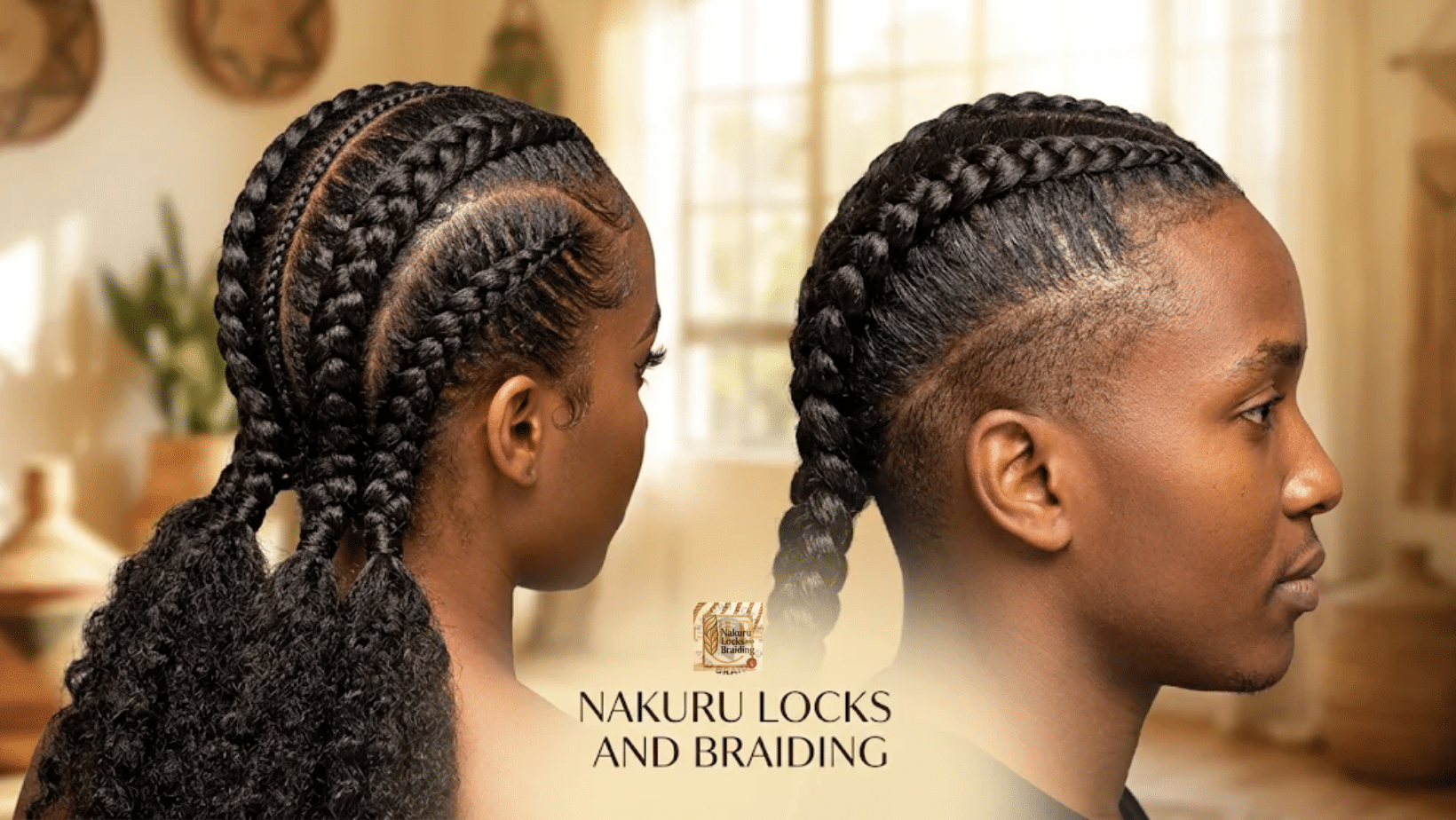
Double Dutch Braids Hairstyles: The Complete Guide (Short Hair, Black Hair, Men, Tutorial & More)
Double Dutch braids are two raised, scalp-hugging braids created by crossing hair sections under the middle strand.
They are sporty, sculptural, and practical—keeping hair secure for school, workouts, travel, festivals, and everyday wear—while offering endless styling options for short, long, curly, coily, straight, and men’s hair.
At Nakuru Locks and Braiding, we see double Dutch braids as more than a trend: they are a versatile styling technique that can be tailored to your texture, lifestyle, and scalp comfort. The key is symmetry, gentle tension, and a clean centre part.
What Are Double Dutch Braids?
Double Dutch braids—also called two Dutch braids, pigtail Dutch braids, or boxer braids—are two parallel Dutch braids, usually created on either side of a centre part.
Each braid incorporates additional hair from its side of the head as it travels from the front hairline toward the nape.
A Dutch braid is often described as an “inside-out” or reverse French braid because the outer strands are crossed under the centre strand rather than over it. This creates a raised, three-dimensional braid that visibly sits above the surrounding hair.
The defining feature
|
Feature |
Double Dutch braids |
|---|---|
|
Number of braids |
Two |
|
Placement |
One on each side of a centre part |
|
Technique |
Underhand braiding |
|
Appearance |
Raised, defined, rope-like |
|
Best for |
Secure everyday styling, sports, protective looks, festivals |
|
Finish options |
Pigtail braids, low ponytail, buns, curls, braided ponytail, half-up style |
Double Dutch braids can stop at the nape as two pigtails, continue into a single low ponytail, coil into two buns, or flow into long braided tails.
Double Dutch Braids Hairstyles
The beauty of double Dutch braids is their adaptability. You can keep them sleek and athletic, soften them for a romantic look, or make them bold with extensions, colour, beads, and accessories.
Classic double Dutch braids
This is the signature version: a clean centre part, two even braids from the hairline to the ends, and small elastics at the tips. It is ideal for busy days, workouts, travel, and hot weather because it keeps hair controlled and off the face.
Double Dutch braids with low ponytail
Braid both sides to the nape, then combine the two braids into one low ponytail. This creates a polished, secure look that works well for office days, school, weddings, and casual outings.
Double Dutch braid buns
Create the two braids, then wrap each one into a bun at the nape. This is a neat, feminine style that works especially well for active days, formal events, and protective styling.
Double Dutch braids with curls
Leave the ends loose and add soft curls or waves for a playful contrast between structured roots and flowing lengths. This version is popular for photos, date nights, and events.
Double Dutch braids with extensions
Extensions add length, fullness, and colour. They can be incorporated gradually as you braid, allowing the style to look fuller while maintaining the raised Dutch-braid pattern.
Double Dutch braids with beads
Beads, cuffs, rings, and thread can turn a simple athletic style into a statement look. This works particularly well on textured hair, braids with extensions, and festival-inspired designs.
Half-up double Dutch braids
Braid only the top sections into two Dutch braids, then leave the remaining hair down. This is a softer, more casual version that suits medium and long hair.
Dutch braids into a braided ponytail
Braid both sides toward the back, merge them, and continue as one large braid. This creates a sleek, sculptural ponytail that is excellent for workouts and events.
Double Dutch Braids for Short Hair
Yes—double Dutch braids can work on short hair. You do not need waist-length hair to enjoy the style; even pixie cuts can support two small Dutch braids at the top, with the remaining hair left loose or slicked back.
For short hair, the goal is usually not a full-length braid but a front or crown Dutch-braid detail. Start with a small section at the hairline, braid backward while adding hair, and secure the ends with mini elastics or pins.
Best short-hair variations
-
Double Dutch top braids: Two small braids from the front hairline toward the crown, with the rest of the hair loose.
-
Double Dutch braids into mini pigtails: Best for chin-length or bob-length hair.
-
Double Dutch braids with a slicked-back finish: Use gel or styling cream for a clean, sporty finish.
-
Double Dutch braids with curls: Braid the top and leave natural curls or waves at the back.
-
Double Dutch braids with clips: Secure shorter ends with decorative clips, pins, or small cuffs.
Short hair may need a little styling product for grip. A light gel, mousse, or texture spray can help control flyaways and make smaller sections easier to manage.
Double Dutch Braids for Black Hair
Double Dutch braids can look beautiful on Black hair, but the approach should respect the hair’s texture, density, curl pattern, and scalp sensitivity. Natural coils, curls, and kinks can create gorgeous definition, while extensions can add length and volume when installed with care.
Natural hair options
For natural hair, double Dutch braids can be done on stretched, blow-dried, blowout, or freshly detangled hair. The style can be worn as two braids, converted into buns, or finished with curls at the ends.
For tighter curl patterns, moisturising before braiding is important. Detangle gently from the ends toward the roots, use a leave-in conditioner or styling cream as needed, and avoid braiding dry, brittle hair too tightly.
With braiding hair
Adding braiding hair can create fuller, longer double Dutch braids. The extension hair should be fed in gradually and securely, without creating excessive bulk or tension at the roots.
This style is different from cornrows. Cornrows are typically flat, scalp-level three-strand braids, while Dutch braids use an underhand crossing pattern that makes the braid rise above the scalp.
Protective-styling considerations
Double Dutch braids can be protective when they are neat but not tight. The American Academy of Dermatology warns that tightly braided styles, cornrows, locs, extensions, and weaves can contribute to traction alopecia over time.
To protect your hairline:
-
Ask for comfortable tension, especially around the temples and nape.
-
Avoid painful pulling, stinging, scalp bumps, or “tenting” of the scalp.
-
Do not keep the same tight style in for too long; the AAD advises giving hair breaks and avoiding frequent tight styles.
-
Moisturise the scalp and ends as appropriate for your hair type.
-
Choose thicker braids rather than very small, heavy braids if your hairline is sensitive.
At Nakuru Locks and Braiding, we prioritise low-tension installation so clients can enjoy a polished style without compromising scalp health.
Double Dutch Braids for Men
Double Dutch braids are not only for women. Men with chin-length hair or longer can wear two Dutch braids running down the back, or braid the sides and allow the ends to fall behind the head.
This look pairs especially well with:
-
An undercut or faded sides
-
A man bun
-
A braided ponytail
-
Curly or wavy hair
-
Athletic and streetwear styles
-
Festival, gym, and travel looks
For men with shorter sides, the braids can begin where there is enough length at the top and crown, then flow into a ponytail or bun. The style keeps hair controlled while adding a bold, expressive edge.
Men with locs can also adapt the concept by braiding or twisting locs into two sections, though the technique and maintenance differ from a traditional Dutch braid.
Dutch Braid vs French Braid
The main difference is simple: a French braid crosses strands over the middle, while a Dutch braid crosses strands under the middle. That one change changes the entire appearance of the braid.
|
Feature |
French braid | Dutch braid |
|---|---|---|
|
Crossing direction |
Outer strands cross over the middle | Outer strands cross under the middle |
|
Appearance |
Lies flatter against the scalp | Raised and prominent |
|
Also called |
Classic plait | Reverse French braid, inside-out braid, boxer braid |
|
Look |
Soft, blended, traditional | Bold, defined, sculptural |
|
Hold |
Good | Often feels more secure because the raised pattern traps hair |
|
Learning curve |
Often slightly easier for beginners | Takes practice because the motion is reversed |
Both styles add hair as they go, which is why they are called “feed-in” or scalp braids. The difference is not the amount of hair added—it is the direction in which the strands cross.
Double French Braid vs Double Dutch Braidz
A double French braid is two French braids, one on each side of the centre part. A double Dutch braid is two Dutch braids, one on each side of the centre part.
The difference is entirely in the braiding direction:
|
Style |
Technique | Final look |
|---|---|---|
|
Double French braids |
Each side strand crosses over the centre strand | Softer, flatter, more blended |
|
Double Dutch braids |
Each side strand crosses under the centre strand | Raised, chunky, more defined |
Double French braids tend to look more casual and understated, while double Dutch braids create a stronger visual pattern and a more secure, sporty finish.
If you want a subtle, romantic style, choose double French braids. If you want bold definition, better hold, and a style that stands out in photos, choose double Dutch braids.
Which Is Harder: Dutch or French Braid?
For many beginners, French braids are slightly easier because crossing hair over the middle feels more natural. Dutch braids require reversing that instinct, which can feel awkward at first.
However, neither style is inherently difficult once the hand position becomes familiar. The real challenge with double Dutch braids is maintaining:
-
A straight centre part
-
Equal section sizes
-
Consistent tension
-
Symmetry between the left and right braids
-
Comfortable pressure at the hairline
A useful beginner exercise is to practise the underhand motion on a loose three-strand braid before adding hair. Once the under-cross feels automatic, begin incorporating small sections from the side of the head.
Double Dutch Braids Tutorial
Here is a beginner-friendly method for creating two Dutch braids at home. This tutorial works best with detangled hair, a tail comb, sectioning clips, and small elastics.
What you need
-
Wide-tooth comb or detangling brush
-
Rat-tail comb for a clean part
-
Hair clips
-
Light gel, mousse, or styling cream
-
Small elastics
-
Optional: styling wax, beads, cuffs, or edge control
Step 1: Prep the hair
Start with clean, fully detangled hair. Apply a small amount of leave-in conditioner, styling cream, or gel to reduce frizz and give the hair grip.
Step 2: Create a centre part
Use a tail comb to part the hair from the centre of the forehead straight back to the nape. A crooked part is immediately noticeable in this style, so take your time.
Clip one side out of the way so it does not mix into the braid you are working on.
Step 3: Begin the first Dutch braid
On one side, take a small section near the front hairline and divide it into three equal strands: left, middle, and right.
Cross the right strand under the middle strand. Then cross the left strand under the new middle strand. This underhand movement is what makes it a Dutch braid.
Step 4: Add hair as you braid
Before each cross, pick up a small amount of loose hair from that side of the head and add it to the outer strand. Then cross that strand under the middle.
Repeat this pattern:
1. Add hair to the right section.
2. Cross it under the middle.
3. Add hair to the left section.
4. Cross it under the middle.
Continue down the side of the head, keeping the braid close to the centre part.
Step 5: Finish the braid
Once you reach the nape and have incorporated all the hair on that side, continue with a regular three-strand braid to the ends. Secure it with a small elastic.
Step 6: Repeat on the other side
Release the clipped side and repeat the same process. Match the starting point, section size, and tension so the two braids look balanced.
Step 7: Style the finish
Choose one of these finishes:
-
Leave the braids loose as pigtails.
-
Combine them into a low ponytail.
-
Wrap each braid into a bun.
-
Add curls to the ends.
-
Gently pull the outer loops for a fuller, softer effect.
How Long Do Double Dutch Braids Last?
A double Dutch braid style can last from one day to several weeks, depending on the hair type, installation method, products, and whether extensions are used.
-
Natural hair without extensions: Usually one to three days.
-
Braids with extensions: Often longer, but comfort and scalp health should guide wear time.
-
Tight braided styles: The AAD advises avoiding frequent tight styles and giving the hair recovery time.
Do not choose a style based only on how long it can last. A style that pulls, itches, stings, or causes bumps should be adjusted or removed.
Double Dutch Braids Maintenance
To keep the style looking fresh:
-
Sleep with a satin or silk scarf, bonnet, or pillowcase.
-
Refresh flyaways with a light styling product rather than adding heavy grease.
-
Moisturise the scalp and ends as needed.
-
Avoid repeatedly pulling the braids tighter.
-
Change your part or style after several wears to reduce repeated tension in the same areas.
If you notice broken hairs around the forehead, a receding hairline, scalp pain, crusting, or patches of thinning, loosen or remove the style and seek advice from a dermatologist if symptoms persist.
Who Should Choose Double Dutch Braids?
Double Dutch braids suit people who want a style that is:
-
Secure for school, work, gym, travel, or outdoor activities
-
Stylish without requiring daily heat styling
-
Adaptable to straight, wavy, curly, coily, thick, or fine hair
-
Easy to customise with buns, ponytails, beads, colour, and extensions
-
Suitable for both casual and dressed-up occasions
They are especially useful for anyone who wants hair off the face while still maintaining a polished, intentional look.
FAQ: Double Dutch Braids
What are double Dutch braids?
Double Dutch braids are two Dutch braids created on either side of a centre part. Each braid is made using an underhand technique, which gives the style a raised, defined appearance.
What is the difference between a Dutch braid and a French braid?
In a French braid, the outer strands cross over the middle. In a Dutch braid, they cross under the middle, creating a raised braid.
What is the difference between a double French braid and a double Dutch braid?
A double French braid has two French braids, while a double Dutch braid has two Dutch braids. The Dutch version is more raised and sculptural; the French version lies flatter and looks softer.
Which is harder, Dutch or French braid?
French braids are often slightly easier for beginners because the overhand motion feels more intuitive. Dutch braids become easy once you practise crossing the strands under instead of over.
Can you do double Dutch braids on short hair?
Yes. Short hair can support two small Dutch braids at the crown or front, with the remaining hair left loose, slicked back, or secured with clips.
Can men get double Dutch braids?
Yes. Men with chin-length hair or longer can wear double Dutch braids, especially with an undercut, fade, man bun, or braided ponytail.
Are double Dutch braids good for Black hair?
Yes. They can be styled on natural textures or with extensions. The most important factor is gentle tension, proper moisturising, and avoiding styles that pull painfully at the hairline.
How long does it take to do double Dutch braids?
For beginners, expect about 10 to 15 minutes once the technique is familiar. The time can increase with extensions, intricate parting, or a more detailed finish.
Are double Dutch braids the same as boxer braids?
They are often called boxer braids because the two-braid style is associated with athletic, secure styling. Technically, “boxer braids” usually refers to two tight braids, which may be Dutch or French braids depending on the technique used.
Can double Dutch braids damage your hairline?
They can if installed too tightly or worn too frequently. The AAD recommends loosening braids, avoiding frequent tight styles, and changing hairstyles to allow the scalp and hairline to recover.
Related Articles from Nakuru Locks and Braiding
References
-
American Academy of Dermatology. Hairstyles that pull can lead to hair loss.
-
Garnier USA. 15 Braid Hairstyle Ideas for Short, Medium, and Long Hair.
-
Cloud Nine. 25 Types of Braids and How to Achieve Them.
-
ghd. Braid Hairstyles.
-
StyleCraze. Dutch Braid Hairstyles.
-
Show Me Step by Step. How to Do a Dutch Braid: Beginner Tutorial vs French Braid.
Double Dutch braids are a timeless, versatile choice: bold enough to make a statement, practical enough for everyday life, and adaptable enough to suit nearly every hair type.
For a comfortable, customised installation in Nakuru, Nakuru Locks and Braiding can tailor the parting, tension, length, and finishing style to your hair and lifestyle.
Leave a Reply