
Traditional Locs Styles: The Complete Guide for Men, Women and Long Hair
Picture a Maasai warrior in the Rift Valley, his hair divided into long, carefully tended strands. Picture a Kenyan freedom fighter of the 1950s whose matted locks became a symbol of resistance.
Picture a young woman in Toronto, a banker in Lagos, a footballer in Rio, a student in Seoul: all wearing the same ancient foundation of hair, interlocked strand by strand, month after month, until it becomes something permanent.
Traditional locs are one of the oldest hair traditions on Earth. Historians and cultural writers link locked or matted hair to ancient Egypt, to Hindu ascetics, to various African communities, and, much later, to the Rastafari movement. Today the style has no single owner and no single look. It belongs to anyone willing to commit to the journey.
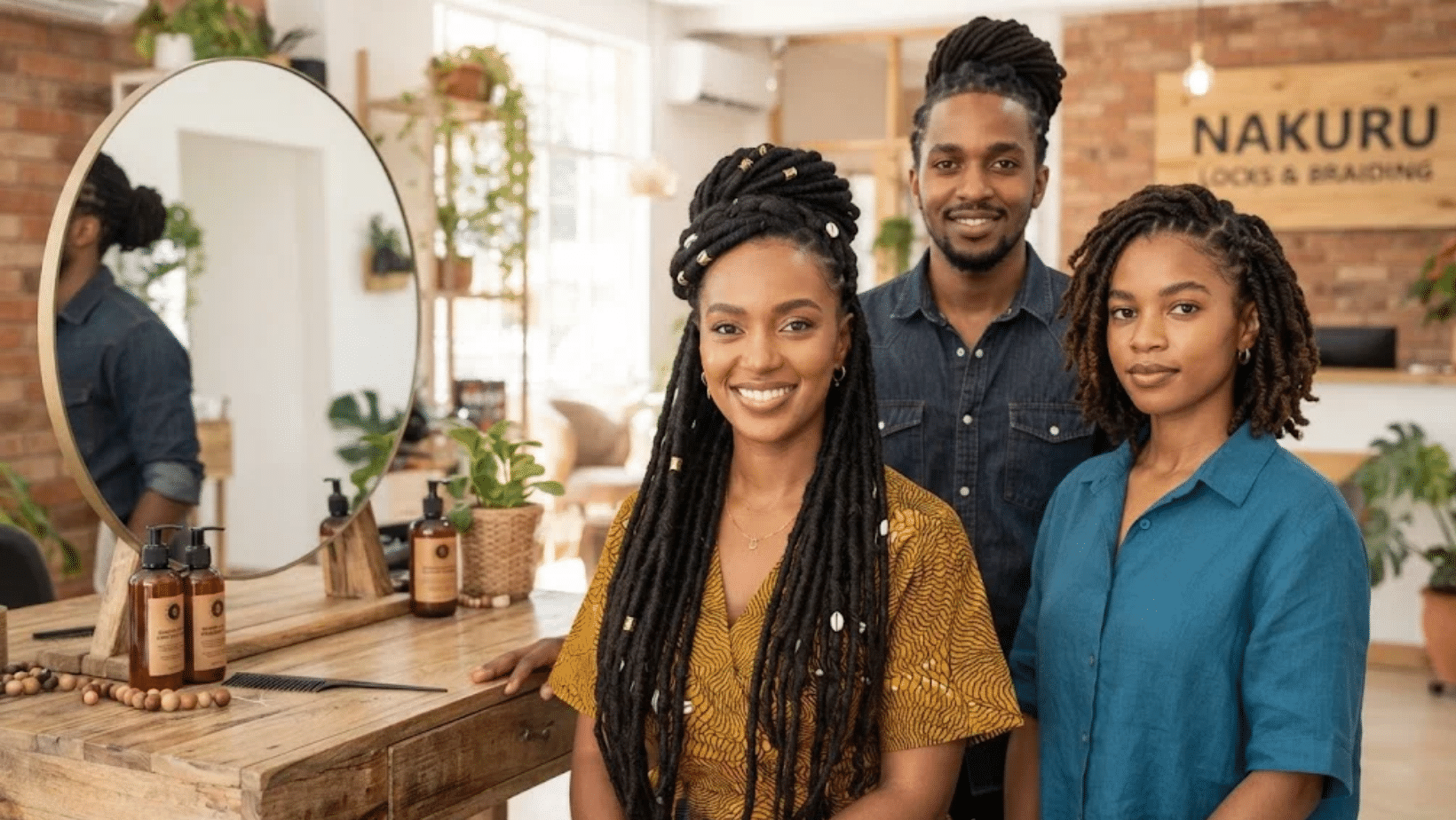
At Nakuru Locks and Braiding, we install, maintain and restyle locs for clients of every age and background.
This guide pulls together what we see every week in the chair: which traditional locs styles are most requested, how small and medium traditional locs differ, what separates traditional locs from sisterlocks, and how to care for your hair so it stays healthy for decades.

What Are Traditional Locs?
Traditional locs (also called locks or, historically, dreadlocks) are sections of hair that have been encouraged to bond into rope-like strands. Unlike a braid, which you can undo, a loc is formed when the hair fibres tangle and mesh together until they cannot be combed apart.
What makes locs “traditional” in modern salon language is mainly size and method. Traditional locs are thicker than micro locs or sisterlocks, usually numbering somewhere between roughly 20 and 100 on a full head, depending on hair density and the size you choose. They are commonly started with:
- Coils (comb coils): hair is twisted into small coils with a comb or finger. Best for short hair.
- Two-strand twists: two sections wrapped around one another. Best for medium length and for a defined, neat start.
- Palm-rolling: hair is rolled between the palms with a light product. Often used for maintenance and for natural-looking, rounded locs.
- Interlocking: a tool pulls the hair’s end through the base to lock it tightly at the root. This is a retightening and installation method that gives a very secure hold.
- Backcombing (crochet or comb): hair is teased into a knot structure. Useful for instant locs, but it can be harder on fragile hair if done too tightly.
A good loctician will choose the method according to your hair texture, length and lifestyle, not simply what is fashionable.
The Four Stages of Your Loc Journey
Every loc wearer goes through a similar timeline, though the speed differs for each person.
- Starter stage (weeks 0 to 8): neat coils or twists. Locs can unravel easily, so avoid heavy washing early on.
- Budding stage (months 2 to 6): the hair begins to swell and bud; frizz appears. This is normal.
- Teen (“awkward”) stage (months 6 to 18): locs may be uneven, bend, or poke in different directions. Patience is the main “treatment.”
- Mature stage (around 18 months to 2+ years): locs are tight, dense and settled. They may continue to thicken and lengthen for many more years.
Timelines vary with texture, hair type and care routine, so treat these as typical ranges rather than guarantees.
Small Traditional Locs
Small traditional locs are on the thinner end of the traditional range, roughly the width of a pencil or slightly wider. At Nakuru Locks and Braiding, we often describe them as the “versatile middle path” between sisterlocks and chunky locs.
Advantages
- Styling freedom: thinner locs can be pinned up, braided, curled, or swept into updos more easily.
- Faster maturing: thinner locs often feel settled sooner than very thick ones.
- Natural movement: they swing and drape, which many people find flattering.
Considerations
- More locs means longer installation and maintenance appointments.
- Thinner locs can be more vulnerable to breakage if retwisted too tightly or too often.
- They may be harder to keep from merging at the roots on very dense hair.
Best for: people with fine to medium hair, people who want to style frequently, and people who like an elegant, detailed look.
Medium Traditional Locs
Medium traditional locs are about the width of a standard marker or a little larger. This is the most requested size we see, because it balances style, strength and maintenance time.
Advantages
- Durability: they tend to be sturdier and less likely to snap than very thin locs.
- Easier maintenance: fewer locs means shorter retightening sessions.
- Balanced look: suits most face shapes and works for both men and women.
Considerations
- Less versatile for intricate updos than small locs.
- They are heavier when long, so weight on the roots should be watched.
Best for: first-time loc wearers, busy professionals, men and women who want a timeless, low-fuss style.
How to choose between small and medium traditional locs: think about your hair density, your styling habits and your patience for maintenance.
Fine, thin hair often does better with medium locs (for support). Thick, dense hair can be divided into small locs without much visible gap between them. When in doubt, a consultation before installation helps you avoid a decision you will live with for years.
Traditional Locs vs Sisterlocks
This is one of the most common comparison questions we are asked. The two are often confused, but they are different in method and size.
Sisterlocks is a trademarked system created by Dr. JoAnne Cornwell in 1993. It uses a special tool and a specific, patterned technique to install very small, uniform locs.
Installation is meant to be done by a trained and certified Sisterlocks consultant. Traditional locs, by contrast, are a general category without a trademark and can be created with several methods.
| Feature | Traditional locs | Sisterlocks |
|---|---|---|
| Size | Medium to small (thicker) | Very small (micro) |
| Typical number of locs | Roughly 20 to 100 | Often several hundred |
| Method | Coils, twists, palm-rolling, interlocking, backcombing | Proprietary tool and grid pattern |
| Installation time | A few hours to a day | Many hours, often over multiple sessions |
| Maintenance | Easier, less frequent | More detailed, requires trained hands |
| Styling | Good; fewer intricate options | Very versatile, hair-like styling |
| Who offers it | Any skilled loctician | Certified Sisterlocks consultants |
| Cost | Generally lower | Generally higher |
Which is right for you?
If you want a bold, classic, low-maintenance look, choose traditional locs. If you want locs that behave more like loose hair, with very fine detail, and you are comfortable with a higher cost and longer appointments, sisterlocks may be worth exploring. Always ask whether your loctician is certified if you specifically want the Sisterlocks method.
Traditional Locs Male: Styles for Men
Traditional locs male styles have exploded in popularity worldwide, thanks to athletes, musicians, and everyday people embracing them as a sign of identity and low-maintenance grooming.
Popular looks for men
- Taper or fade with locs on top: clean sides with a mass of locs on top. Sharp, modern and professional.
- Short loc crown: locs of 3 to 6 inches, ideal for the starter stage and for work environments.
- Shoulder-length locs: free-hanging, the classic image.
- Top knot or man bun: locs tied up for gym, work or formal events.
- Undercut with fade and designs: adds personality and sharp definition.
- Loc twists or braids (loc updos): useful for events.
Tips for men
- Keep the beard and hairline neat, because locs look best with clean edges.
- Do not over-twist; rolling too tightly at the roots can stress the scalp.
- Wash regularly. Scalp health matters as much as the look.
Men starting with short hair can often use comb coils; those with longer hair may prefer two-strand twists.
Traditional Locs Female: Styles for Women
Traditional locs female looks range from ultra-casual to red-carpet elegant. Women often love locs for the way they combine natural texture with endless styling potential.
Traditional locs styles for ladies
- Pinned-up crown: locs swept into a halo or crown. Wedding and formal-event friendly.
- Pipe-cleaner curls: wrapped around rods or wire for bouncy ringlets.
- High ponytail or top bun: quick, polished and practical.
- Side-swept locs: dramatic and flattering on most face shapes.
- Loc buns and twisted updos: timeless and professional.
- Colour accents: honey, burgundy or copper highlights. Proceed with care and professional help, because bleach can weaken locs.
- Accessories: cuffs, beads, scarves and wraps for personality and protection.
Traditional locs styles for females: professional vs everyday
- Office-ready: neat low bun, side part, or loc-twist updo.
- Everyday casual: half-up, half-down; headband with free-hanging locs.
- Event glam: curled locs, braided crown, or sculpted updo.
- Active lifestyle: braided back, ponytail, or wrapped with a scarf for the gym.
Traditional locs styles for ladies are also friendly to many life stages: new mothers, professionals, students, and women rediscovering their natural texture after years of chemical relaxers.
Traditional Locs Styles for Long Hair
Traditional locs styles for long hair give you the most options, but they also demand the most care because length means weight.
Style ideas
- Waist-length free-hanging locs: dramatic, graceful, a head-turning classic.
- Braided or twisted halo: locs wrapped around the head like a crown.
- Double buns or space buns: playful and secure.
- Low chignon: locs coiled low at the nape. A formal staple.
- Side braid of locs: several locs woven together into a thick plait.
- Half-up top knot: keeps weight off the neck and roots.
Long locs care points
- Manage the weight. Constant tight, heavy updos can pull on the roots. Switch styles often and avoid tension.
- Dry thoroughly. Long, thick locs can hold water for a long time, and damp locs can develop odour. Dry completely after washing.
- Moisturise ends. Ends are the oldest hair and the most fragile.
- Protect at night. A satin or silk bonnet or scarf cuts friction and lint.
If you are starting with long hair, we usually recommend sectioning carefully and selecting a size that will support the final length.
How to Care for Traditional Locs
Good care is what turns a loc journey into a lasting success.
1. Wash regularly
Myth: locs should never be washed. Fact: clean locs are healthier. Many locticians suggest washing every one to two weeks with a residue-free shampoo. Avoid heavy waxes, which can build up inside locs and are difficult to remove.
2. Moisturise lightly
Light oils and water-based sprays help dry hair. Use small amounts to avoid buildup.
3. Retighten (maintain) on a schedule
Most clients return every 4 to 8 weeks for retightening, depending on loc size, hair growth and style. Over-retightening can cause breakage and scalp stress.
4. Protect your edges and scalp
Traction alopecia is hair loss caused by repeated pulling on the hair follicles, and the American Academy of Dermatology notes that tight hairstyles can contribute to it. If you feel pain, see bumps, or notice thinning at the hairline, loosen the style and consult a professional or a dermatologist.
5. Sleep protected
Use a satin bonnet, scarf or pillowcase.
6. Be gentle with chemicals
Colour and bleach can weaken the hair. Always use a professional who understands locs.
7. Avoid unnecessary breakage
Do not pull or rip apart merging locs without guidance. A trained loctician can separate them safely when needed.
Choosing the Right Loc Size, Method and Salon
Before you book, ask yourself:
- What is my hair texture and length? Short hair suits coils; longer hair suits twists or interlocking.
- What is my lifestyle? Athletes and busy parents may prefer low-maintenance medium locs.
- What is my budget and time? Small locs take more hours and more frequent maintenance.
- What is my goal? A neat corporate look, a creative statement, or a cultural connection.
And ask any salon:
- Do you offer a consultation before installation?
- What methods do you use, and why?
- How do you protect the scalp and edges?
- What aftercare will you advise?
A trustworthy loctician explains risks as clearly as benefits.
Cultural Roots and Workplace Rights
Locs carry meaning that goes beyond fashion. In Kenya, hair has long been tied to identity, age and social role; Maasai warriors historically wore elaborate styled hair as part of their warrior identity.
Locs have also been associated with the Mau Mau struggle for independence [8], and with the Rastafari movement, where they hold spiritual significance.
Around the world, hair discrimination has been a real problem. In the United States, California became the first state to pass the CROWN Act in 2019, prohibiting discrimination based on hair texture and protective styles, and other states have followed. For many wearers, locs are not simply a style but a statement of belonging.

Frequently Asked Questions
How long do traditional locs take to mature?
Most people see significant locking within 6–18 months; full maturity often takes 1–2 years depending on hair texture, method, and care.
Can traditional locs be started on short hair?
Yes—comb coils or two-strand twists work well on a few inches of length. Consult a professional for the best starter method for your texture.
Are traditional locs suitable for professional environments?
Yes. Neatly maintained traditional locs are widely accepted and can be styled into polished updos or sleek arrangements.
How often should I retwist traditional locs?
Typically every 4–8 weeks, adjusted for growth rate, climate, and preferred neatness versus organic texture.
Can I switch from traditional locs to freeform later?
Yes. Many people start with structured traditional maintenance and later reduce intervention for a semi-freeform or freeform evolution.
Ready to Start Your Loc Journey?
Whether you are drawn to small traditional locs for their detail, medium traditional locs for their strength, or a bold long-hair statement, the right start makes everything easier.
At Nakuru Locks and Braiding, we begin every installation with a consultation to match the method, size and style to your hair and your life.
Related Articles from Nakuru Locks and Braiding
References
- Byrd, A. D., & Tharps, L. L. (2014). Hair Story: Untangling the Roots of Black Hair in America. St. Martin’s Press.
- Sherrow, V. (2006). Encyclopedia of Hair: A Cultural History. Greenwood Press.
- American Academy of Dermatology Association. Traction alopecia: overview, causes and treatment.
- Sisterlocks (official website). About Sisterlocks and certified consultants.
- Cleveland Clinic. Traction alopecia.
- The CROWN Act (official campaign site).
- Encyclopaedia Britannica. Maasai.
- Encyclopaedia Britannica. Mau Mau.
- Encyclopaedia Britannica. Rastafari.
Disclaimer: This article is for general information and does not replace advice from a dermatologist or trichologist. If you experience persistent scalp pain, hair thinning or irritation, please seek professional medical advice.
Leave a Reply