
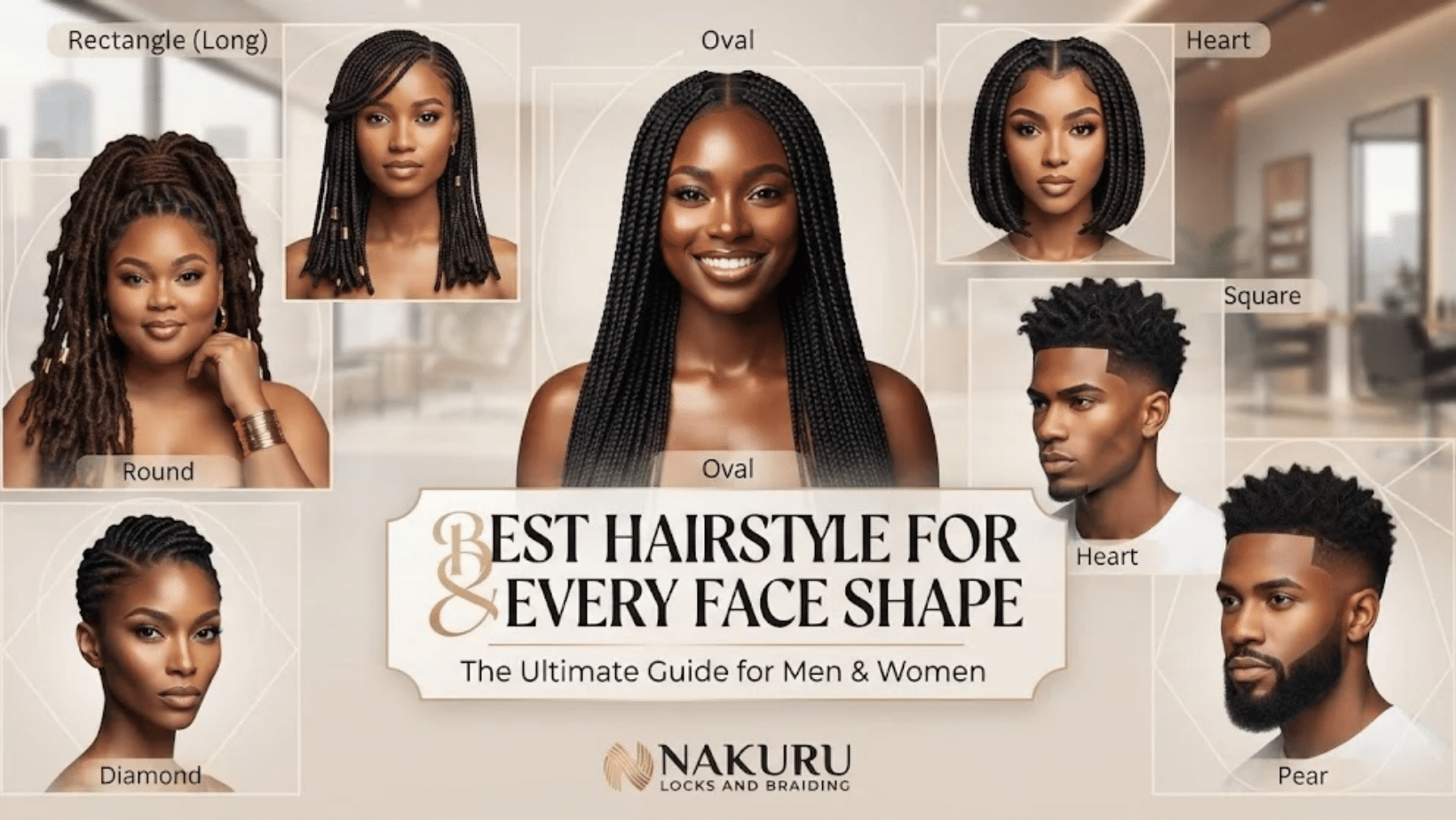
Hairstyle for Every Face Shape: The Complete Guide for Men and Women
The best hairstyle is not the one that follows a trend—it is the one that balances your face proportions, suits your hair texture, and fits your lifestyle.
Whether you are choosing braids, locs, twists, a fade, bangs, or long flowing hair, face shape is a useful starting point for creating a flattering silhouette.
At Nakuru Locks and Braiding, we see hairstyle selection as personal styling, not a rigid rulebook. A great cut or protective style should make you feel confident while protecting your hair and scalp.
What Is the Best Hairstyle for Each Face Shape?
There is no single “best” hairstyle for everyone. The most flattering option depends on whether you want to add visual height, create width, soften angles, or maintain an already balanced face shape.
These recommendations follow a simple visual-balance principle: height and vertical lines can make a face appear longer, while fringe, waves, and side volume can add apparent width.
What Are the 7 Different Face Shapes?
Hairstylists commonly use seven face-shape categories: oval, round, square, oblong or rectangular, heart, diamond, and triangle or pear. Many people do not fit one category perfectly, so a stylist should assess your overall proportions rather than force you into a single label.
To identify your face shape, pull your hair away from your face and take a straight-on photo in natural light. Compare your face length, forehead width, cheekbone width, and jawline width; avoid wide-angle selfies because phone lenses can distort proportions.
-
Oval: Longer than wide, with balanced forehead and chin proportions.
-
Round: Similar length and width, fuller cheeks, and a soft curved jawline.
-
Square: Similar forehead, cheekbone, and jaw widths, with an angular jaw.
-
Oblong or rectangle: Noticeably longer than wide, often with a strong jawline.
-
Heart: Wider forehead and cheekbones, narrowing to a delicate chin.
-
Diamond: Widest at the cheekbones, with a narrower forehead and jaw.
-
Triangle or pear: Narrower forehead and wider jawline.
Hairstyle for Every Face Shape
Oval face hairstyles
An oval face is often considered the most adaptable because its length and width are already relatively balanced. Almost any hairstyle can work, including bobs, long layers, curtain bangs, ponytails, braids, locs, fades, and textured crops.
For women, long layers, curtain bangs, soft waves, and shoulder-length bobs are especially versatile. For men, fades, side parts, crops, quiffs, and both short and long locs can suit an oval face well.
The main caution is proportion: excessive height at the crown can make an already long oval face appear even longer.
Round face hairstyles
A round face benefits from styles that create the illusion of length. Add height at the crown, keep the sides less bulky, and use diagonal or vertical lines rather than a blunt horizontal shape at cheek level.
- Best female hairstyles: long layers, side-swept bangs, high ponytails, long bobs, deep side parts, and long locs.
- Best male hairstyles: high-top fades, quiffs, pompadours, textured upward styles, tapered sides, and high-top locs.
Avoid styles that add major width directly at the cheeks, such as a very blunt chin-length bob with no layers. That does not mean short hair is off-limits; short styles can work when they include height, a side part, or tapered sides.
Square face hairstyles
Square faces have strong, defined jawlines and relatively even width across the forehead, cheekbones, and jaw. The most flattering styles either soften the angles with texture or intentionally emphasize the jaw for a bold, structured look.
- Best female hairstyles: soft waves, layered cuts, side-swept bangs, rounded bobs, and loose braids or locs.
- Best male hairstyles: side parts, Ivy League cuts, taper fades, textured crops, and medium-length locs.
Avoid a blunt, geometric jaw-length cut if your goal is to soften the face. Wispy layers, curls, and rounded silhouettes introduce curves that balance angular features.
Oblong or rectangle face hairstyles
An oblong or rectangular face is noticeably longer than it is wide. The goal is to add horizontal width and avoid excessive vertical height at the crown.
- Best female hairstyles: curtain bangs, chin-length bobs, waves, cheekbone-level layers, and side parts.
- Best male hairstyles: French crops, Caesar cuts, medium fades, fringes, and styles with controlled side fullness.
Avoid extremely tall pompadours, very high-top locs, and long straight hair with a centre part if you want to reduce the appearance of length. Bangs, waves, and side volume help shorten the face visually.
Heart-shaped face hairstyles
Heart-shaped faces are widest at the forehead or temples and narrow toward the chin. Hairstyles that add fullness around the jawline create balance and prevent the upper face from appearing disproportionately wide.
Best female hairstyles: chin-length bobs, layered lobs, side-swept bangs, shoulder-length waves, and locs with volume near the jaw.
Best male hairstyles: medium-length textured styles, fringes, side parts, and fuller beard shaping where appropriate.
Avoid very high, sleek styles that emphasize the forehead if balance is your main goal. A few loose face-framing strands can soften the transition from a wider upper face to a narrower chin.
Diamond face hairstyles
Diamond faces are widest at the cheekbones, with a narrower forehead and jawline. The best hairstyles add width at the forehead or jaw while avoiding a wide band of volume directly across the cheeks.
- Best female hairstyles: side-swept bangs, curtain bangs, textured lobs, soft layers, and loose updos with framing pieces.
- Best male hairstyles: textured crops, fringes, side parts, and medium-length styles with moderate side volume.
For locs, braids, or twists, ask your stylist to vary the length and direction around the cheek area. This prevents the style from exaggerating the widest part of the face.
Triangle or pear-shaped face hairstyles
A triangle or pear-shaped face is narrower at the forehead and wider through the jaw. Styles that add height and volume toward the crown help balance the lower half of the face.
- Best female hairstyles: layered shags, voluminous updos, crown lift, side parts, and textured long layers.
- Best male hairstyles: quiffs, pompadours, textured tops, tapered sides, and high-top locs.
Avoid short blunt cuts that make the jaw area appear wider. Long layers at the crown and volume near the temples can create a more balanced outline.
Hairstyle for Every Face Shape: Male
For men, the most flattering haircut depends on more than face shape. Hair density, hairline, beard growth, lifestyle, and preferred grooming routine all affect the final result.
For men with long faces, a fringe or French crop is often more balancing than a tall style. For round faces, height at the crown and tapered sides create a longer visual line.
Hairstyle for Every Face Shape: Female
For women, face shape is only one part of the decision. Hair texture, density, parting, length, colour, extensions, and daily styling time also determine whether a look will be practical and flattering.
Curtain bangs are particularly useful for oblong faces because they shorten the visual length of the face. Side-swept bangs can also draw attention toward the eyes and cheekbones while softening a wider forehead.
Which Hairstyle Suits My Face?
To find the hairstyle that suits your face, start with your proportions, then adapt the style to your hair type and personal preferences.
-
Identify your face shape using a straight-on photo and the four measurements: face length, forehead width, cheekbone width, and jawline width.
-
Decide what you want to balance. Do you want more height, more width, softer angles, or a stronger jawline?
-
Consider your hair texture. A layered bob may behave differently on straight, wavy, coily, or loc’d hair.
-
Account for maintenance. A precise fade, silk press, or sleek bun requires more frequent styling than twists, braids, or locs.
-
Bring reference photos to your stylist. Choose photos of people with a similar hair texture and general face proportions, not only a similar face shape.
-
Prioritise comfort and scalp health. A beautiful style should never cause ongoing pain, tension, or hairline stress.
What Are the Top 3 Most Attractive Face Shapes?
There is no scientific ranking of the “most attractive” face shapes. Beauty standards vary across cultures, generations, and individuals, and facial attractiveness depends on harmony, symmetry, expression, grooming, confidence, and personal preference—not a single face category.
In hairstyle content, oval, heart-shaped, and diamond-shaped faces are often described as versatile because their proportions create opportunities for many styling directions. However, that does not make them more attractive than round, square, oblong, or triangle faces.
The most attractive face shape is the one you feel confident wearing. A skilled stylist can create balance through length, volume, parting, layers, bangs, loc thickness, and styling direction.
What Hairstyle Suits All Face Shapes?
No haircut suits every face in exactly the same way, but some adaptable styles work well across many face shapes when adjusted by a stylist.
-
Layered cuts: Layers can be positioned to add height, width, softness, or movement depending on the face.
-
Side parts: A side part creates diagonal movement and can be adjusted to balance round, square, heart, and diamond faces.
-
Textured styles: Texture softens angular features and prevents hair from looking flat or overly severe.
-
Curtain bangs: When cut to suit the face, they can work on oval, round, long, and diamond-shaped faces.
-
Medium-length locs, braids, or twists: These protective styles can be adapted through parting, length, thickness, and styling.
For example, a medium-length loc style can add height for a round face, softness for a square face, or side fullness for an oblong face. The base style is similar, but the finishing details change the effect.
Worst Haircuts for Oval Faces: Male
Oval faces are versatile, but the main issue is adding too much vertical height. For men, extremely tall pompadours, exaggerated high-top fades, or very long styles with a centre part can make an oval face appear longer than desired.
Other styles to approach carefully include:
-
Very high, sharply vertical quiffs.
-
Extremely long straight hair with no layers or framing.
-
Ultra-tight slicked-back styles that remove all softness around the face.
-
Very heavy, blunt bangs that hide balanced facial proportions.
These are not “bad” haircuts in every case. If you like a dramatic style, your barber can moderate the height, add texture, or use a side part to preserve balance.
Long Face Shape Hairstyles: Male
For men with long, oblong, or rectangular faces, the goal is to avoid making the face look even longer. Choose haircuts that add width at the sides, include a fringe, or reduce excessive height at the crown.
Good options include:
-
French crop with a short fringe.
-
Caesar cut.
-
Medium fade with textured top.
-
Side-parted haircut with moderate volume.
-
Medium-length locs with side fullness.
-
Low or mid fade rather than a very high, tall silhouette.
Avoid a very high pompadour, extremely tall high-top locs, or long straight hair with a centre part if your priority is a shorter-looking face.
Hairstyles for Braids, Twists, and Locs
Face-shape principles apply to protective styles too. With braids, twists, and locs, your stylist can adjust parting, thickness, length, colour, accessories, and the way the style frames the face.
Dreadlocks suit every major face shape because they can be worn short or long, thick or thin, tied up or loose, symmetrical or asymmetrical. The right loc design depends on face proportions, hairline, loc size, parting, volume, and personal style.
Healthy Styling Matters
A flattering hairstyle should never come at the expense of your hairline or scalp.
Tight braids, locs, ponytails, and extensions can contribute to traction alopecia when repeated pulling damages the hair follicles; the American Academy of Dermatology advises loosening styles that pull and changing hairstyles regularly.
Warning signs that a style may be too tight include persistent pain, stinging, crusting, scalp tenderness, broken hairs along the hairline, or a receding hairline.
Choose a stylist who considers your scalp sensitivity, hair density, lifestyle, and maintenance routine—not just the final photo.
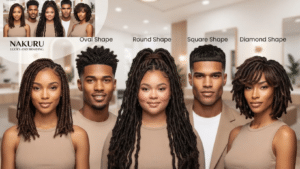
Frequently Asked Questions
What hairstyle suits all face shapes for men?
Soft textured crops, classic side parts, and medium-length styles with some movement tend to be the most universally flattering when adjusted for individual proportions.
What hairstyle suits all face shapes for women?
Medium-length layered cuts, soft waves, and versatile protective styles such as medium box braids or boho braids that can be worn in multiple ways.
Which hairstyle suits my face shape (male)?
Identify your shape using the measurements above or a professional consultation, then prioritize height for round faces, softness for square faces, width for long faces, and balance for heart or diamond shapes.
Are there hairstyles that work for long face shapes on men?
Yes—textured fringes, side parts, and styles that add horizontal volume while keeping height moderate.
Do protective styles like braids and locs work for every face shape?
Yes, when length, parting, and volume are customized. Longer styles often help round faces; styles with side volume help oblong faces; softer ends help square and heart shapes.
Authoritative References and Further Reading
Book a Consultation at Nakuru Locks and Braiding
The right hairstyle should complement your features without forcing you into a trend.
At Nakuru Locks and Braiding, a consultation can help you choose the best braid size, loc thickness, parting, length, colour, and maintenance plan for your face shape, hair type, and lifestyle.
Bring two or three inspiration photos, but remember that the same hairstyle can look different depending on hair density, shrinkage, texture, and loc maturity.
A professional stylist can adapt the design so it flatters you—not just the person in the photo.publications.mgcafe.
Related Nakuru Locks and Braiding Articles
-
Dreadlocks for Different Face Shapes: Best Styles for Men and Women
-
How to Make Dreadlocks Naturally at Home: Step-by-Step Guide
References
-
University of Kentucky Cooperative Extension Service, Face Shape and Hair Care (FCS2-847).
-
Glamour, The Best Hairstyles for Your Face Shape, According to Stylists.
-
Perfect Corp, The Ultimate Styling Guide to Women’s Face Shapes.


Leave a Reply