
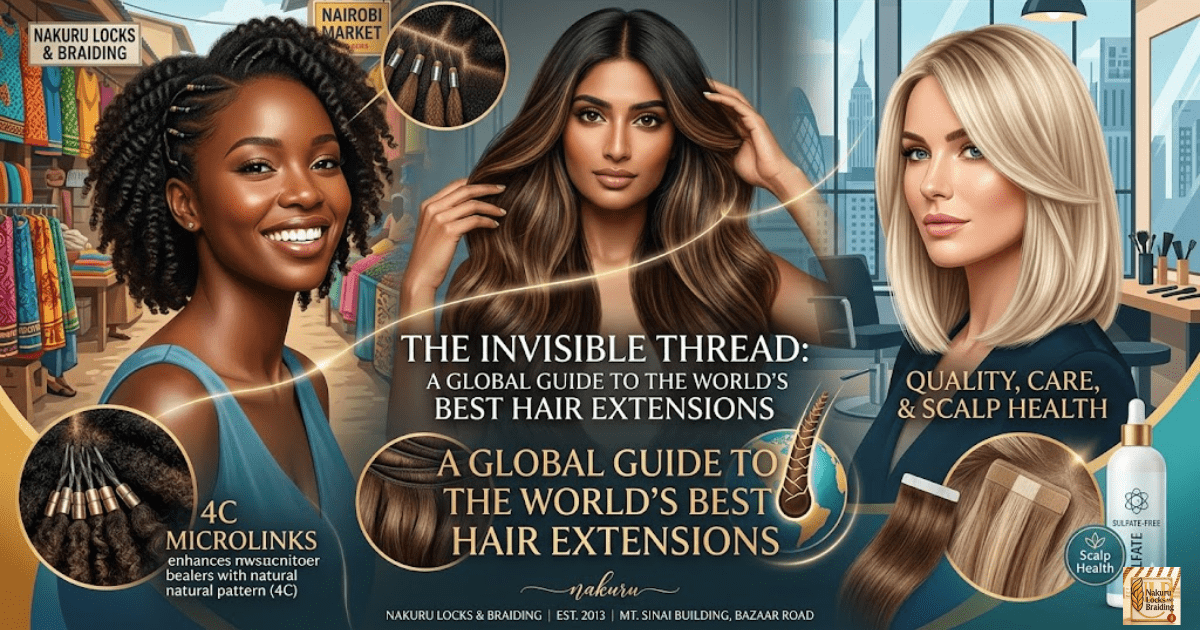
The Invisible Thread: A Global Guide to the World’s Best Hair Extensions
Imagine standing in a bustling market in Nairobi, a high-end salon in London, or a boutique studio in New York. Across every culture and continent, the desire for transformation remains a universal human narrative. Hair is more than just aesthetic; it is an expression of identity, a crowning glory that evolves with our life’s chapters.
However, the journey from desiring length and volume to achieving a seamless, healthy look is often fraught with confusion. With a dizzying array of synthetic fibers, Remy human hair, and varying installation methods, how do you choose what is truly “the best”?
At Nakuru Locks and Braiding, we believe that the best hair extensions are not just about the hair you buy, but how that hair respects your natural scalp health and lifestyle. Whether you are navigating the complexities of a sensitive scalp or looking for the most durable luxury strands, this comprehensive guide explores the intersection of quality, care, and cost in the global hair extension market.
Which Type of Hair Extensions Are the Best?
The “best” extension type is subjective, depending entirely on your hair goal: length, volume, or a temporary style change. In the professional industry, we categorize extensions into four primary groups based on their attachment method:
1. Tape-In Extensions
Tape-ins consist of thin wefts, usually about an inch wide, that are “sandwiched” between your natural hair using medical-grade adhesive.
-
Best for: Fine to medium hair.
-
Pros: They lie completely flat against the head, making them nearly invisible.
-
Cons: Not ideal for high-intensity athletes who sweat excessively, as moisture can loosen the adhesive.
2. Keratin Bond (I-Tip or U-Tip) Extensions
Often referred to as “fusion” extensions, these use a keratin protein bond melted onto small sections of your natural hair.
-
Best for: Longevity and versatility. You can tie your hair up easily.
-
Pros: They can last 3–5 months with proper maintenance.
-
Cons: Requires a long installation time (3+ hours) and professional removal to prevent breakage.
3. Weaves and Sew-Ins
The natural hair is braided into a foundation (cornrows), and hair wefts are sewn onto the braids.
- Best for: Coarse, thick, or curly hair.
-
Pros: No heat or glue is used on the hair. It provides a complete “tucked away” protective style.
-
Cons: If the braids are too tight, it can lead to traction alopecia.
4. Microlinks (Cold Fusion)
Small silicone-lined beads are used to attach the extension to the natural hair.
-
Best for: Maximum movement and a natural feel.
-
Pros: No heat, no glue, and no sewing.
-
Cons: Not recommended for very fine hair, as the beads may slip or become visible.
Which are the Best Quality Hair Extensions? (The Luxury Standard)
When discussing “best quality,” the industry standard is defined by the integrity of the cuticle.
-
Virgin Hair: This is hair that has never been chemically processed (never dyed, permed, or bleached). It is harvested from a single donor.
-
Remy Human Hair: This is considered the gold standard for high-quality extensions. In Remy hair, the cuticles are kept intact and all face the same downward direction. According to the Journal of Cosmetic Dermatology, intact cuticles prevent tangling, matting, and allow the hair to reflect light naturally, giving it a healthy sheen.
-
Single Drawn vs. Double Drawn: Double-drawn hair is manually processed to remove shorter hairs, resulting in hair that is the same thickness from root to tip. This is the hallmark of luxury extensions.
What is the Most Natural Looking Extension?
The most natural-looking extension is the one that mimics your hair’s natural movement and density.
Hand-Tied Wefts are currently the industry leader for a “born-with-it” look. Unlike machine-made wefts, hand-tied wefts are incredibly thin and light. When installed using a “Natural Beaded Row” method, they stack invisibly.
For those with textured hair, Micro-loop or I-Tip extensions that match the user’s specific curl pattern (from 3C to 4C) offer the most seamless blend. The key to a natural look is a custom color match—often involving a “rooted” color where the top of the extension is dyed slightly darker to match your natural regrowth.
What are the Best Hair Extensions for Psoriasis and Sensitive Scalps?
Scalp health is a non-negotiable priority. For individuals dealing with scalp psoriasis or seborrheic dermatitis, the wrong extension can trigger a flare-up.
-
The Problem: Glues and heavy weights can trap moisture and bacteria against the scalp, exacerbating inflammation and scaling.
-
The Solution: Clip-in extensions are widely considered the best for psoriasis. They allow you to remove the hair daily, enabling you to apply medicated topical treatments (like coal tar or corticosteroids) directly to the scalp.
-
Professional Alternative: If a permanent solution is desired, Microlinks are preferred over tape-ins or sew-ins because they allow for better airflow to the scalp and easier access for cleaning.
Citation: The National Psoriasis Foundation emphasizes the importance of avoiding “occlusive” styles that trap heat and moisture, which can worsen lesions.
Best Hair Extensions for Thick Hair
If you have naturally thick hair, the challenge isn’t hiding the extension; it’s ensuring the extension is dense enough to blend with your natural ends.
-
The Choice: Sew-in Wefts or Double-Drawn Clip-ins. * Why: Thick hair requires a higher “gram weight.” While a person with fine hair might only need 100g of hair, someone with thick hair may require 200g to 250g. Using too little hair will create a “mullet” effect where the natural thick hair sits like a shelf over the thin extensions.
-
Styling Tip: A “blunt cut” on extensions rarely works for thick hair. Ask your stylist to “shatter” the ends of your natural hair and the extensions with thinning shears to create a seamless transition.
Care and Maintenance: Protecting Your Investment
Quality hair extensions can cost anywhere from $300 to $3,000 (KES 40,000 to KES 400,000+) including installation. Protecting that investment requires a strict regimen:
-
Sulfate-Free Products: Sulfates strip the hair of moisture. Since extensions don’t receive natural oils from your scalp, they can become brittle quickly.
-
The “Looped” Brush: Use a brush specifically designed for extensions with looped bristles that won’t snag on bonds or tapes.
-
Night-time Care: Never sleep on wet extensions. This causes irreversible matting. Braid the hair loosely and sleep on a silk or satin pillowcase.
-
Heat Protection: Always apply a heat protectant before using styling tools. High heat can melt keratin bonds or damage the cuticle of Remy hair.
The Cost Factor: Why Prices Vary
The cost of extensions is determined by the Source, Length, and Weight.
-
Economic Choice: Synthetic or “Mastermix” (a blend of human and synthetic). Best for short-term events.
-
Mid-Range: Machine-weft Remy hair.
-
Investment Grade: Double-drawn Virgin Slavic or Indian hair. This hair can often be reused for over a year, making the “cost-per-wear” lower in the long run.
FAQ: Common Questions at Nakuru Locks and Braiding
Q: Do extensions cause hair loss? A: When installed by a certified professional and maintained correctly, extensions should not cause hair loss. However, “Traction Alopecia” can occur if the extensions are too heavy or installed with too much tension.
Q: How often should I “move up” my extensions? A: Tape-ins and Microlinks generally need to be moved up every 6–8 weeks as your natural hair grows.
Q: Can I swim with extensions? A: Yes, but take precautions. Wet your hair with fresh water and apply a leave-in conditioner before entering a pool or the ocean to prevent the hair from absorbing chlorine or salt.
Conclusion
Choosing the “best” hair extensions is a balance of science and art. It requires an understanding of your hair’s biological limits and your lifestyle’s demands. Whether you are seeking the luxury of Virgin Remy hair or a scalp-friendly solution for psoriasis, the goal remains the same: a confident, radiant you.
At Nakuru Locks and Braiding, located at the Mt. Sinai Building on Bazaar Road, Nakuru City, we specialize in these transitions. Our 13 years of experience ensures that every installation is performed with the highest regard for hair health, ensuring your natural locks flourish beneath your beautiful extensions.
Related Articles from Nakuru Locks and Braiding
Sources
-
Journal of Investigative Dermatology: Studies on tension-induced hair loss.
-
Trichology Society Guidelines: Standards for scalp health during protective styling.
-
International Society of Hair Restoration Surgery (ISHRS): Patient guides on avoiding traction alopecia.
Leave a Reply